
Castles & knights

CITE
We have made every effort to follow citation style rules, but there may be some minor differences. If in doubt, please refer to the appropriate citation style manual.
Knights' armour. (2022). In Q-files Encyclopedia, History, Castles & knights. Retrieved from
https://www.q-files.com/history/castles-knights/knights-armour
"Knights' armour." History, Castles & knights, Q-files Encyclopedia, 10 Feb. 2022.
https://www.q-files.com/history/castles-knights/knights-armour.
Accessed 21 Sep. 2026.
Knights' armour 2022. History, Castles & knights. Retrieved 21 September 2026, from
https://www.q-files.com/history/castles-knights/knights-armour
History, Castles & knights, s.v. "Knights' armour," accessed September 21, 2026.
https://www.q-files.com/history/castles-knights/knights-armour


Knights' armour
The first knights wore chainmail coats, made from thousands of metal rings joined together. Plate armour offered much more protection than mail, and so by the 1400s complete suits of armour were worn. They were designed to make the sharp edges or points of weapons glance off their smooth surfaces. Armour was no heavier than the mail suits and quite flexible to wear. The suits were jointed together with metal rivets or leather straps so the knight could still bend his legs and swing his sword or mace. On his hands he wore gauntlets, metal gloves that were also jointed so he could move his fingers. A shield was no longer needed to fend off the blows of a hand-held weapon, although a crossbow bolt or metal-tipped arrow from a longbow could still penetrate the armour.
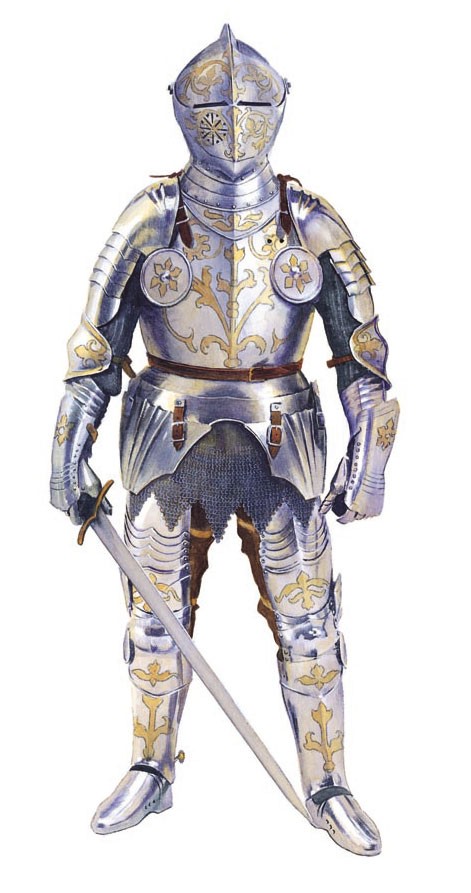
Hauberk
Knights in the 1100s and 1200s wore a hauberk, a tunic made of chainmail—small iron rings linked together—over a padded jacket called an aketon. The combination of the two gave some protection from sword blows, but a direct hit from an arrow or a lance could still be fatal. For a helmet, knights of this period wore a pointed metal cap with a noseguard.

Plate armour
In the 1300s, mail coats were shorter. Steel plates were added to protect the arms and knees. Wealthy knights had plate armour specially made by an armourer to fit them. Each piece was cut and shaped to the right size. They were jointed together with metal rivets or leather straps so the knight could still bend his legs and swing his sword or mace.
Chainmail
Armourers made mail by snipping separate rings from a length of coiled wire. Each one was linked with four other rings before the ends were pinched together and fixed by a tiny rivet. A full hauberk might be made of 30,000 rings, each joined by hand in this fashion. A full suit, including mail leggings and mittens, might weigh up to 30 kilograms (nearly 70 pounds).

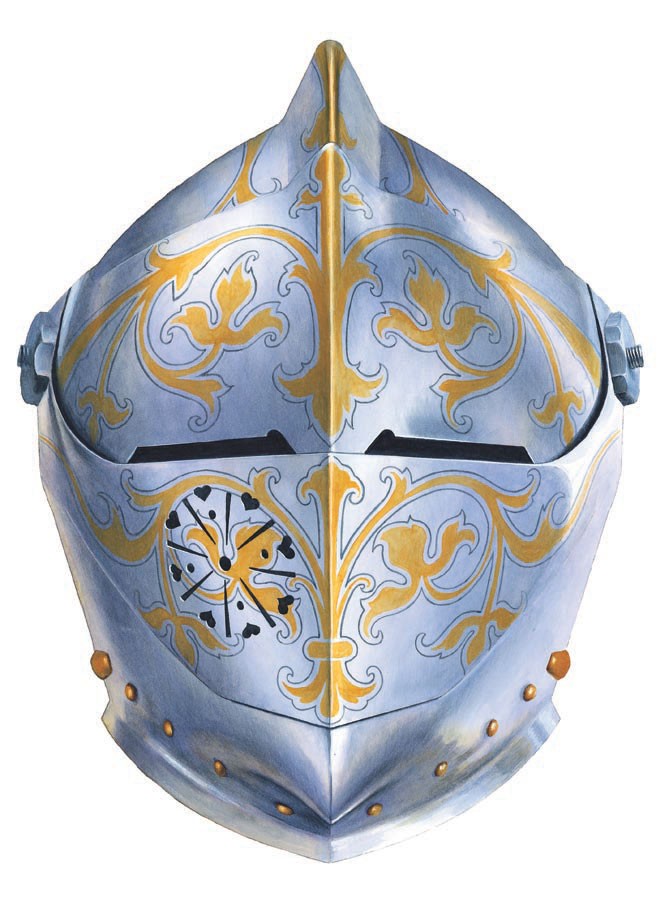
Helmet
The helmet changed along with the introduction of plate armour in the 1300s. A square helmet covering the whole head, called a helm, was used. The eyeslits gave a very narrow field of vision so the bascinet, a helmet with a “pig-faced” lift-up visor, was introduced. Small holes let in air for ventilation.
Dressing a knight
Getting a suit of armour on could take a knight a long time. He needed help from his assistant, called a squire, to dress him. First on were padded undergarments, including a thick linen undershirt called a doublet, to protect his skin from bruises and rubbing. On top of that the knight wore a hauberk. The squire then buckled plate armour to his arms and legs. His hands and wrists were protected by padded metal gloves called gauntlets. Over his head and shoulders he wore a chainmail hood called an aventail. His helmet went on top of this. Finally, on top of the armour, the knight wore a surcoat in his personal colours.

Consultant: Philip Parker
pics

Without in any way limiting Q-files Ltd’s exclusive rights under copyright, any use of this publication to “train” generative artificial intelligence (AI) technologies to generate text is expressly prohibited. Q-files Ltd reserves all rights to license use of this work for generative AI training and development of machine learning language models.