
Castles & knights

CITE
We have made every effort to follow citation style rules, but there may be some minor differences. If in doubt, please refer to the appropriate citation style manual.
Building a castle. (2022). In Q-files Encyclopedia, History, Castles & knights. Retrieved from
https://www.q-files.com/history/castles-knights/building-a-castle
"Building a castle." History, Castles & knights, Q-files Encyclopedia, 10 Feb. 2022.
https://www.q-files.com/history/castles-knights/building-a-castle.
Accessed 21 Sep. 2026.
Building a castle 2022. History, Castles & knights. Retrieved 21 September 2026, from
https://www.q-files.com/history/castles-knights/building-a-castle
History, Castles & knights, s.v. "Building a castle," accessed September 21, 2026.
https://www.q-files.com/history/castles-knights/building-a-castle


Building a castle
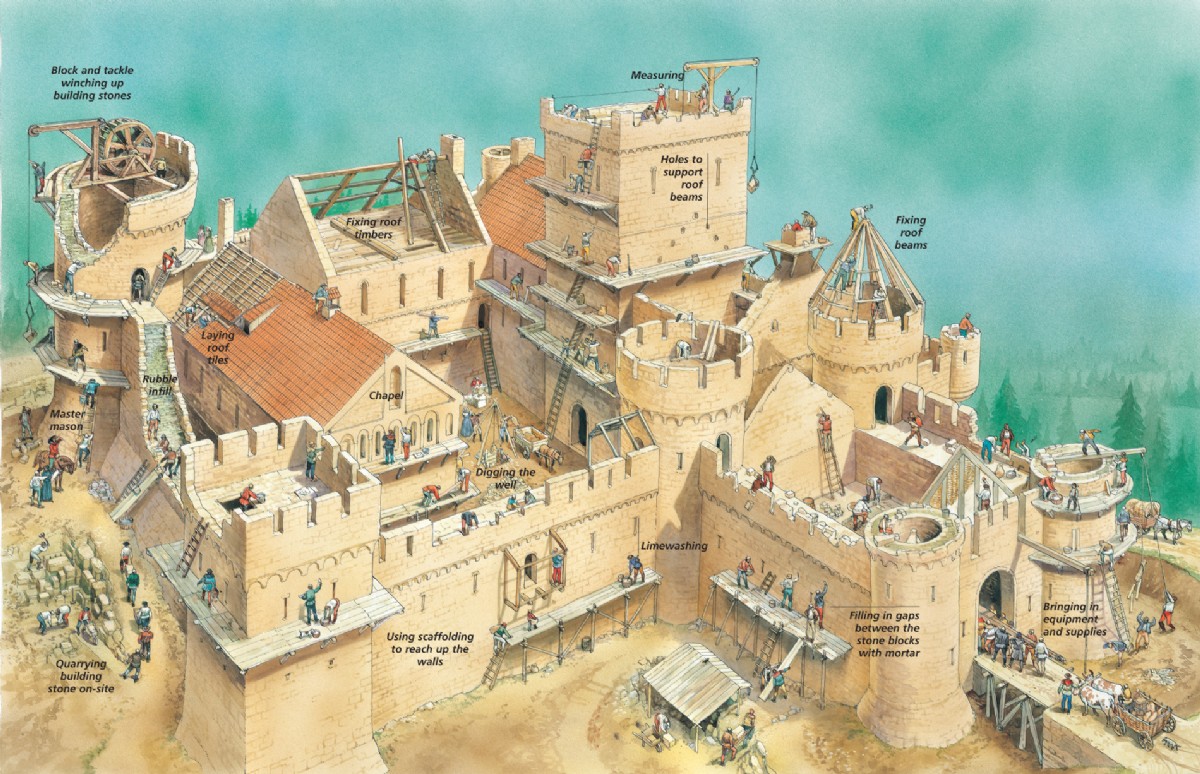
The most important factors to be taken into consideration when building a castle were that it should be able both to resist attack and to withstand a siege for at least several months. It needed to have high, thick stone walls and be located in a good position. With only a few basic kinds of tool available, most of the work to build a castle was achieved by a combination of skilled craftsmanship and muscle power. Between 2000 and 3000 men, including masons, blacksmiths, carpenters and labourers, would be required if the job was to be completed within a few years.


Siting the castle
The first decision to be made was where to build the castle. Some castles were perched high on crags or mountains, but most were located on low ground. There were several reasons for this. It would be useful if the people from local villages could visit the castle easily: supplies and labour would then be easier to come by. Most importantly, the castle would be far better able to survive a siege if fresh water could be obtained from within the castle walls themselves. Wells could be dug down to the water table much more easily in a lowland location. It was also more difficult to dig tunnels in soft valley gravels, which would give the castle extra protection against undermining by a siege army.
Stone
A new castle needed to have stone as its basic building material. Timber lasted for only about 20 years, and an attacking army could set fire to it or smash it apart easily with their catapults and battering rams.
Most of the stone needed was rubble for the insides of the walls. The outside faces of the walls, towers and keep were made of finer-quality dressed stone, called ashlar.


Masons
The stones were fashioned by masons. A master mason was in charge of the design of the castle and all the building operations. He worked in a tracing house, built for him by carpenters, where he drew out the plans on a plaster floor. He oversaw the work of the freemasons, who cut and carved the stones, and roughmasons, who built the walls. Using small axes or saws, they trimmed and smoothed the stones, before carving them with mallets and chisels.
A mason's tools
A mason used a range of tools: chisels (1) for splitting, smoothing and carving, and a special claw chisel (2) for scraping away stone. He used a trowel (3) for laying mortar and an axe (4) for trimming large, rough blocks.


Carpenters
Carpenters made all the wooden items needed for the castle, including joists, floorboards, gates and scaffolding. If the castle came under siege, carpenters would be ordered to make timber hoardings to cover the battlements and turrets. They used tools called awls to make holes in the wood and adzes for smoothing rough-cut wood.
Ditch and foundations
Before any stone could be laid, the workers dug a ditch around the perimeter of where the castle would be built. If it was to be filled with water to form a moat, it needed to be both deep enough to prevent enemy soliders from wading through it and wide enough to prevent them leaping over it.

Next came the foundations. Trenches were dug and filled with rubble, rammed down to be as compact as possible. The foundations needed to be strong enough to bear the weight of the thick walls that would be built on top of them.
Building the walls
Labourers carried the building stones to the walls. Others mixed up the mortar, a mixture of sand, lime and water, that would be used to fix the stones firmly in position. Standing on scaffolding, roughmasons laid the stones in rows, checking frequently that they were absolutely level. The walls were completed by packing rubble mixed with mortar between two outer layers of stones.


Scaffolding
It was hard work to lift heavy stone by hand, so various simple machines were needed. As the castle walls were built up, carpenters erected wooden scaffolding by lashing together planks and poles with rope. They drove supporting beams into putlogs, holes intentionally left in the stone walls. The scaffolding was now secured to the walls.
Hoist and treadwheel
Stones and mortar were then lifted to the upper levels using hoists, wooden frames with ropes fed through pulleys. The heaviest stones were raised using more elaborate machines: treadwheels. These were driven by a man walking inside a giant wheel, rather like a hamster.

Consultant: Philip Parker
pics
Without in any way limiting Q-files Ltd’s exclusive rights under copyright, any use of this publication to “train” generative artificial intelligence (AI) technologies to generate text is expressly prohibited. Q-files Ltd reserves all rights to license use of this work for generative AI training and development of machine learning language models.