
Castles & knights

CITE
We have made every effort to follow citation style rules, but there may be some minor differences. If in doubt, please refer to the appropriate citation style manual.
Trebuchet. (2022). In Q-files Encyclopedia, History, Castles & knights. Retrieved from
https://www.q-files.com/history/castles-knights/trebuchet
"Trebuchet." History, Castles & knights, Q-files Encyclopedia, 10 Feb. 2022.
https://www.q-files.com/history/castles-knights/trebuchet.
Accessed 22 Sep. 2026.
Trebuchet 2022. History, Castles & knights. Retrieved 22 September 2026, from
https://www.q-files.com/history/castles-knights/trebuchet
History, Castles & knights, s.v. "Trebuchet," accessed September 22, 2026.
https://www.q-files.com/history/castles-knights/trebuchet


Trebuchet
During the Middle Ages, the trebuchet was one of the largest and most powerful weapons in a siege army's armoury. It was a huge catapult, capable of flinging objects with great force and deadly accuracy from distances of up to 300 metres (1000 feet). As well as hurling rocks at the castle walls, it could also lob various other sorts of missiles into the castle itself, including firepots, dead animals or even human heads. Rocks could cause severe damage, but the others could harm or kill people inside the castle, start fires or even spread diseases.


How it worked
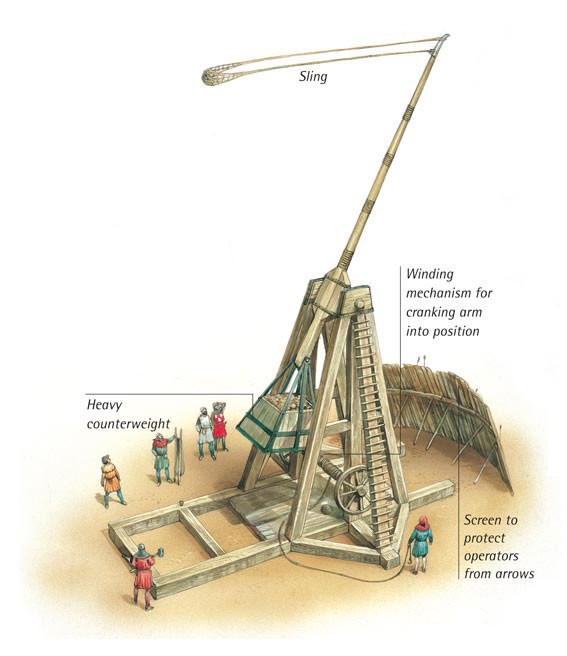
The trebuchet was usually erected on-site and at some distance from the castle, before being brought up closer. A screen, made of wooden mantlets, was erected in front of it to protect the operators from arrows.
The trebuchet had a long arm with a sling at one end and a heavy counterweight at the other. Turning the winding gear lowered the sling end of the arm while operators loaded the sling with ammunition. The arm was locked in place at ground level by a trigger.
When the trebuchet was ready to fire, another operator released the trigger by striking it with a heavy mallet. The counterweight dropped rapidly, causing the arm to fly upwards. The missile, contained by a guide chute to stop it falling out of the sling, was hurled on its way.
Ammunition
Ammunition for use in a trebuchet included (pictured, from the top): heads of executed prisoners, dead animals, firepots (vessels filled with flammable materials that created a fireball on impact), rocks and rubble and disease-ridden bodies. Sharp wooden poles, darts, burning sand or dung were also used as missiles.
The largest objects recorded as being fired by a trebuchet were 1500 kilograms (3300 pounds), although the average weight of missiles was normally between 50 and 100 kilograms (110–220 pounds).
The firing of disease-ridden bodies was a tactic used both to intimidate the besieged occupants of the castle and spread disease among them. The short supply of food—much of which would have turned rotten during the long months of the siege—combined with poor hygiene and infestation by rats created ideal conditions for the spread of disease.

Consultant: Philip Parker
pics
Without in any way limiting Q-files Ltd’s exclusive rights under copyright, any use of this publication to “train” generative artificial intelligence (AI) technologies to generate text is expressly prohibited. Q-files Ltd reserves all rights to license use of this work for generative AI training and development of machine learning language models.