
Castles & knights

CITE
We have made every effort to follow citation style rules, but there may be some minor differences. If in doubt, please refer to the appropriate citation style manual.
Castles and knights. (2022). In Q-files Encyclopedia, History, Castles & knights. Retrieved from
https://www.q-files.com/history/castles-knights/castles-and-knights
"Castles and knights." History, Castles & knights, Q-files Encyclopedia, 10 Feb. 2022.
https://www.q-files.com/history/castles-knights/castles-and-knights.
Accessed 6 Aug. 2026.
Castles and knights 2022. History, Castles & knights. Retrieved 6 August 2026, from
https://www.q-files.com/history/castles-knights/castles-and-knights
History, Castles & knights, s.v. "Castles and knights," accessed August 6, 2026.
https://www.q-files.com/history/castles-knights/castles-and-knights


Castles and knights
The Middle Ages, also known as medieval times, lasted from around 600 to 1500. In those days, the most powerful person in the kingdom was, of course, the king. But even he had to rely on barons, the most important noblemen, to help him fight wars against his enemies. In the Middle Ages, power and wealth came from the ownership of land. So, in return for the promise of an army of knights and footsoldiers to fight for him, the king granted the barons land. To control their lands, the barons built castles on them. Most castles had a moat or ditch, a strong outer wall and a gatehouse with a drawbridge and portcullis. For extra protection, the outer wall had jagged tops, called battlements or crenellations.

Stronghold

Wars could break out between barons, often over control of land, and especially when the king was weak. The castle, the home of the lord, his family and his followers, was a base from which he and his army could launch attacks on his enemies—or a stronghold to which he could retreat if he himself came under attack. Castles needed to be strong enough to withstand the weapons likely to pitted against them, anything from arrows or crossbow bolts to boulders hurled by giant catapults.
Castle defences
A heavily fortified gatehouse was built at the castle’s weakest point: its entrance. The gateway was flanked by two rounded towers, from which guards could shoot down at enemy soldiers. The entrance was also protected by one or more portcullises (heavy wood or iron grilles). The outer walls were usually topped with crenellations, allowing defenders to fire arrows while remaining under cover. There were also narrow slits in the walls through which archers fired. The castle was often surrounded by a ditch or a water-filled moat. A drawbridge across the moat could be pulled up if the castle was attacked.

Keep

The strong tower inside the walls was called the keep. This was where the lord, his family and his followers lived. It was the stronghold of the castle—the safest place to be if the castle ever came under attack. The stone walls were several metres thick. There were look-out towers on each of the four corners. The keep was surrounded by a high stone wall called a curtain wall. From the late 1200s, castles were designed without keeps: all the main rooms were inside the towers or housed in separate buildings inside the walls.
Knights
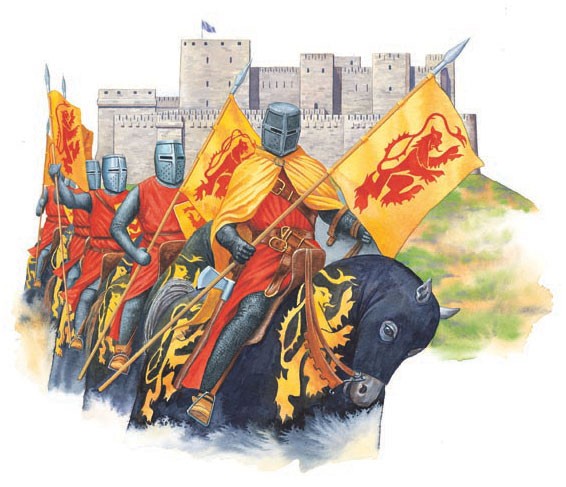
Knights were fighting men who promised loyalty to a baron and who served in battle as mounted soldiers. They were expected to follow a code of chivalry. During the Middle Ages, knights became a separate class of people, below the nobility in the feudal system, but above the merchants and craftworkers. Knights underwent years of training to learn fighting skills.
Consultant: Philip Parker
pics


Without in any way limiting Q-files Ltd’s exclusive rights under copyright, any use of this publication to “train” generative artificial intelligence (AI) technologies to generate text is expressly prohibited. Q-files Ltd reserves all rights to license use of this work for generative AI training and development of machine learning language models.