
Castles & knights

CITE
We have made every effort to follow citation style rules, but there may be some minor differences. If in doubt, please refer to the appropriate citation style manual.
Squires. (2022). In Q-files Encyclopedia, History, Castles & knights. Retrieved from
https://www.q-files.com/history/castles-knights/squires
"Squires." History, Castles & knights, Q-files Encyclopedia, 10 Feb. 2022.
https://www.q-files.com/history/castles-knights/squires.
Accessed 29 Oct. 2026.
Squires 2022. History, Castles & knights. Retrieved 29 October 2026, from
https://www.q-files.com/history/castles-knights/squires
History, Castles & knights, s.v. "Squires," accessed October 29, 2026.
https://www.q-files.com/history/castles-knights/squires


Squires
Only the sons of a knight could grow up to be a knight. In order to fulfil their destiny, they had to go through years of training as a squire, to learn the fighting skills and the code of chivalrous behaviour that was expected of a knight. The first step was to become a page. At the age of 7 he was sent to work in the household of another knight or noble lord. A page performed a variety of tasks in his master’s household, including helping his master dress in the mornings and serving food and drinks at mealtimes.


Becoming a squire
At the age of 15, the page became a squire, acting as a personal servant to a knight. By this time, he was spending long hours learning swordsmanship, using wooden swords in mock duals with other squires. A squire dedicated his life to learning from his master: how to ride a horse, how to fight with a sword, mace, lance or axe, and how to out-think an opponent in battle.
A squire's duties
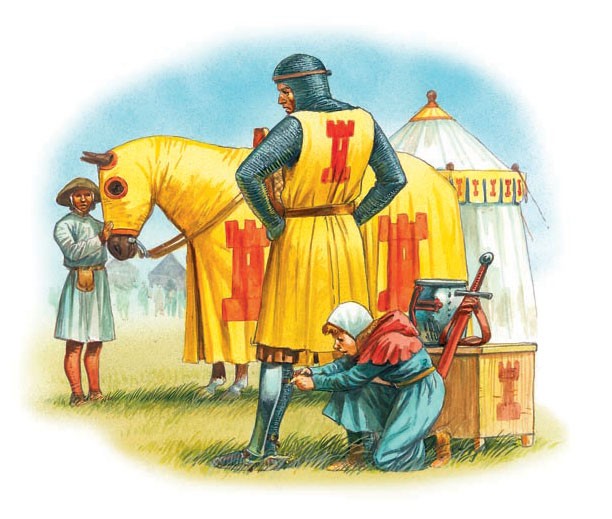
One of a squire’s duties was to look after the knight’s horses. He had three: a warhorse, called a destrier or a courser, which was trained for battle; a palfrey, used for travelling from place to place; and a packhorse to carry the knight’s arms and equipment. A squire was expected to follow his master into battle. His duties also included polishing his armour, sharpening his weapons and dressing him in readiness for combat.

Quantain
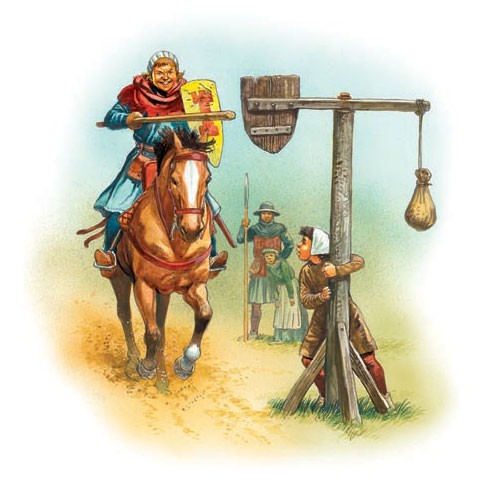
A useful training for the joust was to take part in a game called quintain. The quintain was a post with a spinning arm at the top. At one end was a shield, at the other a heavy sack of sand. The squire had to aim his lance exactly at the middle of the shield. If he struck it off-centre, the sack of sand would instantly swing round and quite possibly knock him off his horse.

Dubbing ceremony
By the time a squire reached the age of 21, he would become a knight. This happened at a dubbing ceremony, in which the squire knelt before his master, a noble lord or the king himself. Sometimes, if the squire had been especially brave in battle, he was knighted on the battlefield. Normally, however, it took place in the Great Hall of a castle, before invited family and friends.
The squire knelt before the lord, who lightly tapped the young man on the neck with a sword, accompanied by the words: “I dub you a knight”. He was then presented with his own sword and spurs, often a gift from his father or his master.

Consultant: Philip Parker
pics
Without in any way limiting Q-files Ltd’s exclusive rights under copyright, any use of this publication to “train” generative artificial intelligence (AI) technologies to generate text is expressly prohibited. Q-files Ltd reserves all rights to license use of this work for generative AI training and development of machine learning language models.