
Aircraft

CITE
We have made every effort to follow citation style rules, but there may be some minor differences. If in doubt, please refer to the appropriate citation style manual.
Story of helicopters. (2026). In Q-files Encyclopedia, Technology, Aircraft. Retrieved from
https://www.q-files.com/technology/aircraft/story-of-helicopters
"Story of helicopters." Technology, Aircraft, Q-files Encyclopedia, 13 Mar. 2026.
https://www.q-files.com/technology/aircraft/story-of-helicopters.
Accessed 21 Sep. 2026.
Story of helicopters 2026. Technology, Aircraft. Retrieved 21 September 2026, from
https://www.q-files.com/technology/aircraft/story-of-helicopters
Technology, Aircraft, s.v. "Story of helicopters," accessed September 21, 2026.
https://www.q-files.com/technology/aircraft/story-of-helicopters


Story of helicopters
The way in which a helicopter flies has been understood for many centuries. A flying top, invented by the Chinese around 500 BC, was a small propeller that flew upwards when the stick on which it was balanced was spun rapidly. The propeller "bit" into the air, producing uplift. This method of flight worked well for small toys but how could a full-sized machine capable of carrying people through the air be built? Only when light petrol engines became available in the early 1900s would the helicopter at last take to the skies.


Leonardo's design
The Italian painter, scientist and inventor, Leonardo da Vinci (1452–1519), designed a simple helicopter in about 1500, but he did not have an engine to power it. He was fascinated by the idea of helicopter flight. His design had a corkscrew-shaped rotor which, he thought, would soar upwards through the air as it spun. To power the machine, the pilot simply pulled sharply on a rope wound around the central column. Not surprisingly, his machine never flew.
Paul Cornu
On 13th November 1907, Frenchman Paul Cornu flew a twin-rotor helicopter near Lisieux, France, but he had no controls. The flight only lasted 20 seconds—and his machine rose only 30 centimetres (1 foot) from the ground. This was the first manned, untethered helicopter flight.


Autogyro
The autogyro, an aircraft designed by Spaniard Juan de la Cierva in 1923, was the forerunner of the modern helicopter. It was an ordinary monoplane with a rotor fitted above the cockpit. The rotor blades turned by themselves in the airflow caused by the forward motion and lifted the machine. In 1928 Cierva flew an autogyro across the English Channel.
First successful helicopters
The bodies of early single-rotor helicopters spun in the opposite direction to the rotors. The German aircraft designer Heinrich Focke (1890–1979) and Russian-born American engineer Igor Sikorsky (1889–1972) both came up with answers to the problem. Focke solved the spinning problem by using two rotors, turning in opposite directions, for lift and a propeller for propulsion.

The first completely practical helicopter, the Focke-Achgelis Fa-61, first flew in 1936. The following year it set both distance and endurance world records when it covered 122 kilometres (76 miles) in 1 hour 20 minutes.

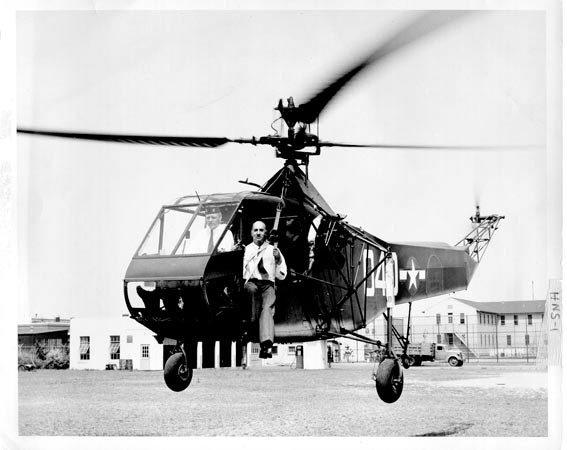
The single-rotor helicopter was developed by Igor Sikorsky in 1939. The main rotor provided lift and propulsion, and the tail rotor prevented the fuselage (body of the aircraft) from twisting. Helicopters were soon being used by navies and for passenger services. The development of the jet engine in the 1950s made larger, faster helicopters possible.
Consultant: Chris Oxlade
pics

Without in any way limiting Q-files Ltd’s exclusive rights under copyright, any use of this publication to “train” generative artificial intelligence (AI) technologies to generate text is expressly prohibited. Q-files Ltd reserves all rights to license use of this work for generative AI training and development of machine learning language models.