
Aircraft

CITE
We have made every effort to follow citation style rules, but there may be some minor differences. If in doubt, please refer to the appropriate citation style manual.
Jet engine. (2026). In Q-files Encyclopedia, Technology, Aircraft. Retrieved from
https://www.q-files.com/technology/aircraft/jet-engine
"Jet engine." Technology, Aircraft, Q-files Encyclopedia, 13 Mar. 2026.
https://www.q-files.com/technology/aircraft/jet-engine.
Accessed 21 Sep. 2026.
Jet engine 2026. Technology, Aircraft. Retrieved 21 September 2026, from
https://www.q-files.com/technology/aircraft/jet-engine
Technology, Aircraft, s.v. "Jet engine," accessed September 21, 2026.
https://www.q-files.com/technology/aircraft/jet-engine


Jet engine
All jets work in the same way: hot, compressed air is expelled from the back of the engine, driving it forwards. There are several kinds of jet engine, including turbojets, turbofans, turboprops and turboshafts. Airliners, business jets, military jets, missiles and some speed boats are powered by jet engines. An aeroplane's jet engines are contained within engine cowlings (casings) usually attached to the wing undersides or either side of the fuselage. The front entrance to the engine is known as the intake.
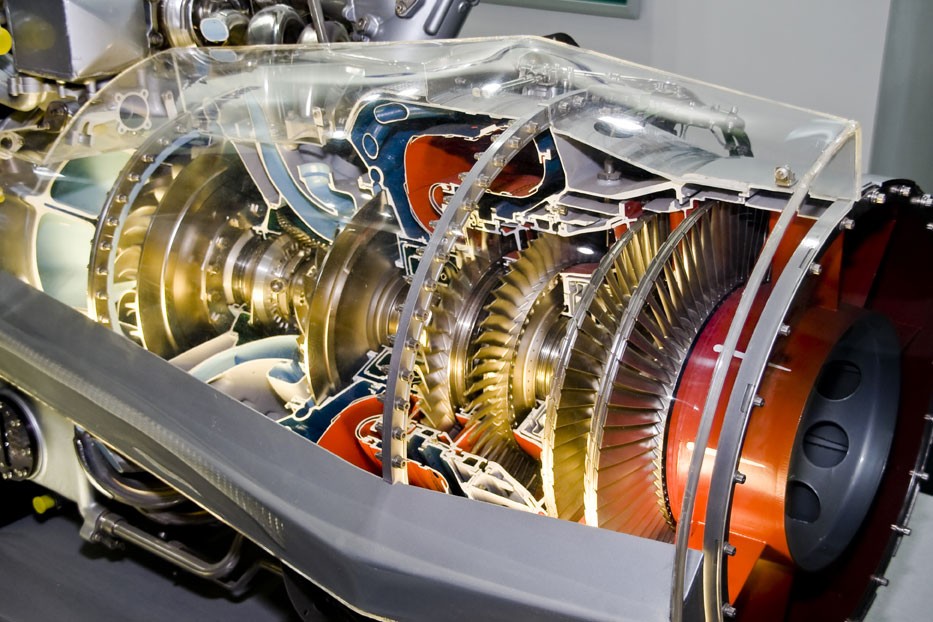
How it works
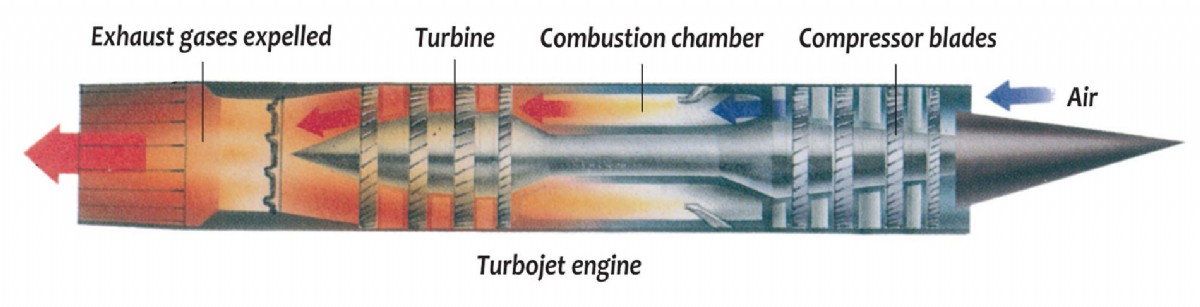
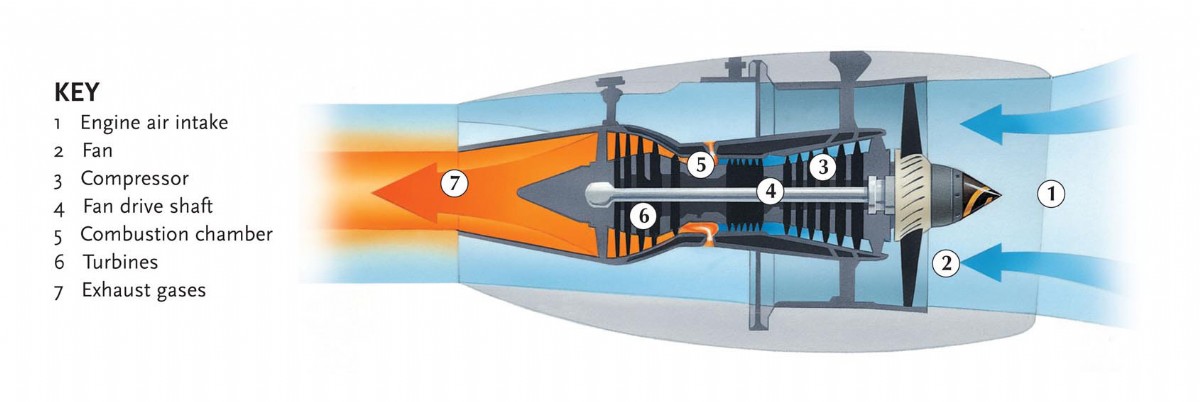
The air is drawn in through the opening at the front of the engine and compressed by spinning blades. Then, in the combustion chamber, it is mixed with kerosene fuel and the air-fuel mixture is ignited. The hot exhaust gas produced by the burning fuel escapes at speed through the rear of the engine, powering a turbine, which drives the compressor, as it rushes past. The backward-flowing gases provide a forward thrust, like the kick of a rifle after a bullet is fired.

Turbofan
Airliners are driven by jet engines called turbofans. Besides being much more powerful than other types of jet engine, turbofan engines are cooler and quieter, and more economical in their use of fuel. Some are also equipped with thrust reversers. When the reversers are in use, the jet of hot exhaust gases is deflected forwards instead of backwards, producing a force that rapidly slows down the plane landing on the runway.
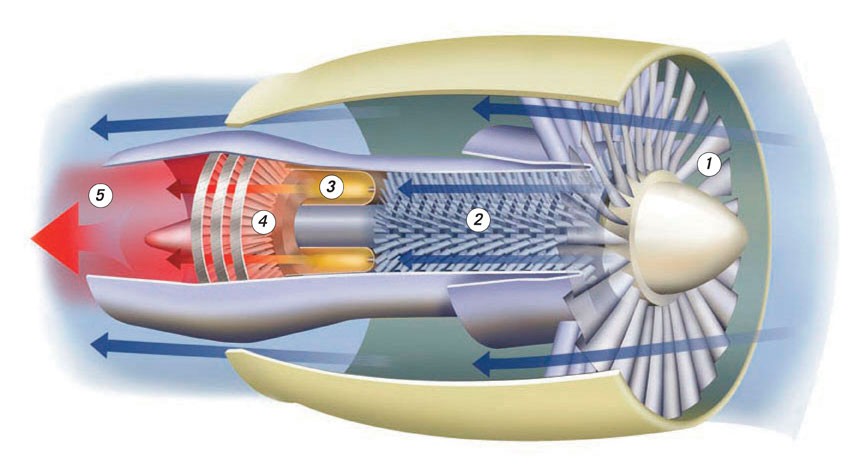
Air is sucked into the engine by a whirling fan (1) in front of the compressor. Some of it is compressed by spinning blades and mixed with kerosene fuel (2), then the air-fuel mixture is ignited in a combustion chamber (3). The hot exhaust gas produced by the burning fuel escapes at speed through the rear of the engine, powering a turbine, which drives the compressor, as it rushes past (4). The rest of the sucked-in air is ducted around this chamber and joins the exhaust gases from the ignited mixture (5). The gases escape at speed out of the back of the engine, providing forward thrust for the aircraft.
New designs
Aircraft manufacturers are looking for ways to cut carbon emissions from airliners, which are responsible for 2.5% of emissions globally. Neither battery technology (to provide enough electrical power for long flights) nor hydrogen technology (to replace fossil fuels altogether) is sufficiently advanced, meaning significant improvements in fuel efficiency are the only option. Reducing drag by redesigning the airliner's shape is one way of achieving this. Another is to improve the efficiency of the jet engine itself, to cut the rate of fuel burn.
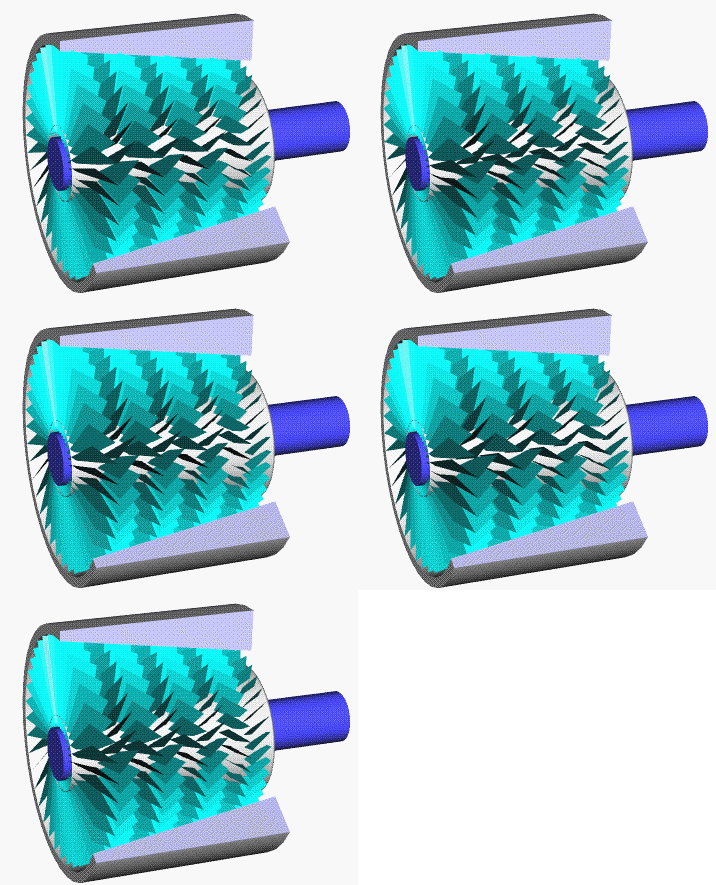
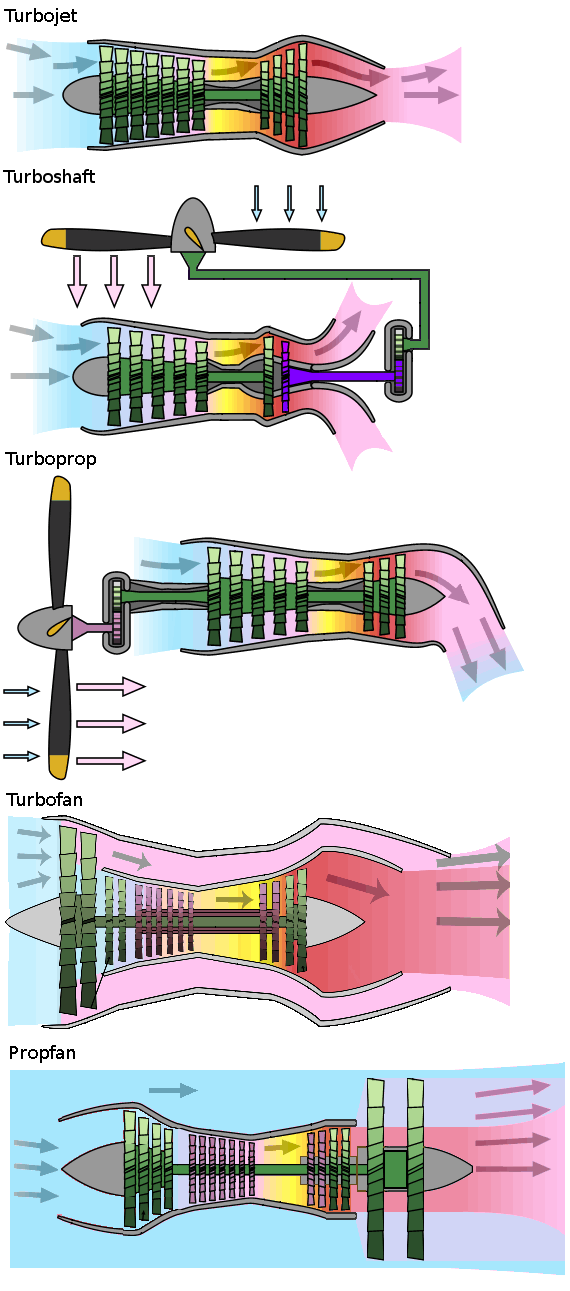
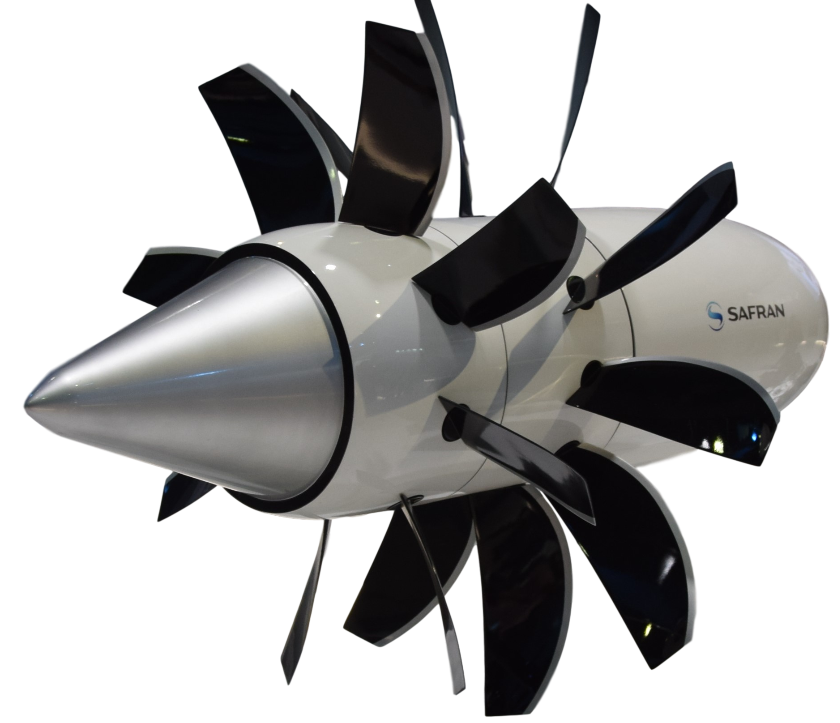
Engineers are working on what is known as the propfan or open fan engine. This type of engine shares some features of both the turboprop and turbofan engines. The engine uses a turbine to drive an open (not contained within a nacelle or case) propeller like a turboprop. But in a propfan, the propeller is made up of a number of short, highly twisted blades, resembling the fan of a turbofan. Carbon emissions could be reduced by up to 20%, with the added advantage that noise could be lowered as well.
Consultant: Chris Oxlade
Timeline
1930s
The jet engine is developed separately in Germany, by Hans von Ohain, and in Britain, by Frank Whittle.
1939
The first jet aircraft, the Heinkel He-178 takes to the air as part of the German Air Force.
1941
The first fighter jet, the Messerschmitt Me 262 is built in Germany.
1949
The Leduc 010, the first ramjet powered aircraft makes its maiden flight.
1970
The first wide-bodied, jet-powered airliner, the Boeing 747, begins service.
1976
The Lockheed SR-71 Blackbird sets the world speed record for a jet aircraft of 3530 km/h (2193 mph).
pics

Without in any way limiting Q-files Ltd’s exclusive rights under copyright, any use of this publication to “train” generative artificial intelligence (AI) technologies to generate text is expressly prohibited. Q-files Ltd reserves all rights to license use of this work for generative AI training and development of machine learning language models.