
Forces

CITE
We have made every effort to follow citation style rules, but there may be some minor differences. If in doubt, please refer to the appropriate citation style manual.
Motion. (2026). In Q-files Encyclopedia, Science, Forces. Retrieved from
https://www.q-files.com/science/forces/motion
"Motion." Science, Forces, Q-files Encyclopedia, 10 Mar. 2026.
https://www.q-files.com/science/forces/motion.
Accessed 21 Sep. 2026.
Motion 2026. Science, Forces. Retrieved 21 September 2026, from
https://www.q-files.com/science/forces/motion
Science, Forces, s.v. "Motion," accessed September 21, 2026.
https://www.q-files.com/science/forces/motion


Motion
Motion is any kind of movement. Motion is caused by forces. A still or stationary object does not move unless a force acts on it to start it going. Once it is moving it carries on at the same speed in a straight line unless a force makes it speed up, change direction, slow down or stop. There are many kinds of movement. An object going in a straight line like a rocket shooting through deep space has linear motion. An object going around a central point like a ball swung round on a string has circular motion. An object moving to and fro like a pendulum or a playground swing has oscillating motion. An object that twists around like a wheel or a screwdriver has rotary motion.


Inertia
An object stays still or keeps moving in a straight line, unless forces act on it. A bus will not start to move unless the engine provides a force to make it do so. This tendency of an object’s motion to stay the same is called inertia. Once the bus is moving, the force of air resistance tries to slow it down. The engine keeps the bus going forward. If the bus stops suddenly, people on it fall forward because there is nothing to stop them moving (seat belts would hold them in place).
Momentum
If the bus were moving at 50 mph it would take more force on the brakes to stop it than if it were moving at only 30 mph. It would take less force to stop a car moving at the same speed as the bus because the car is lighter (it has less mass). Both the bus and the car have momentum. The larger their mass and the faster their speed, the greater their momentum. The momentum of anything is its mass multiplied by its speed.

If two objects collide, their total momentum is unchanged. When a snooker ball is struck by a cue ball, both balls then "share" the momentum: the momentum of each adds up to the original momentum of the cue ball. This is called the law of conservation of momentum.
Laws of motion
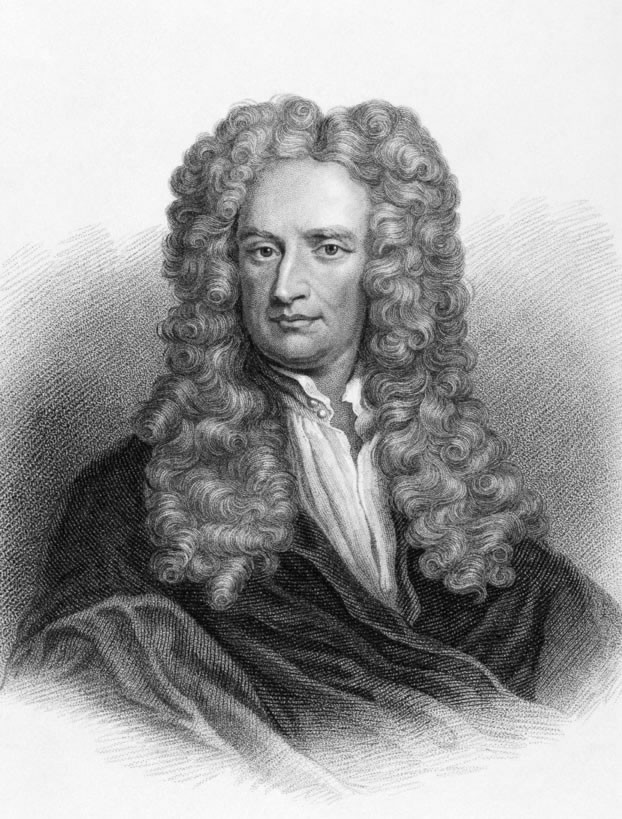
The English scientist Sir Isaac Newton (1642–1727) published three laws of motion in 1687. The first law states an object at rest will remain at rest unless acted on by a force. An object in motion continues in motion with the same speed and in the same direction unless acted upon by a force. This law is also known as the law of inertia.
The second law states that the rate of change of momentum of a body is directly proportional to the force applied, and that this change of momentum takes place in the direction of the applied force. The third law states that for every force, there is a reaction force that is equal in size, but one that acts in an opposite direction.
Lift-off
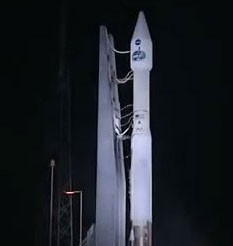
An Atlas V rocket lifts off from Cape Canaveral Air Force Station, Florida, carrying a NASA satellite in January 2014. This footage illustrates Newton's three laws of motion well. To begin with, the spacecraft remains still on the launchpad: the downward force of its weight is equal to the upward reaction force from the ground. When its engines fire, the force sends it into space. A high velocity is needed for this, and because the rocket is so heavy, that means a very large increase in momentum. This is why the rocket engines must apply an enormous force.

Balancing forces
Even still objects have forces acting on them. Imagine a dog trying to pull in one direction, while its owner is pulling the lead in another. Because they are both pulling with exactly the same force, neither is moving anywhere. This is because when forces are balanced, they cancel each other out.
Consultant: Mike Goldsmith
pics
Without in any way limiting Q-files Ltd’s exclusive rights under copyright, any use of this publication to “train” generative artificial intelligence (AI) technologies to generate text is expressly prohibited. Q-files Ltd reserves all rights to license use of this work for generative AI training and development of machine learning language models.