
Energy

CITE
We have made every effort to follow citation style rules, but there may be some minor differences. If in doubt, please refer to the appropriate citation style manual.
Musical sounds. (2026). In Q-files Encyclopedia, Science, Energy. Retrieved from
https://www.q-files.com/science/energy/musical-sounds
"Musical sounds." Science, Energy, Q-files Encyclopedia, 10 Mar. 2026.
https://www.q-files.com/science/energy/musical-sounds.
Accessed 13 Sep. 2026.
Musical sounds 2026. Science, Energy. Retrieved 13 September 2026, from
https://www.q-files.com/science/energy/musical-sounds
Science, Energy, s.v. "Musical sounds," accessed September 13, 2026.
https://www.q-files.com/science/energy/musical-sounds


Musical sounds
Musical sounds have wave patterns that are evenly spaced and regular, while noises—unpleasant sounds—usually have irregular patterns. Each musical note has a specific pitch that is the same for every instrument. The lowest pitch for each note is called the fundamental frequency (or, simply, fundamental). The note A, for example, is produced by 440 vibrations per second (440 Hz). No musical instrument produces a perfectly pure note. Each is coloured by the presence of other, fainter notes of higher pitch, called overtones. These are different for each musical instrument, and so give that instrument its characteristic sound, or timbre.

Musical instruments
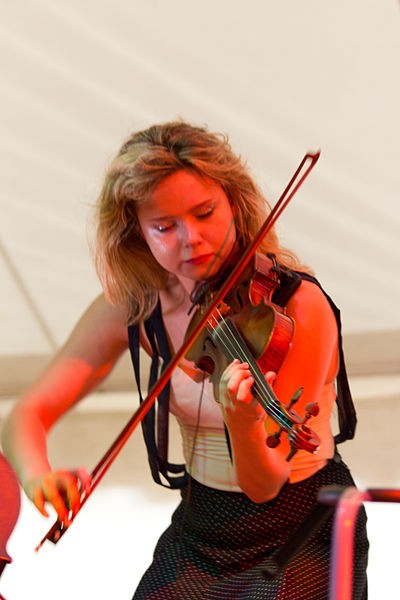
Musical notes may be produced by bowing or plucking a string (string instruments, such as violin or cello), blowing into a pipe (wind instruments, such as the clarinet and brass instruments such as the trumpet) or striking something (percussion instruments, such as the drums or triangle).
In string instruments, the vibration of the string sets the air inside a soundbox vibrating. The vibration of the soundbox is called resonance: it makes the sound produced louder and richer in quality. The pitch is varied by both the tightness of the string and by varying its length (which the player achieves by pressing down the string on the fingerboard with their finger).
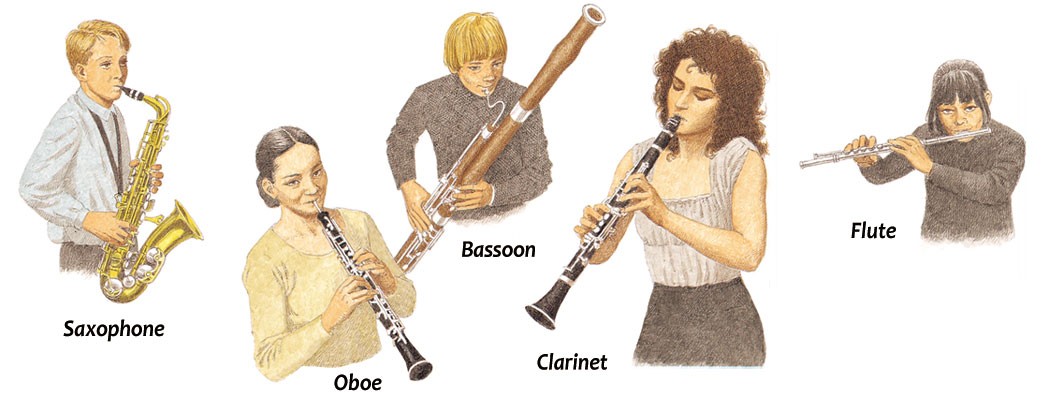
In a wind or brass instrument blowing into a pipe of some kind causes the column of air inside it to vibrate. The frequency of the vibrations depends on the length of air in the pipe. This can be controlled by opening or closing holes at different places on the tube, or by lengthening or shortening the tube itself.
Trumpet players produce sounds from their instruments by vibrating their lips. This causes the air inside to vibrate as well. They can play different notes (of higher or lower pitch) both by changing the tension of their lips and by opening or closing valves in the tube, which alters the length of the air column.

Consultant: Mike Goldsmith
pics

Without in any way limiting Q-files Ltd’s exclusive rights under copyright, any use of this publication to “train” generative artificial intelligence (AI) technologies to generate text is expressly prohibited. Q-files Ltd reserves all rights to license use of this work for generative AI training and development of machine learning language models.