
Materials

CITE
We have made every effort to follow citation style rules, but there may be some minor differences. If in doubt, please refer to the appropriate citation style manual.
Petrochemicals. (2026). In Q-files Encyclopedia, Science, Materials. Retrieved from
https://www.q-files.com/science/materials/petrochemicals
"Petrochemicals." Science, Materials, Q-files Encyclopedia, 10 Mar. 2026.
https://www.q-files.com/science/materials/petrochemicals.
Accessed 13 Sep. 2026.
Petrochemicals 2026. Science, Materials. Retrieved 13 September 2026, from
https://www.q-files.com/science/materials/petrochemicals
Science, Materials, s.v. "Petrochemicals," accessed September 13, 2026.
https://www.q-files.com/science/materials/petrochemicals


Petrochemicals
Petrochemicals are chemicals that are processed from petroleum and natural gas, which are fossil fuels. Primary petrochemicals—such as ethylene and benzene—are made directly from fossil fuels. They are produced in large quantities in oil refineries and chemical plants. Primary petrochemicals are often sold to other chemical plants to be processed into secondary petrochemicals. For example, a chemical reaction between hydrogen and the primary petrochemical benzene produces the secondary petrochemical cyclohexane. Cyclohexane is used in the production of nylon.


Petrochemical or petroleum product?
Petrochemicals, which are pure chemicals, are different from petroleum products, which are complex mixtures of different chemicals. Petroleum products include liquid fuels (such as petrol, diesel and jet fuel), gaseous fuels (such as propane), lubricants (such as motor oils and greases), asphalt (used as a road surface) and paraffin wax (used in candles and lubrication). Oil refineries can produce both petrochemicals and petroleum products. Specialized chemical plants for producing petrochemicals are often close to oil refineries.
Why is petroleum
so useful?
Petroleum (also called crude oil) is a mixture of thousands of different hydrocarbons: chemical compounds made only of linked hydrogen and carbon atoms. Hydrocarbons are a key source of the world’s energy because they release heat when burnt. Hydrocarbons are also extremely useful building blocks, because they are excellent at linking together in many different ways. As a result, hydrocarbons take many different forms: gases (methane), liquids (benzene), solids (naphthalene) and polymers (polystyrene). Chemical engineers use the hydrocarbons in petroleum to produce chemicals that have a vast range of properties and are used in many industries, from plastics to pharmaceuticals, agrochemicals to detergents.

Types of petrochemicals

The two key types of petrochemicals are olefins and aromatics, which are different in their chemical structure. They are both hydrocarbons. However, olefins contain one or more pairs of carbon atoms linked by a double bond. (Bonds are made by electrons: a double bond has four bonding electrons, while a single bond has two.) Key olefins are ethylene and propylene. In aromatics, the carbon atoms form rings, with alternating double and single bonds. Key aromatics are benzene, toluene and the xylenes.
Producing primary petrochemicals

The hydrocarbons naturally present in crude oil are not very useful: they are often in long, straight chains. (Hydrocarbons that contain long chains are solids or thick liquids and are fairly unreactive.) A number of processes are used to break down these large hydrocarbon molecules into smaller, useful primary petrochemicals.
Steam cracking is the main method for producing olefins such as ethylene and propylene. The raw materials, called feedstocks, for steam cracking are usually naphtha, which is obtained by distilling crude oil, or ethane, propane or butane, obtained by processing natural gas or petroleum refining. The feedstock is mixed with steam and heated in a furnace to around 850°C (1560°F), creating a chemical reaction. The product of the chemical reaction—often ethylene or propylene—depends on the feedstock, quantity of steam and temperature.
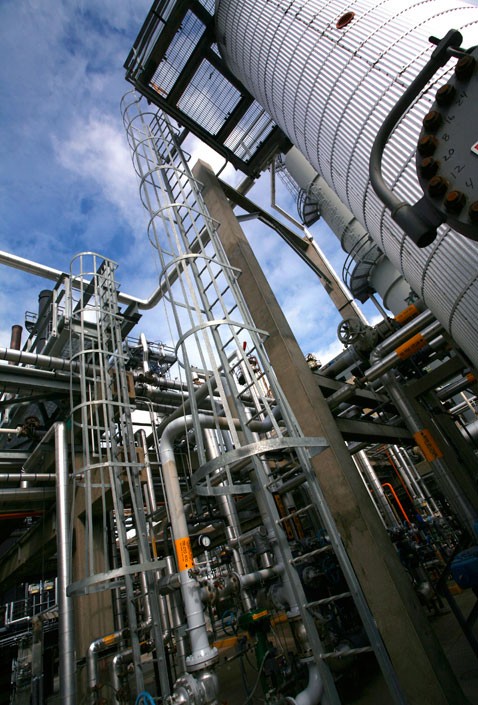
Catalytic reforming is the main method of producing the important aromatic chemicals: benzene, toluene and the xylenes. The feedstock is usually naphtha. The naphtha is mixed with hydrogen and passed over a catalyst (usually platinum) at high temperature and pressure. The resulting chemical reaction can cause the hydrocarbon chains to form into compounds containing rings of carbon atoms.
Ethylene
Ethylene is the most widely produced chemical in the world, because of its usefulness in the chemical industry. It is a gas, and, like all primary petrochemicals, it is flammable (burns easily). Ethylene’s key uses are producing ethylene dichloride (used to produce the plastic PVC), ethylene oxide (used in plastics, detergents and textiles), ethylbenzene (used to produce polystyrene, paints, inks and adhesives) and polyethylene (the world’s most common plastic).


Propylene
The gas propylene is the second most important olefin in the chemical industry, after ethylene. Propylene’s key use is making the plastic polypropylene. The plastic is made by the process of polymerization, which links propylene atoms into long chains called polymers. Polypropylene is used in textiles (such as thermal underwear and carpets), containers and packaging.
Benzene
The aromatic hydrocarbon benzene is a colourless liquid. It is used in the production of the important commodity chemicals ethylbenzene (used to produce polystyrene, paints, inks and adhesives), cumene (often converted to phenol for use in plastics, pharmaceuticals, herbicides and detergents) and cyclohexane (used in the production of nylon).

Toluene
Toluene is a colourless liquid. It is used as a feedstock for producing secondary petrochemicals such as benzoic acid (used as a food preservative and in pharmaceuticals) and toluene diisocyanate (used in polyurethane plastics and the explosive TNT). Toluene itself is used as a solvent (a liquid in which other substances are dissolved) in the production of paints, rubbers and adhesives.
Xylenes
The three xylenes—orthoxylene, paraxylene and metaxylene—are liquids. They are sometimes used as solvents but are more often used in the production of secondary petrochemicals, such as terephthalic acid, which is used to produce the plastic polyethylene terephthalate, commonly known as PET or polyester.

Consultant: Nina Notman
pics
Without in any way limiting Q-files Ltd’s exclusive rights under copyright, any use of this publication to “train” generative artificial intelligence (AI) technologies to generate text is expressly prohibited. Q-files Ltd reserves all rights to license use of this work for generative AI training and development of machine learning language models.