
Planets and moons

CITE
We have made every effort to follow citation style rules, but there may be some minor differences. If in doubt, please refer to the appropriate citation style manual.
Galilean moons. (2026). In Q-files Encyclopedia, Space, Planets and moons. Retrieved from
https://www.q-files.com/space/planets-and-moons/galilean-moons
"Galilean moons." Space, Planets and moons, Q-files Encyclopedia, 25 Mar. 2026.
https://www.q-files.com/space/planets-and-moons/galilean-moons.
Accessed 7 Aug. 2026.
Galilean moons 2026. Space, Planets and moons. Retrieved 7 August 2026, from
https://www.q-files.com/space/planets-and-moons/galilean-moons
Space, Planets and moons, s.v. "Galilean moons," accessed August 7, 2026.
https://www.q-files.com/space/planets-and-moons/galilean-moons


Galilean moons
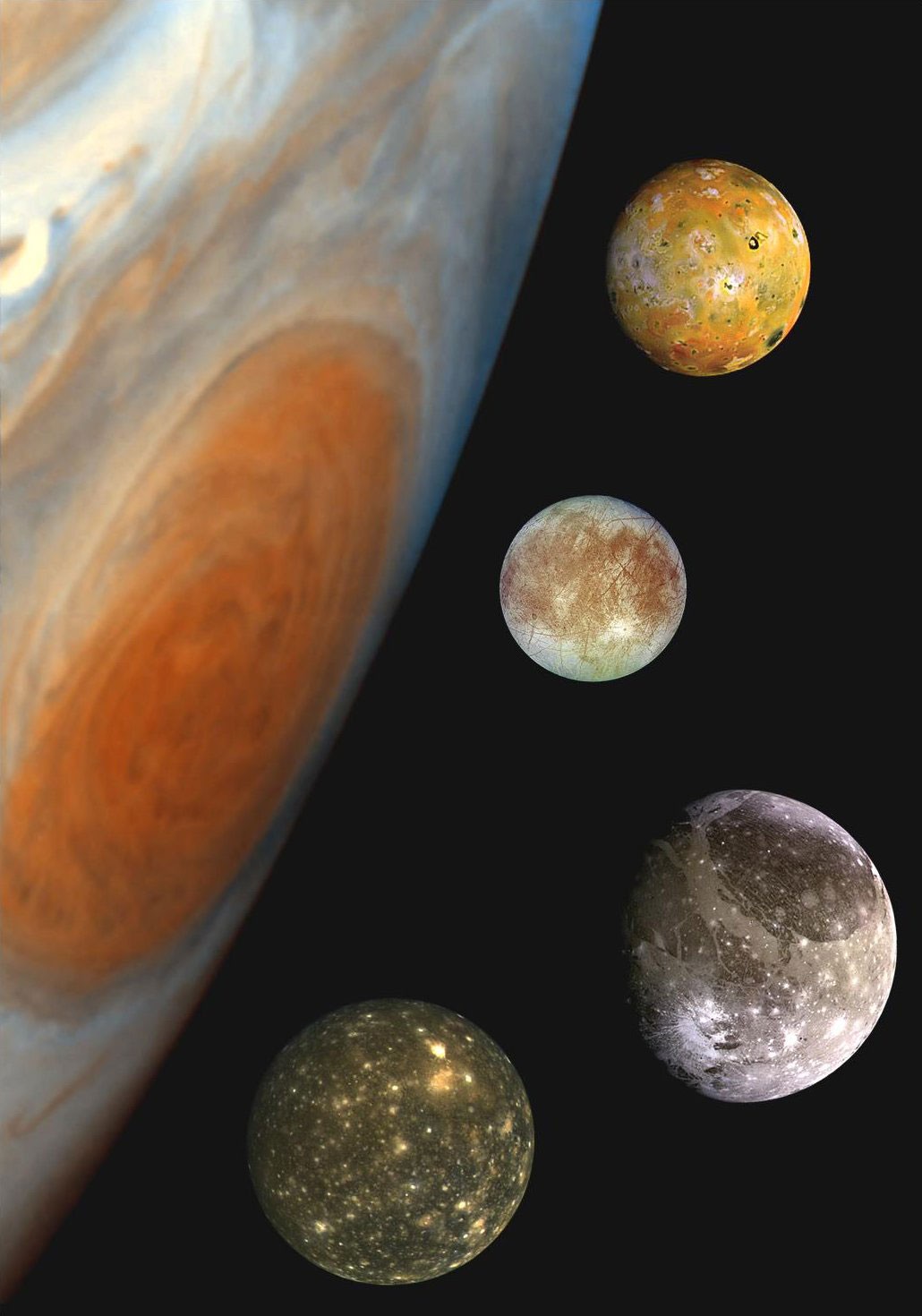
Jupiter’s four largest moons (at the latest count, Jupiter has 95 in all) are known as the “Galileans” after the Italian scientist Galileo Galilei (1564–1642) who discovered them with one of the first telescopes in 1610. Until he saw that they moved around Jupiter, Galileo's first thought was that they were stars. Galileo called his discoveries the Medicea Sidera ("the Medician stars") in honour of the Medici family, who ruled Florence at the time. They were given their current names four years later. In order of distance from Jupiter they are: Io, Europa, Ganymede and Callisto. All the Galilean moons are larger than the dwarf planet Pluto, and Ganymede is larger than Mercury.

Formation
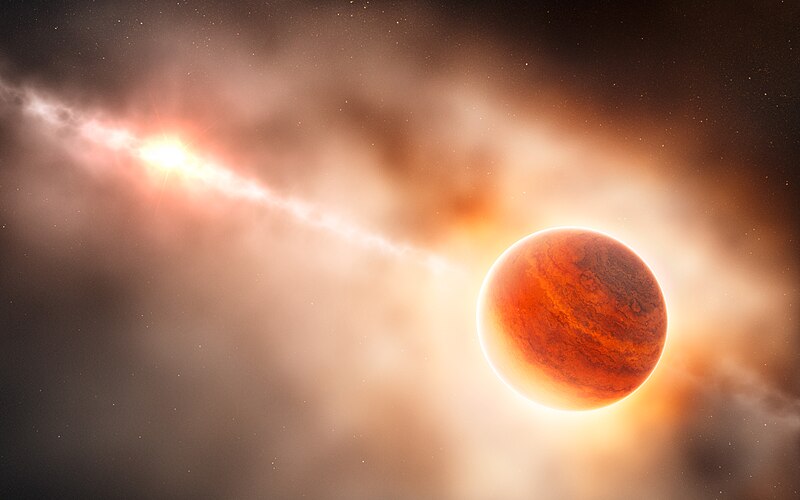
Like the other Solar System planets, Jupiter formed out of the disc of dust and gas surrounding the young Sun. Once Jupiter came into existence, the leftover material making up another disc of gas and dust (but this time swirling around the new planet) clumped together to become the Galilean moons. The moons are thus nearly as old of the Solar System itself: about 4.5 billion years old. While the Galileans are spherical, all of Jupiter's many other moons remained too small for their gravity to pull them into spheres, so they have irregular shapes.
Orbital resonance
Orbital resonance occurs when orbiting bodies exert a gravitational influence on each other when they align. Ganymede has orbital resonances with both Europa and Io: for every orbit of Jupiter made by Ganymede, Europa orbits twice and Io orbits four times. As the moons orbit, they line up on the same side of Jupiter at regular intervals; this alignment is known as a conjunction. Orbital resonance shapes the orbits of Io and Europa in such a way (making them elliptical rather than circular) that Jupiter's gravity affects them both significantly.

Ganymede
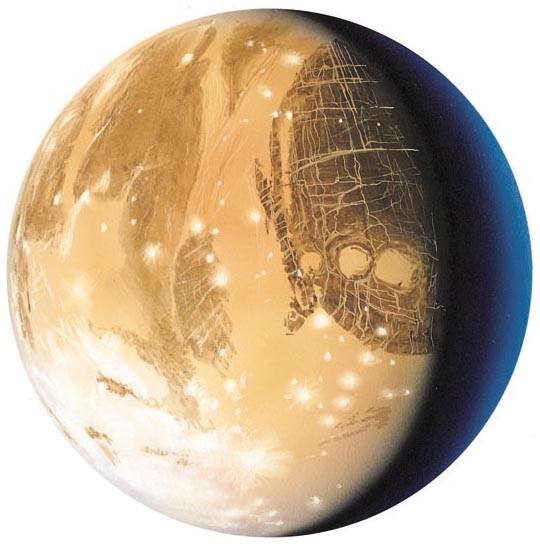
Ganymede, at 5268 kilometres (3273 miles) across on average, is the largest moon in the Solar System. It also has the greatest mass of any moon, more than twice that of Earth's Moon. It is the only moon known to have its own strong magnetic field. Ganymede has an icy surface with dark, cratered plains and areas showing strange “grooved” patterns, as if someone has clawed away at its surface with a giant fork. A saltwater ocean forms a layer a few hundred kilometres below Ganymede's surface, trapped between layers of ice. It may contain more water than all of Earth's oceans combined. Just possibly, it may host living things.
Callisto
Callisto is Jupiter’s second largest moon. It measures 4806 kilometres (2985 miles) across on average. For its size, it has more craters than any other planet or moon in the Solar System. Its largest crater, called Valhalla, is a series of circular ridges, one inside the other, extending outwards like frozen ripples on a pond about 1900 kilometres (1200 miles) from its centre. Callisto has a thick crust made of a mixture of water ice and rock, making it look a little like a “dirty snowball”. A saltwater ocean 150–200 kilometres (90–125 miles) deep, may lie beneath the crust.


Io
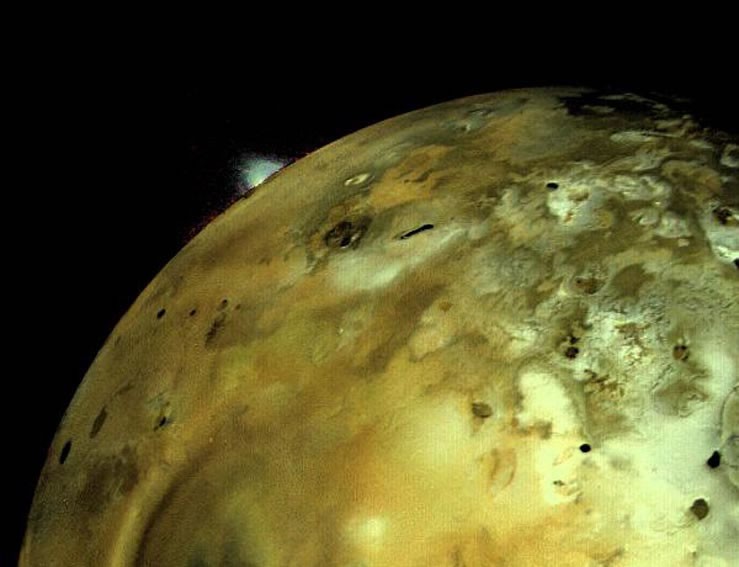
Io, Jupiter's third largest moon, measures 3630 kilometres (2255 miles) across on average. With a crust of vivid mix of yellows, oranges, reds and blacks, Io’s surface looks a little like a pizza. In fact, it is covered with active volcanoes and lava flows. In 1979 the space probe Voyager 1 witnessed eruptions in which plumes of sulphur dioxide gas burst through from Io’s rocky interior, jetting 300 kilometres (200 miles) above the surface. Io is being affected by the gravity of nearby Jupiter, which tugs at the moon, generating sufficient heat deep inside it to cause the eruptions.
Europa
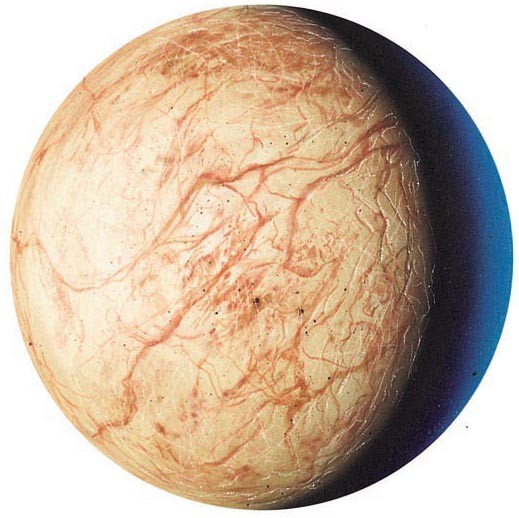
Jupiter’s fourth largest moon, Europa, measures 3140 kilometres (1950 miles) across on average. It is a world of great interest to astronomers. Europa's smooth, icy surface is covered by a maze of dark streaks. These are cracks, the result of constant disturbance to Europa's interior brought about by Jupiter's gravitational pull. Astronomers suspect that below the ice there is an ocean of water, kept warm by Jupiter's gravity. Could it be that there are living things swimming in this ocean?
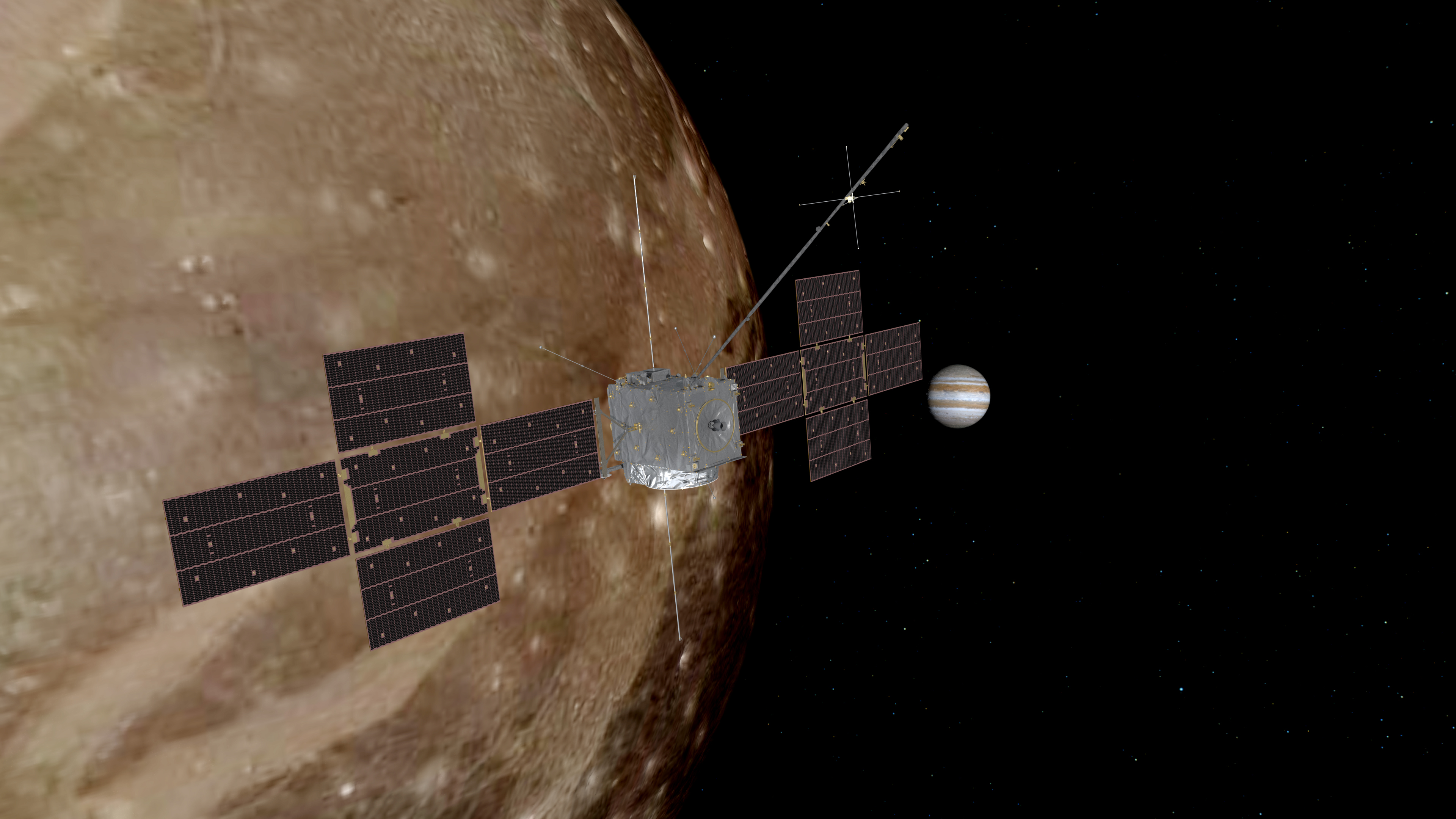
JUICE
A European Space Agency space probe, known as JUICE (the name stands for Jupiter Icy Moons Explorer), blasted off in April 2023 on a mission to Jupiter’s Galilean moons. it is expected to reach Jupiter in July 2031, then fly by Callisto and Europa before entering into orbit around Ganymede in December 2034. When it does so, it will become the first spacecraft to orbit a moon other than our own. JUICE's period of operations will overlap with NASA's Europa Clipper mission, which was launched in October 2024. When JUICE runs out of fuel, likely to be around the end of 2035, the spacecraft will crash into Ganymede.
Consultant: Mike Goldsmith
pics


Without in any way limiting Q-files Ltd’s exclusive rights under copyright, any use of this publication to “train” generative artificial intelligence (AI) technologies to generate text is expressly prohibited. Q-files Ltd reserves all rights to license use of this work for generative AI training and development of machine learning language models.