
Space transport

CITE
We have made every effort to follow citation style rules, but there may be some minor differences. If in doubt, please refer to the appropriate citation style manual.
Apollo mission. (2026). In Q-files Encyclopedia, Technology, Space transport. Retrieved from
https://www.q-files.com/technology/space-transport/apollo-mission
"Apollo mission." Technology, Space transport, Q-files Encyclopedia, 2 Jun. 2026.
https://www.q-files.com/technology/space-transport/apollo-mission.
Accessed 7 Aug. 2026.
Apollo mission 2026. Technology, Space transport. Retrieved 7 August 2026, from
https://www.q-files.com/technology/space-transport/apollo-mission
Technology, Space transport, s.v. "Apollo mission," accessed August 7, 2026.
https://www.q-files.com/technology/space-transport/apollo-mission


Apollo mission
After the former Soviet Union launched the first man into orbit in 1961, American President John F. Kennedy announced that the USA would land a man on the Moon before the end of the 1960s. The mission was carried out by the National Aeronautics and Space Administration (NASA). A new spacecraft specially designed for the mission, called Apollo, was built. During a series of missions in Earth and Moon orbit throughout the 1960s, Apollo was thoroughly tested and astronauts trained for the Moon landing. The first manned flight of Apollo was in 1968, followed by the first successful landing by humans on the Moon on 20th July 1969. Five more landings followed, the last in December 1972. Twelve men walked on the Moon.

Saturn V

The enormous Saturn V launch vehicle, built to launch the Apollo spacecraft, consisted of three rocket stages. In a multi-stage rocket, the engines of each stage fire until their fuel runs out. Then the stage is jettisoned (cast off) and the engines of the next stage fire. The rocket gets lighter each time a stage is lost, allowing it to accelerate more easily. This is more efficient than one rocket.
The first stage (1) of a Saturn V had five engines (2) fuelled by kerosene and liquid oxygen stored in huge tanks (3). It created as much thrust as 50 jumbo jets. The second stage (4) also had five engines, fuelled by liquid hydrogen and oxygen. The third stage (5) had one engine, also fuelled by liquid hydrogen and oxygen.
On top of the 111-metre (364-foot) rocket (as high as a 30-storey skyscraper), were the Lunar Module (6), Service Module (7) and Command Module (8) of the Apollo spacecraft, and an escape rocket (9), that pulled the Command Module clear of the rocket in case of an emergency during launch.
The Command Module (CM), located in the Saturn V’s nose, was both the control centre and living quarters for the crew. The Service Module (SM) contained the main rocket engine used to power the craft in space. Until the very last stage of the mission, the CM and SM were linked to form the CSM. The Lunar Module (LM) had two stages—a descent stage for landing on the Moon, and an ascent stage to send the astronauts back into lunar orbit after their time on the surface of the Moon.
Journey to the Moon
On 16th July 1969, Saturn V, with Apollo 11 on board, lifted off from the Kennedy Space Center in Florida. The launch vehicle powered it into orbit around Earth. As fuel was used up, the first and second stages of the rocket were jettisoned, leaving the third stage to power Apollo into Earth orbit. There, the parts of the spacecraft were re-arranged. The LM, named Eagle, was moved to the front of the CSM, called Columbia. The third stage of Saturn V then fell away and Apollo headed for the Moon. Aboard were US astronauts Neil Armstrong, Edwin "Buzz" Aldrin and Michael Collins.
Three days later Columbia went into orbit around the Moon. The next day, 20th July 1969, Armstrong and Aldrin moved into Eagle, while Collins stayed in Columbia. Eagle then undocked from Columbia and began its descent to the surface. "The Eagle has wings!" Armstrong joked. Meanwhile, Columbia, with Collins aboard, continued in lunar orbit.
Lunar landing
Eagle's descent to the lunar surface was far from straightforward. Soon after its engine fired to slow its descent from an altitude of 15,000 metres (50,000 feet), Armstrong realised that Eagle would be "landing long"—beyond its planned landing zone in the plain called Mare Tranquillitatis (Sea of Tranquility). A series of alarms blared in the cockpit as Eagle neared the surface, indicating computer overload. Mission Control quickly checked and decided these could be safely ignored.
Armstrong saw that the trajectory on Eagle's flight computer was leading them towards a large crater and a field of boulders. It would be far too dangerous to land here. Taking over manual control, he flew Eagle like a helicopter, slowing its descent while looking for a smoother landing site further on. The extended flight meant Eagle was burning up much more fuel than expected.


Charlie Duke at Mission Control—the only person who communicated directly with the flight crew—told Armstrong and Aldrin that Eagle had around one minute's worth of fuel left in its tank. But Aldrin was too busy giving Armstrong detailed directions to acknowledge the call. Then, just when Mission Control were expecting to hear the 15-second warning, Armstrong landed Eagle and shut down the engine.

"Man on the moon!" announced the CBS News anchorman Walter Cronkite to millions of people watching the events unfold on live TV.
"We copy you down, Eagle," Duke radioed the astronauts, nervously.
"Houston, Tranquillity Base here," Armstrong replied. "The Eagle has landed."
"Roger, Twam...Tranquillity, we copy you on the ground" stammered a relieved Duke. "You've got a bunch of guys about to turn blue. We're breathing again. Thanks a lot."
It was the first landing by a manned spacecraft on another body in the Solar System.
First on the Moon
About six-and-a-half hours later, at 10.56 p.m. EDT (Eastern Daylight Time), Armstrong stood on Eagle's foot pad before placing his foot on to the dusty lunar surface. Millions of people around the world peered at the grainy TV pictures in wonder.
"That's one small step for man, one giant leap for mankind." (Armstrong dropped the "a" before "man", which would have given his words the full meaning he intended—but everyone knew what he meant.) Neil Armstrong thus became the first person to step on to the lunar surface. He was soon followed by the second man, fellow astronaut Buzz Aldrin.
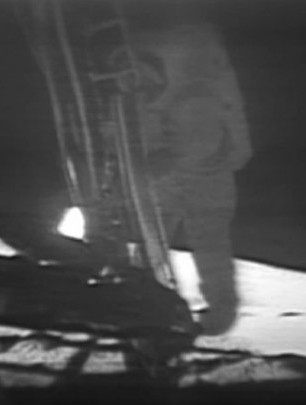


The astronauts planted a flag of the United States on the lunar surface, although they struggled with the pole which they could jam only 5 centimetres (2 inches) into the hard lunar surface. President Richard Nixon then spoke to them through a phone-radio link.
"For one priceless moment in the whole history of man, all the people on this Earth are truly one," said Nixon. "One in their pride in what you have done, and one in our prayers that you will return safely to Earth."

The Apollo astronauts also left behind a plaque, mounted on the LM ladder, featuring two drawings of Earth, its Western and Eastern Hemispheres and an inscription which read: "Here men from the planet Earth first set foot upon the Moon, July 1969 A.D. We came in peace for all mankind."
Return home
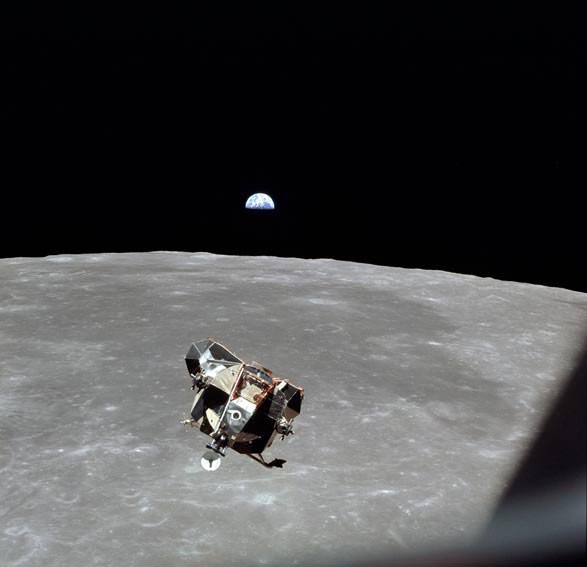
Following their return to Eagle, the two astronauts rested for about seven hours. They then started preparations for the return flight. Finally, they lifted off in Eagle's ascent stage to rejoin Collins aboard Columbia in lunar orbit. Eagle's ascent stage was jettisoned into lunar orbit. Columbia then set off for Earth.
After re-entering Earth's atmosphere (protected by a heat shield from the heat created by friction with air molecules), Columbia splashed down in the central Pacific Ocean, its impact slowed by parachutes. Sea king helicopters dispatched from aircraft carrier USS Hornet were soon on the scene to pick up the astronauts and deliver them to the Mobile Quarantine Facility (MQF). Here they remained for 21 days as a precaution against the possibility that had brought back germs from the lunar surface. After a clean bill of health, they emerged as heroes.


Moon buggy
On later Apollo missions, the astronauts took with them wheeled transport: a collapsible vehicle called the Lunar Rover or Moon buggy. It was the first manned extra-terrestrial vehicle (the unmanned Soviet Lunokhod 1, landed in November 1970, was the first vehicle of all). Powered by electric batteries, it could reach speeds of 16 km/h (10 mph) on the level, about as fast as a long-distance runner.
Apollo 11 mission profile

1. Saturn V, carrying Apollo 11, lifts off from the Kennedy Space Center in Florida.
2. As fuel is used up, the first stage of the rocket is jettisoned.
3. The second stage is jettisoned. Saturn V's the third stage powers Apollo into Earth orbit.
4. The parts of the spacecraft are re-arranged. The LM is moved to the front of the CSM (called Columbia). The third stage of Saturn V falls away.
5. Apollo heads for the Moon.
6. Apollo goes into orbit around the Moon. One astronaut, Michael Collins, stays in the CSM while Neil Armstrong and Buzz Aldrin move into the LM (called Eagle).
7. The LM separates from the CSM and descends to the Moon.
8. The CSM continues in orbit around the Moon while Armstrong and Aldrin land on the Moon in the LM.


9. The upper part of the LM‘s ascent rocket engine fire, and the LM lifts off from the Moon.
10. The LM docks with the CSM in lunar orbit and Armstrong and Aldrin crawl through to rejoin Collins.
11. The LM is then jettisoned and the CSM sets off for Earth.
12. The CM separates from the SM.
13. The CM re-enters Earth’s atmosphere.
14. Parachutes open, and the CM drops into the Pacific Ocean, from where the astronauts are picked up by US Navy helicopters.
Consultant: Chris Oxlade
pics


Without in any way limiting Q-files Ltd’s exclusive rights under copyright, any use of this publication to “train” generative artificial intelligence (AI) technologies to generate text is expressly prohibited. Q-files Ltd reserves all rights to license use of this work for generative AI training and development of machine learning language models.