
Space transport

CITE
We have made every effort to follow citation style rules, but there may be some minor differences. If in doubt, please refer to the appropriate citation style manual.
Spaceplanes. (2026). In Q-files Encyclopedia, Technology, Space transport. Retrieved from
https://www.q-files.com/technology/space-transport/spaceplanes
"Spaceplanes." Technology, Space transport, Q-files Encyclopedia, 2 Jun. 2026.
https://www.q-files.com/technology/space-transport/spaceplanes.
Accessed 22 Sep. 2026.
Spaceplanes 2026. Technology, Space transport. Retrieved 22 September 2026, from
https://www.q-files.com/technology/space-transport/spaceplanes
Technology, Space transport, s.v. "Spaceplanes," accessed September 22, 2026.
https://www.q-files.com/technology/space-transport/spaceplanes


Spaceplanes
A spaceplane is a vehicle that can fly like an aeroplane in Earth's atmosphere, like a spacecraft in space, and be able to orbit the Earth. All types of spaceplanes have so far been rocket-powered and landed as unpowered gliders. Four types of spaceplane have successfully launched into orbit, re-entered Earth's atmosphere and landed. They are: the Space Shuttle, Buran (a Soviet reusable spacecraft project that ran from 1974 to 1993 but which never had a manned mission), the X-37, and the Shenlong, launched by the Chinese Space Programme in 2020. Another US spaceplane, Dream Chaser, and a European project, Space Rider, are currently under development. Two sub-orbital rocket-powered aircraft (those that reach space by flying above an altitude of 100 kilometres or 60 miles, but do not go into orbit) have been launched from carrier aircraft: the X-15 and SpaceShipOne.

Reusability
The main point of any spaceplane is that it can be used many times, rather than just once like a conventional spacecraft. Although so far all spaceplanes have included booster rockets with have been jettisoned (discarded) when empty, these boosters are often retrieved, refilled and reused.


Boeing X-37
The Boeing X-37, also known as the Orbital Test Vehicle (OTV), is a reusable, uncrewed, robotic spacecraft. Began as a NASA project (as the X-37A) in 1999, it has, since 2004, been operated by the United States Space Force (as the X-37B). The spaceplane is boosted into space by a launch vehicle (to date, the Atlas V or SpaceX Falcon 9 rockets), then re-enters Earth's atmosphere and lands as a glider. The X-37's first orbital mission was launched in April 2010 on an Atlas V rocket, returning to Earth in December 2010. The fifth mission completed in October 2019 after 780 days in orbit. The sixth mission launched on an Atlas V on 17th May 2020 (see below), the seventh on 28th December 2023 on a Falcon Heavy rocket, entering a highly elliptical high Earth orbit.
Most of the activities of the X-37 project are secret. Official accounts give the primary objectives of the X-37 as twofold: testing reusable spacecraft technology, and operating scientific experiments which can be returned to Earth. Some experts suggest that the X-37B could be eventually be used as a spy satellite (or to test spy sensors, studying the effects of radiation and other hazards of orbit) and to deliver weapons from space.

X-37B launch, May 2020
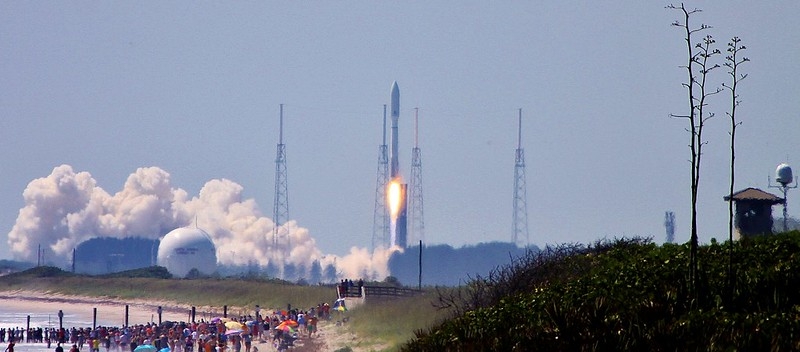
Carried aboard an Atlas V rocket, the X-37B lifted off from Cape Canaveral, Florida, on 16th May 2020. For its sixth mission, the X-37B was fitted with a service module, enabling it to carry out two scientific experiments. In one, the effects of radiation on plant seeds were studied; the other converted solar energy into radio waves, which were then transmitted to the ground (systems like these could, in future, enable sunlight to be converted to electricity which could be beamed down to parts of the Earth even where night has fallen).
The X-37B plane also released from the cargo bay inside its fuselage the FalconSat-8, a small test satellite—about the size of a dishwasher. This conducted its own experiments. The plane uses solar panels for power in orbit.

The Boeing X-37B is one of two identical vehicles. Measuring 8.9 metres (29 feet) long with a wingspan of 4.55 metres (nearly 15 feet), each looks like a smaller version of the Space Shuttle, which was retired by the US space programme in 2011. But whereas the Shuttle was piloted by a crew, the X-37B is fully autonomous: it pilots itself.
Dream Chaser
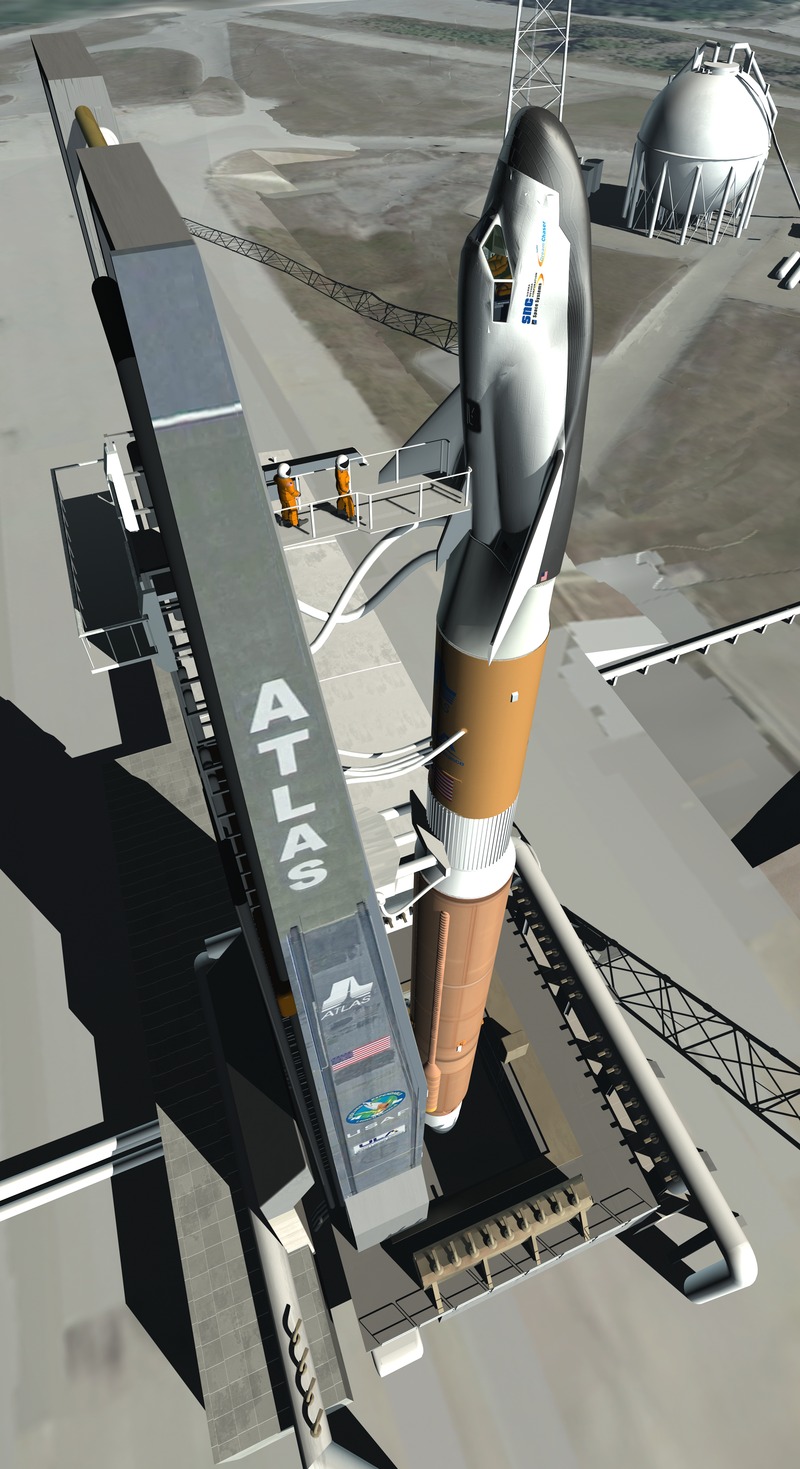
The Dream Chaser is a US reusable spaceplane being developed by Sierra Nevada Corporation (SNC) Space Systems. The crewed version, equipped with a built-in launch escape system, is capable of carrying up to seven people and cargo to and from Low Earth orbit.
The cargo version of the Dream Chaser is an uncrewed, robotic spacecraft. Designed to deliver supplies to the International Space Station (ISS), it will launch vertically on the Vulcan Centaur rocket and land as a glider on conventional aircraft runways. A proposed version operated by the European Space Agency (ESA) would launch on an Ariane 5 rocket. The cargo Dream Chaser will have folding wings and fit within a 5-metre (16-foot) diameter payload fairing (nose cone), known as the "Shooting Star" cargo module. The crewed Dream Chaser is intended to launch without a fairing.


Space Rider
The Space Rider (Space Reusable Integrated Demonstrator for Europe Return) is a planned uncrewed orbital spaceplane. It is intended to provide the ESA with a reusable space transportation system. Its maiden flight is scheduled for 2028.
Designed for launch on an ESA Vega-C rocket from Kourou, French Guiana, the Space Rider will stay in orbit for about two months. It will carry up to 800 kilos of experiments and technology demonstrations in its 1200-litre cargo bay. At the end its mission, it will descend to Earth assisted by a controllable gliding parachute called parafoil, and land on a runway, either in Kourou or Santa Maria in the Azores.
Consultant: Mike Goldsmith
pics

Without in any way limiting Q-files Ltd’s exclusive rights under copyright, any use of this publication to “train” generative artificial intelligence (AI) technologies to generate text is expressly prohibited. Q-files Ltd reserves all rights to license use of this work for generative AI training and development of machine learning language models.