
Solar System

CITE
We have made every effort to follow citation style rules, but there may be some minor differences. If in doubt, please refer to the appropriate citation style manual.
Comets and meteoroids. (2026). In Q-files Encyclopedia, Space, Solar System. Retrieved from
https://www.q-files.com/space/solar-system/comets-and-meteoroids
"Comets and meteoroids." Space, Solar System, Q-files Encyclopedia, 2 Jun. 2026.
https://www.q-files.com/space/solar-system/comets-and-meteoroids.
Accessed 6 Aug. 2026.
Comets and meteoroids 2026. Space, Solar System. Retrieved 6 August 2026, from
https://www.q-files.com/space/solar-system/comets-and-meteoroids
Space, Solar System, s.v. "Comets and meteoroids," accessed August 6, 2026.
https://www.q-files.com/space/solar-system/comets-and-meteoroids


Comets and meteoroids
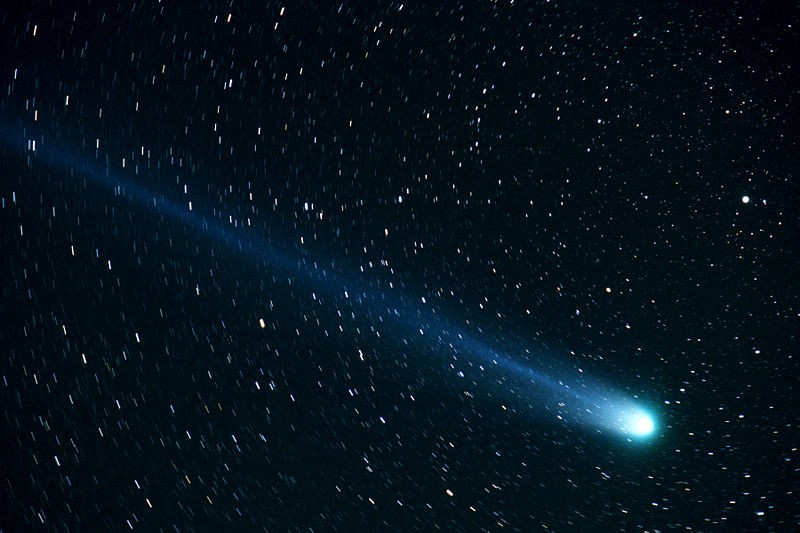
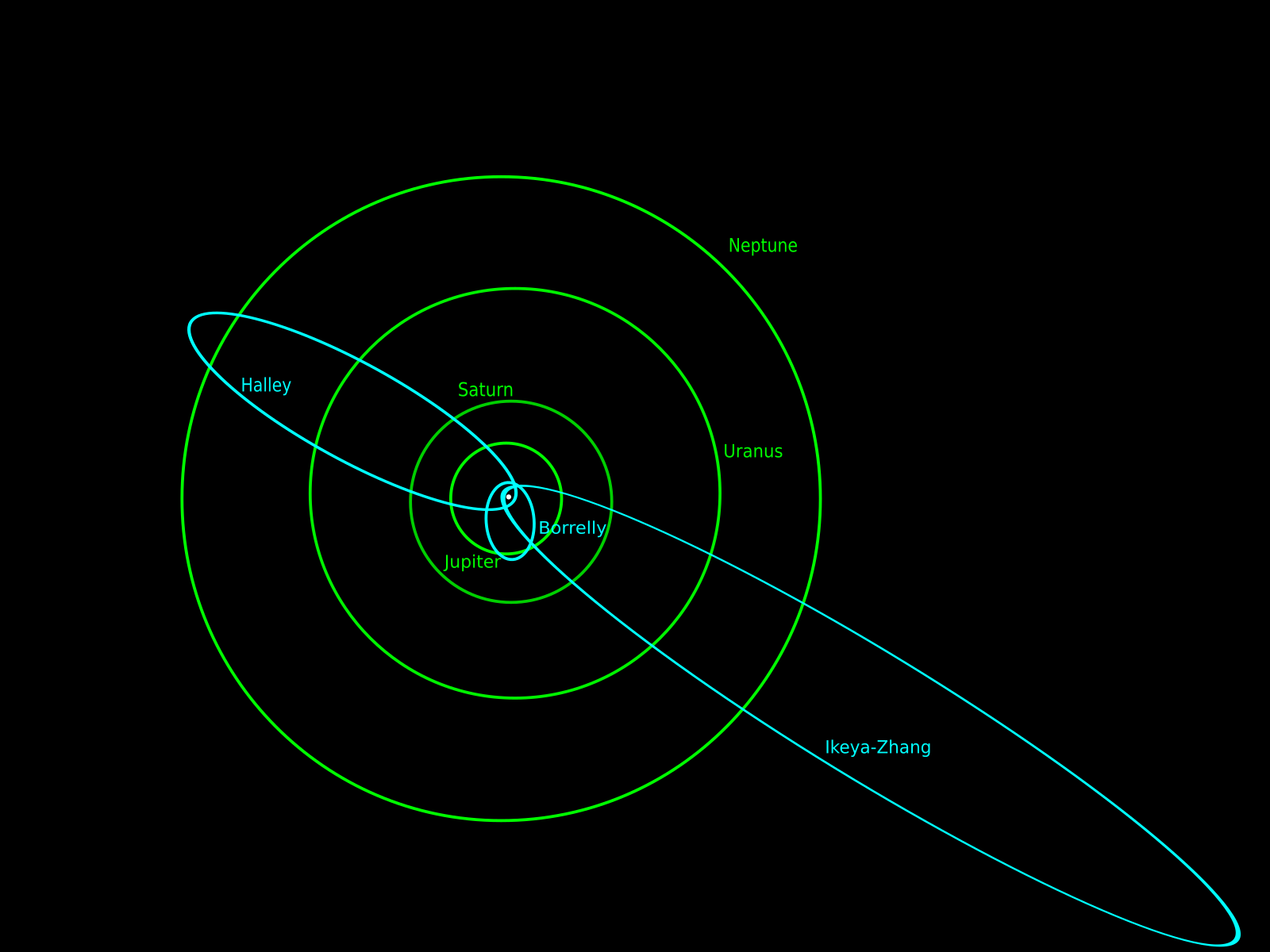
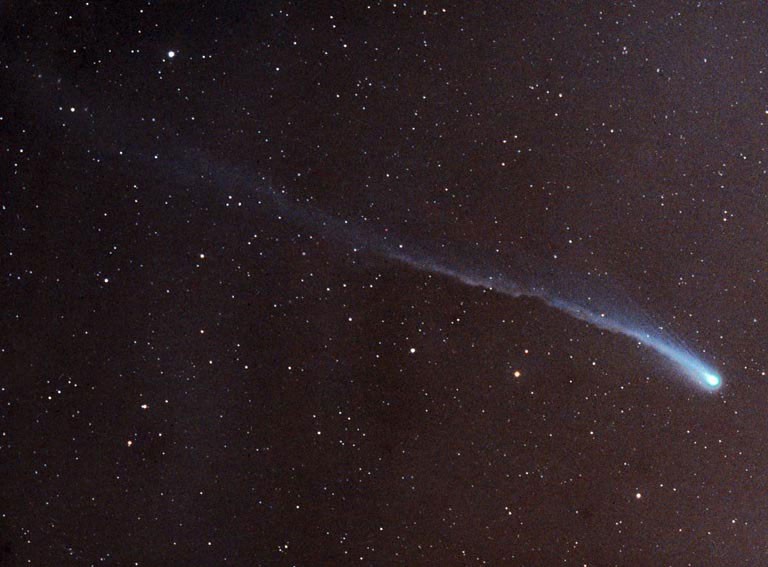
A comet is a potato-shaped lump of dust and ice measuring only a few kilometres across, accompanied by—when near to the Sun—two tails stretching out hundreds of millions of kilometres into space. Occasionally, we can spot a comet from Earth: a dramatic smear of light across the starry heavens. Like the planets and asteroids, comets orbit the Sun, although their orbits are very elliptical (squashed oval). Different comets take anything from a few years to hundreds of thousands of years to complete their circuit. Short-period (or periodic) comets originate in the Kuiper Belt or the Scattered Disc, which lie just beyond the orbit of Neptune. Long-period (or non-periodic) comets probably originate in the Oort Cloud, a cloud of icy bodies around the edge of the Solar System.


Halley's Comet
The English astronomer Edmond Halley (1656–1742) was the first to realise that comets were orbiting objects. He once made a famous prediction: a comet that he had observed in 1682 would return to the skies in 1758. Halley believed that comets recorded in 1531 and 1607 were simply earlier sightings of the one he saw in 1682. Halley did not live to see his prediction come true. Halley’s Comet, as it became known, was duly sighted on Christmas Day 1758 and has reappeared at intervals of 75 to 76 years ever since.
Nucleus
The nucleus of a comet, a lump of dust fused together by frozen gases and water ice, was first studied in detail when the space probe Giotto flew to within 600 kilometres (375 miles) of Halley’s Comet in March 1986. Giotto sent back images of the gases and dust particles given off by it. When a comet nears the Sun, its ices melt, the outer crust of its nucleus cracks open and jets of dust and gas burst out to form a cloud, called a coma.


Tails
Close to the Sun, particles from the comet are swept back by the solar wind (a stream of subatomic particles) and by the force of sunlight to form two tails: a straight gas tail and a broader, curved dust tail. Both tails grow as the comet nears the Sun, always pointing away from it. The comet passes round the Sun and on back to the outer Solar System. Its tails, still pointing away from the Sun, shorten and eventually disappear.
Where do comets come from?

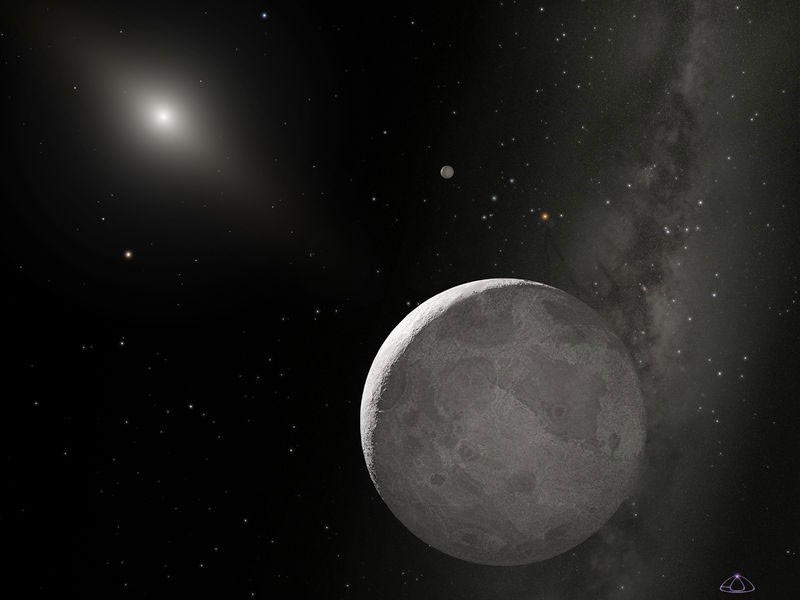
Comets usually have highly elliptical (also known as "eccentric") orbits. They also have a wide range of orbital periods, ranging from several years to millions of years. Short-period comets, those with orbits lasting less than 200 years, such as Halley's, are thought to originate in the Kuiper Belt (or the Scattered Disc, which overlaps it). This consists of a vast array of bodies made of frozen methane, ammonia and water mixed with dust which lie beyond the orbit of Neptune, and are thus known as trans-Neptunian objects. The gravitational influence of the outer planets may cause these bodies, on occasion, to fall inwards towards the Sun along an elliptical orbit. When they approach Earth and their tails develop, they become visible to us.


Long-period comets are thought to originate in the Oort Cloud, a spherical cloud of icy bodies extending from outside the Kuiper Belt to a quarter of the distance to the nearest star, Proxima Centauri. Here, vast swarms of comet-like bodies orbit the Sun in roughly circular orbits. The gravitational pull of other nearby stars may be enough to dislodge comets from their orbits within the Oort Cloud and send them hurtling towards the inner Solar System. Unlike the return of short-period comets, whose orbits have been plotted by previous observations, the appearance of long-period comets in our skies is unpredictable.
Recent comets
On average one comet visible to the naked eye appears in the night sky each year. An exceptionally bright comet, often called a "Great Comet", may be seen every 10 years or so. Comet West in 1976, Comet Hyakutake (which passed very close to Earth) in 1996, Comet Hale-Bopp in 1997 and Comet McNaught in 2007 were the most spectacular of recent years.
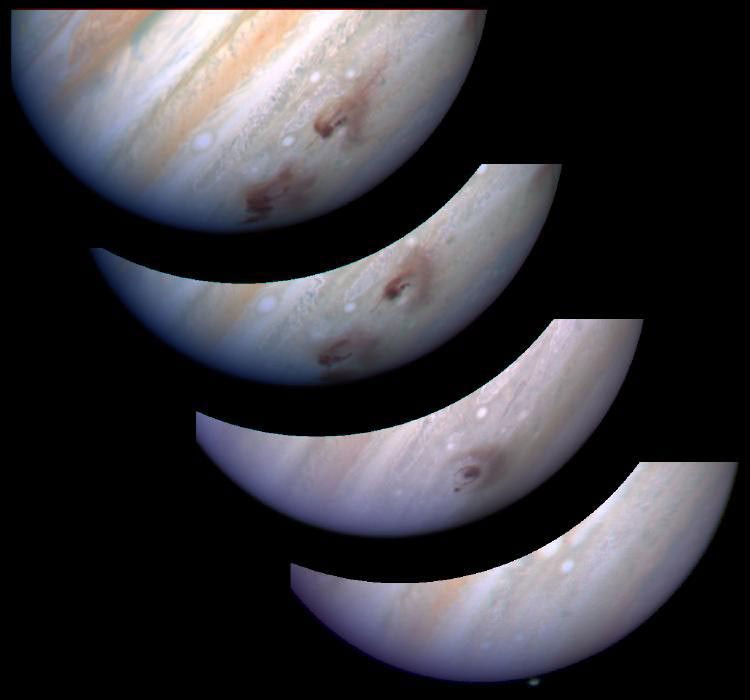
Comets can be destructive if they pass too close to a planet. In July 1994, drawn in by gravity, fragments of Comet Shoemaker-Levy smashed into Jupiter, creating fireballs on impact.
Meteoroids
and meteors
Meteoroids are fragments from comets or asteroids (some are collision impact debris ejected from the Moon or Mars), ranging in size from small grains up to normally no more than 1 metre (3.3 feet) wide. Finer particles are known as space dust or micrometeoroids. As meteoorids hurtle through space, they break up into smaller and smaller fragments. Great showers of them sometimes fly through Earth's atmosphere. Those that do are called meteors. Each year, trillions of them burn up in the atmosphere. We see them as split-second streaks of light in the night sky which we call shooting stars. Some get through and crash to the Earth's surface: these are known as meteorites.

If the comet crosses Earth's orbit, there are likely to be meteor showers while Earth passes through cometary fragments. The Perseid meteor shower occurs every year between 9th and 13th August when the Earth passes through the orbit of Comet Swift–Tuttle.

Meteor air bursts
On 30th June 1908 there was a huge explosion in the Tunguska region of Siberia, Russia. It is estimated at 1000 times greater than the atomic bomb dropped over Hiroshima at the end of World War ll in 1945. Trees in an area about 100 kilometres (60 miles) wide were felled by the blast, but no crater was ever found. The Tunguska fireball was probably caused by a meteor air burst, the explosion of a large meteoroid (or small asteroid or comet) about 50–60 metres (160–200 feet) wide in the Earth's atmosphere. It was the most powerful natural explosion in history. Flattened trees remained littering the ground over a vast area for many years after the event.

The Chelyabinsk meteor was a large meteoroid (or small asteroid) that entered Earth's atmosphere over the southern Ural region of Russia on 15th February 2013. The light from the meteor was briefly brighter than the Sun. Approximately 18 metres (60 feet) in diameter, it exploded in a meteor air burst about 30 kilometres (20 miles) above ground, generating a bright flash and a powerful shock wave. Nearly 1500 people were injured, mainly from broken glass from windows that were blown in when the shock wave arrived.
Consultant: Mike Goldsmith
pics





Without in any way limiting Q-files Ltd’s exclusive rights under copyright, any use of this publication to “train” generative artificial intelligence (AI) technologies to generate text is expressly prohibited. Q-files Ltd reserves all rights to license use of this work for generative AI training and development of machine learning language models.