
Planet Earth

CITE
We have made every effort to follow citation style rules, but there may be some minor differences. If in doubt, please refer to the appropriate citation style manual.
How high is the sky?. (2026). In Q-files Encyclopedia, Earth, Planet Earth. Retrieved from
https://www.q-files.com/earth/planet-earth/how-high-is-the-sky
"How high is the sky?." Earth, Planet Earth, Q-files Encyclopedia, 6 Mar. 2026.
https://www.q-files.com/earth/planet-earth/how-high-is-the-sky.
Accessed 6 Aug. 2026.
How high is the sky? 2026. Earth, Planet Earth. Retrieved 6 August 2026, from
https://www.q-files.com/earth/planet-earth/how-high-is-the-sky
Earth, Planet Earth, s.v. "How high is the sky?," accessed August 6, 2026.
https://www.q-files.com/earth/planet-earth/how-high-is-the-sky


How high is the sky?
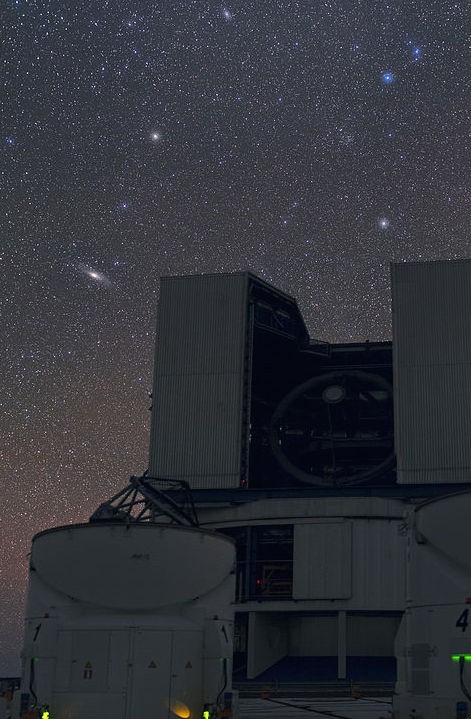
The sky is the name we give for what we can see above the horizon—an expanse of blue during the day, black at night. The sky includes the atmosphere, the blanket of air that envelopes the Earth, as well as space that lies beyond. The highest clouds are no higher than 12 kilometres (7.5 miles) above ground, so that altitude could be considered the “height of the sky”. Or it could be the boundary between the atmosphere and space—the upper limit for aircraft—which scientists give as 100 kilometres (62 miles) above ground. But the upper limit of the atmosphere, beyond which there is no air at all, actually lies at least 10,000 kilometres (6000 miles) above ground—making this a third possible definition of the height of the sky. Yet another answer is the distance of the stars we can see in the night sky. In fact, the most distant object visible without a telescope is a galaxy containing billions of stars: the Andromeda Galaxy. It lies 2.5 million light years or 22.5 quadrillion (15 zeros) kilometres away.


Air
Air contains 78% nitrogen, 21% oxygen, along with small amounts of argon, carbon dioxide and other gases. It also contains a variable amount of water vapour—on average around 1% of its volume. Three quarters of the atmosphere’s mass is found within about 11 kilometres (6.8 miles or 36,000 feet) of the Earth’s surface.
The atmosphere becomes thinner and thinner (meaning it contains fewer and fewer air molecules) with increasing altitude. Air suitable for breathing and for the photosynthesis of plants is found only in the troposphere, the lowest level of the atmosphere. The density of air molecules in the exosphere is extremely thin, dwindling to none at all when the outer edge is reached.
The atmosphere
The Earth’s atmosphere is made up of several different layers: the troposphere, stratosphere, mesosphere, thermosphere and the exosphere, which merges seamlessly into space.
The troposphere rises from the ground to about 9 kilometres (6 miles) above the poles and 16 kilometres (10 miles) above the Equator. It is only one seventieth of the atmosphere’s total volume, yet it contains four fifths of all the air. The troposphere is rich in oxygen and water vapour. This is where clouds form and all our weather occurs. Its temperature falls to –55°C (–67°F) at the boundary with the stratosphere.
The stratosphere extends to 50 kilometres (30 miles) above the ground, between the troposphere and mesosphere. Jet planes sometimes fly in this layer to avoid storms in the troposphere. The stratosphere contains a layer of ozone, a gas that absorbs nearly all the Sun’s ultraviolet radiation—rays harmful to life on Earth. The temperature rises to 10°C (50°F) at the level where the mesosphere begins. It then plunges to a low of –75°C (–100°F) at 80 kilometres (50 miles), before rising again in the thermosphere.

Temperatures in the thermosphere, where the Sun heats the thin air, rise to 1400°C (2500°F). The air in the thermosphere burns up most meteors (fragments of rock from space). The highest layer, the exosphere, starts at about 140 kilometres (225 miles) high. It goes all the way up to an altitude of at least 10,000 kilometres (6000 miles)—but it is impossible to give a precise measurement.

Kármán Line
There is no exact point where the atmosphere stops and space begins, but scientists generally agree that the Kármán Line, at 100 kilometres (62 miles), marks the “official” boundary between atmosphere and outer space. Above this altitude, the atmosphere becomes too thin to allow any aircraft to fly (they cannot get enough lift to keep them in the air). So that is, perhaps, the best answer to the question, how high is the sky. It also shows that space is not as far away as you might think. If you could drive a car vertically upwards, you could be there in an hour or so.
Consultant: Ian Fairchild
Other Q-&-As to explore:
For a full list of all our Q&As, please click here.
If you have a question that you would like to see answered on Q-files, please send us an email to info@Q-files.com or use the contact us page.
pics
Without in any way limiting Q-files Ltd’s exclusive rights under copyright, any use of this publication to “train” generative artificial intelligence (AI) technologies to generate text is expressly prohibited. Q-files Ltd reserves all rights to license use of this work for generative AI training and development of machine learning language models.