
Planet Earth

CITE
We have made every effort to follow citation style rules, but there may be some minor differences. If in doubt, please refer to the appropriate citation style manual.
Magnetic pole reversal. (2026). In Q-files Encyclopedia, Earth, Planet Earth. Retrieved from
https://www.q-files.com/earth/planet-earth/magnetic-pole-reversal
"Magnetic pole reversal." Earth, Planet Earth, Q-files Encyclopedia, 6 Mar. 2026.
https://www.q-files.com/earth/planet-earth/magnetic-pole-reversal.
Accessed 6 Aug. 2026.
Magnetic pole reversal 2026. Earth, Planet Earth. Retrieved 6 August 2026, from
https://www.q-files.com/earth/planet-earth/magnetic-pole-reversal
Earth, Planet Earth, s.v. "Magnetic pole reversal," accessed August 6, 2026.
https://www.q-files.com/earth/planet-earth/magnetic-pole-reversal


Magnetic pole reversal
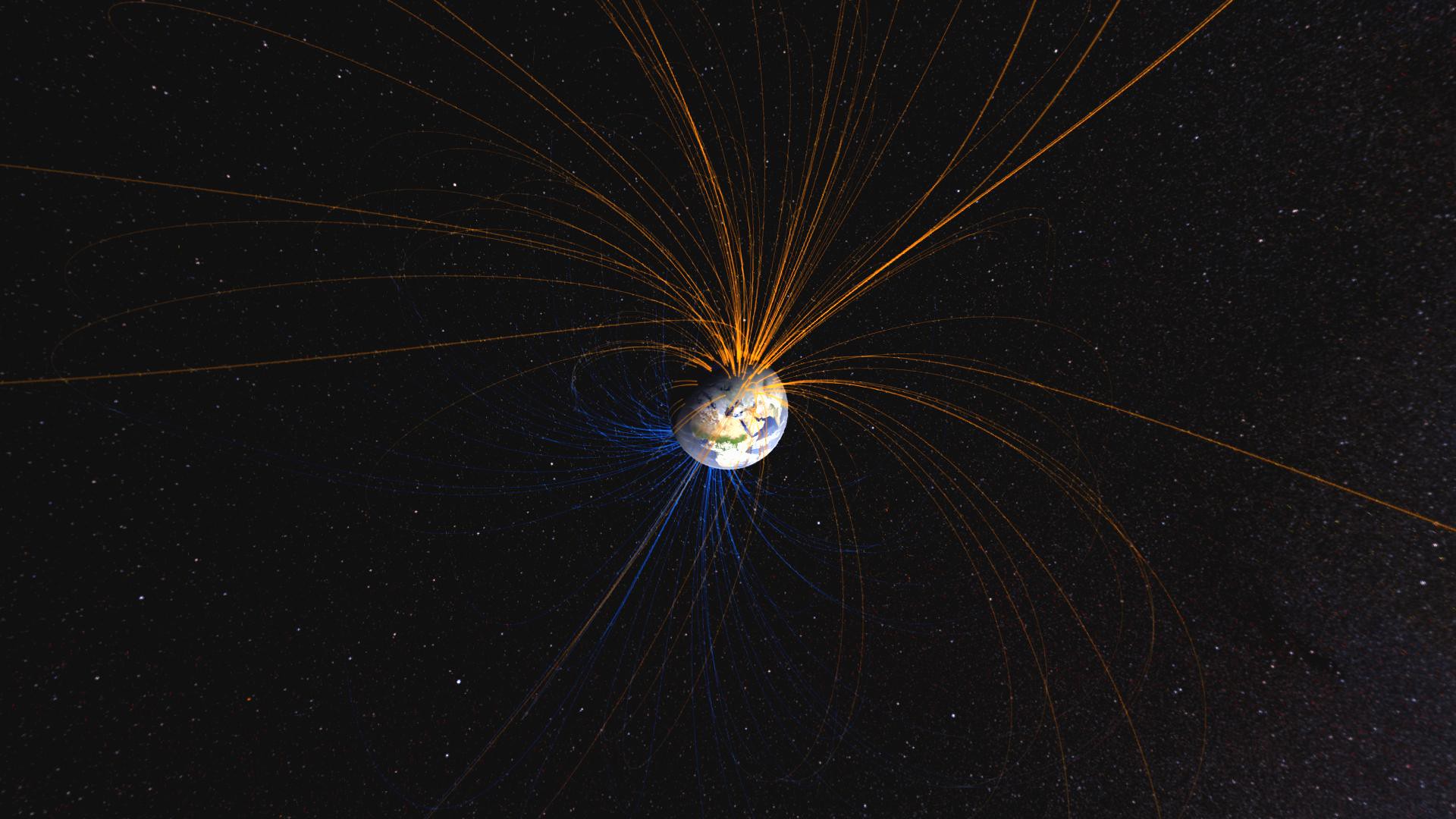
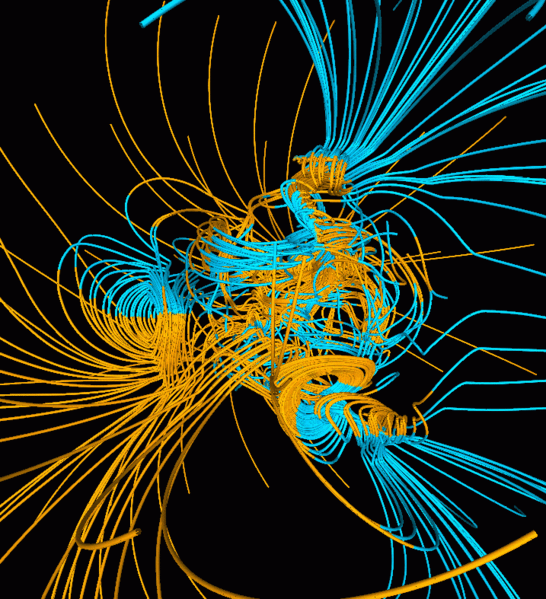
Throughout geological time, the Earth's magnetic field has alternated between periods in which the direction of the field was the same as it is today (normal polarity) and periods in which it was the opposite (reverse polarity). Such changes in the Earth's magnetic field, when the positions of magnetic north and magnetic south swap positions, are known as geomagnetic reversals. Over the course of the Earth's history, they have occurred hundreds of times, and some scientists think the Earth is due another reversal soon.


History
There have been 183 reversals over the last 83 million years—on average once every 450,000 years. The latest, the Brunhes-Matuyama reversal, occurred 780,000 years ago. Scientists estimate the reversal process usually takes between 2000 and 12,000 years. More recently there have been far shorter periods in which the field reversed for just several hundred years. Known as geomagnetic excursions, the most recent short-period reversal was the Laschamp Event which took place 42,000–41,000 years ago. The magnetic field was reversed for approximately 440 years.
No one knows for sure why the reversal happens. The north and south magnetic poles are not the same as the geographic north and south poles, the points around which the Earth rotates and which do not move over time. The positions of the magnetic poles, by contrast, shift constantly (this is often called “polar wandering”), but usually very slowly. At present, the North Magnetic Pole is moving towards Siberia at about 55 kilometres (34 miles) a year. The South Magnetic Pole is moving much more slowly.
The strength of the Earth's magnetic field also varies over time. Studies of magnetized minerals in pots, bricks and tiles made centuries ago show that the magnetic field was very strong in the late 8th century BC, before losing about a quarter of that strength over 30 years. Objects made between the 6th and the 2nd century BC show this weakening continuing, but at a much slower rate.
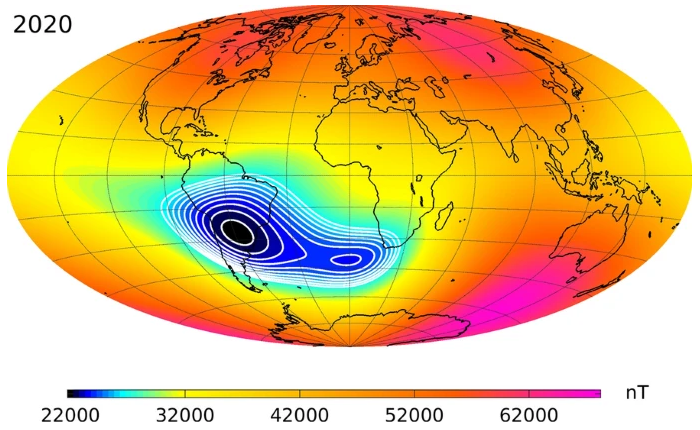
Before a reversal, the Earth's magnetic field weakens and polar wandering speeds up. Both are happening now, although this does not necessarily mean a polar reversal will take place.
Record in the rocks
Samples of rocks taken from deep ocean floors can tell scientists about geomagnetic reversals. The Earth's magnetic field determines the magnetization of lava as it is laid down on the ocean floor on either side of the Mid-Oceanic Ridge running under the centre of the Atlantic Ocean. This is the boundary between two tectonic plates which are slowly spreading apart as magma pushes up from beneath the Earth’s crust and erupts as lava.
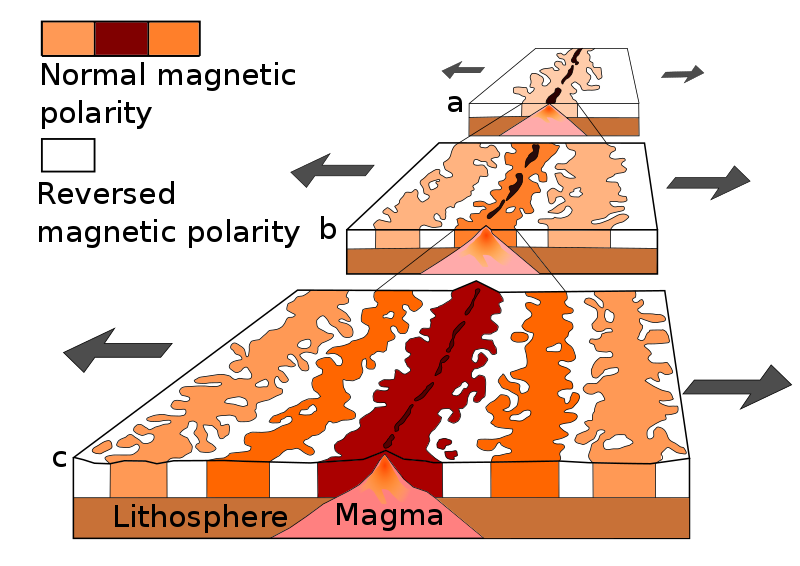
The lava solidifies and turns to basalt rock, forming the sea floor. As new lava erupts, the rock slowly moves away from the ridge: a process called sea-floor spreading. The orientation of past magnetic polarities—either normal or reversed—is recorded in the rocks' minerals. Over time, as the sea floor spreads, a sequence of alternating magnetic “stripes” over the ocean floor forms.

What might happen?
Many animals use the Earth's magnetic field to navigate their way across the world. And we humans rely on it for a range of technologies, including electrical power and satellites, for example, to function. So a geomagnetic reversal is likely to have far-reaching consequences. While a weaker field would certainly lead to a small increase in potentially harmful UV radiation reaching the Earth's surface, the planet's thick atmosphere should offer adequate protection.
Laschamp Event
During the Laschamp Event—a short period of geomagnetic reversal that occurred during the Ice Ages 42,000–41,000 years ago—the Earth's magnetic field was 75% weaker than it is today. While the poles were switching (the process took around 250 years), the field's strength dipped to just 5% of the current strength. This resulted in significantly more radiation, including cosmic rays, reaching the Earth's surface. Some scientists claim this might have been responsible for the extinction of some large animals (called "megafauna") and even the Neanderthals—which occurred around this time—but there is no hard evidence of any impact on the environment.

Consultant: Mike Goldsmith
pics

Without in any way limiting Q-files Ltd’s exclusive rights under copyright, any use of this publication to “train” generative artificial intelligence (AI) technologies to generate text is expressly prohibited. Q-files Ltd reserves all rights to license use of this work for generative AI training and development of machine learning language models.