
Age of Mammals

CITE
We have made every effort to follow citation style rules, but there may be some minor differences. If in doubt, please refer to the appropriate citation style manual.
Evolution of mammals. (2026). In Q-files Encyclopedia, Prehistoric, Age of Mammals. Retrieved from
https://www.q-files.com/prehistoric/age-of-mammals/evolution-of-mammals
"Evolution of mammals." Prehistoric, Age of Mammals, Q-files Encyclopedia, 11 Mar. 2026.
https://www.q-files.com/prehistoric/age-of-mammals/evolution-of-mammals.
Accessed 21 Sep. 2026.
Evolution of mammals 2026. Prehistoric, Age of Mammals. Retrieved 21 September 2026, from
https://www.q-files.com/prehistoric/age-of-mammals/evolution-of-mammals
Prehistoric, Age of Mammals, s.v. "Evolution of mammals," accessed September 21, 2026.
https://www.q-files.com/prehistoric/age-of-mammals/evolution-of-mammals


Evolution of mammals
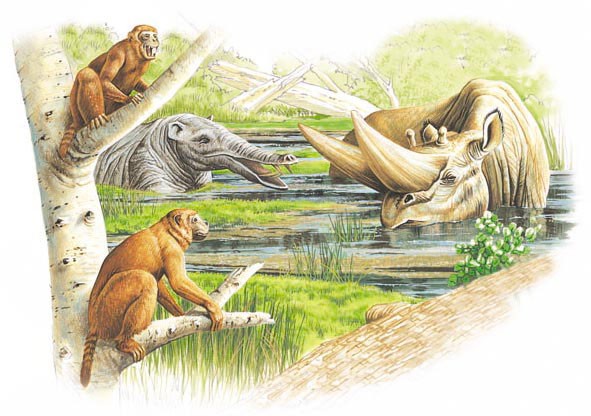
New kinds of mammal evolved to eat different types of food—plants, insects, other animals and so on—in different habitats all over the world. But over the 210 million years since mammals first appeared, many of those habitats have changed as well. Mammals adapted for life in the forest, for example, died out as their sources of food slowly disappeared as grassland took their place. On top of that, the continents have slowly shifted around the globe. Different species of mammal evolved on different continents separated by seas. Sometimes, when continents became joined together, mammals crossed from one to the other by a “land bridge".
Evolution
Over the thousands of millions of years since life began, all types of animals—not just mammals—have very gradually changed in some way. They may, for example, have grown claws or fins, developed wings, lost teeth, or simply become taller. We call this process evolution. The story of mammals, since they first evolved from reptiles about 210 million years ago, is really the story of their evolution.

Early mammals
The extinction of the dinosaurs 66 million years ago meant that there was suddenly an absence of any large animals on land. The mammals spread rapidly and evolved into many different species.
Most of the mammals of the Palaeogene Period, which followed the dinosaurs' extinction, would be unfamiliar to us today. There were some species that do not belong to any surviving family: they became extinct long ago. Plant-eaters, such as the strange, knobbly-headed Uintatherium or twin-horned Arsinoitherium, roamed the forests for stems and roots, or browsed for leaves and fruits.
Andrewsarchus

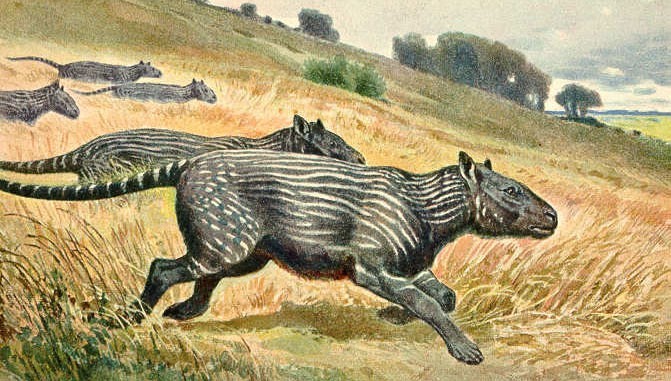
Andrewsarchus was the largest-known, flesh-eating mammal that ever walked on land. It was 4 metres (13 feet) long, nearly a quarter of which was taken up by its massive skull. It probably resembled a large hyena. Andrewsarchus lived in Mongolia about 40 million years ago, where it lived by both hunting and scavenging.
Condylarths
The ancestors of today’s ungulates probably came from a large group of early mammals known as the condylarths. Although today's ungulates have hooves, most early condylarths had claws. The condylarths included horse-like creatures such as Phenacodus. Some condylarths became scavengers and hunters.
Ungulates
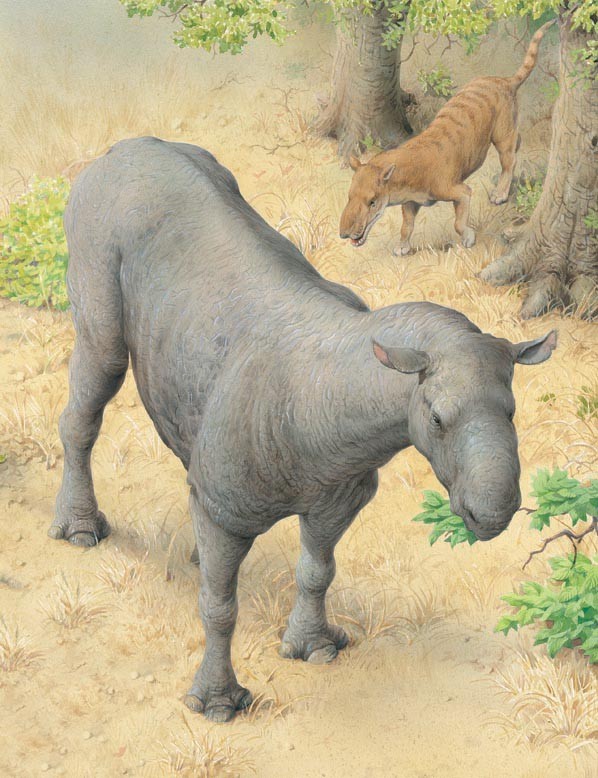
The ungulates, plant-eating, hoofed animals, evolved in the Palaeocene Epoch. A few million years later, during the Eocene Epoch, they divided into forms that had either an odd number of toes (perissodactyls, such as horses and rhinos) or an even number of toes (artiodactyls, such as pigs, antelopes and camels). Early ungulates were small, but, as forests thinned out in the later Eocene and Oligocene, larger species evolved. Paraceratherium, a rhinoceros that stood 5 metres (16 feet) high at the shoulder, was the largest land mammal that ever lived. Archaeotherium was a cow-sized, pig-like carnivore.
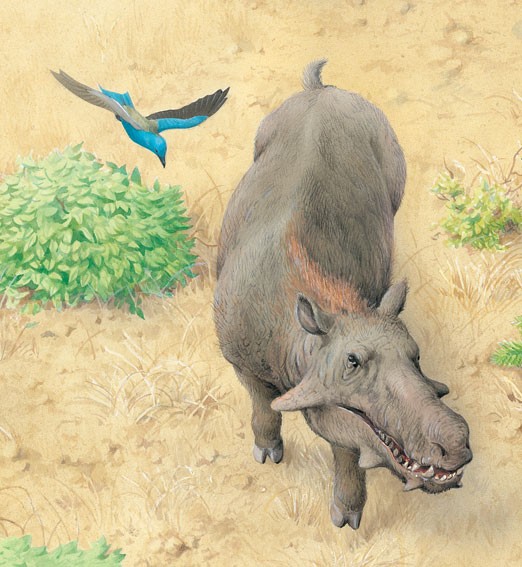
The even-toed ungulates expanded into a wide range of families as climates became drier in the Miocene and forests gave way to grasslands. The ruminants—cattle, sheep, deer, giraffe and antelopes—with their four-chambered stomachs, had an efficient digestive system able to deal with tough grasses. A variety of camels, masters of survival in harsh conditions, arose. Pigs, peccaries, and hippos—all animals willing to eat anything they could find—multiplied in the forests that remained. Of the odd-toed ungulates, only the horses expanded their range. To this day, there are many more even-toed ungulate species than odd-toed.
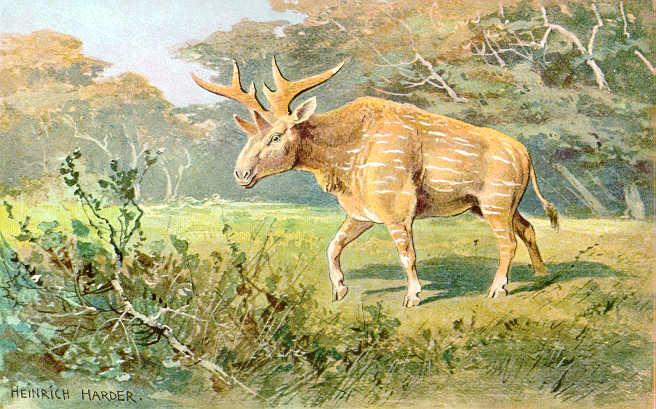
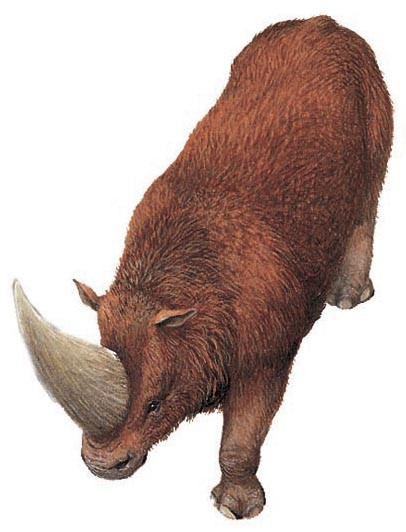
Both kinds of ungulates produced “giants” during the Ice Ages: being large was one way to improve the chances of survival in intense cold. Living during the Pleistocene were massive, moose-like giraffes like Sivatherium, the aurochs (ancestors of modern cattle) and a woolly rhinoceros, Elasmotherium, which was twice the size of its modern relatives. All died out as the modern age dawned.

Horses
Horses evolved from small forest scamperers to large grassland gallopers. On open plains grazing animals are highly visible to ever-watchful carnivorous predators: to run fast was a good way to survive. Horses successfully evolved the means to do this. Over time their legs became longer and more slender, while the number of toes on each foot was reduced from four to one, concentrating the animal’s weight on a single hoof.
The first known horse, Hyracotherium, was the size of a domestic cat. It browsed on leaves in semi-tropical forests. Cooler, drier conditions in the Oligocene brought more open countryside and saw the evolution of the larger, more mobile Mesohippus (now down to three toes).
Merychippus was the first of a number of grazing horses of the Miocene. Only the middle toe on each foot, broadened into a single hoof, bore its weight. It also had powerful, grinding teeth enabling it to chew tough grass. Modern horses (scientific name Equus) evolved in the Pliocene.
Marsupials
Wiped out elsewhere, marsupials survived only in Australia and South America. Because Australia was separated from all the other continents, its marsupials were free from competition with placentals and so, over more than 50 million years, evolved into many different species. During the Pleistocene Epoch, giant species took centre stage (many have become extinct only quite recently). Among them were the rhinoceros-sized wombat, Diprotodon and the giant kangaroo, Procoptodon.
Xenarthrans
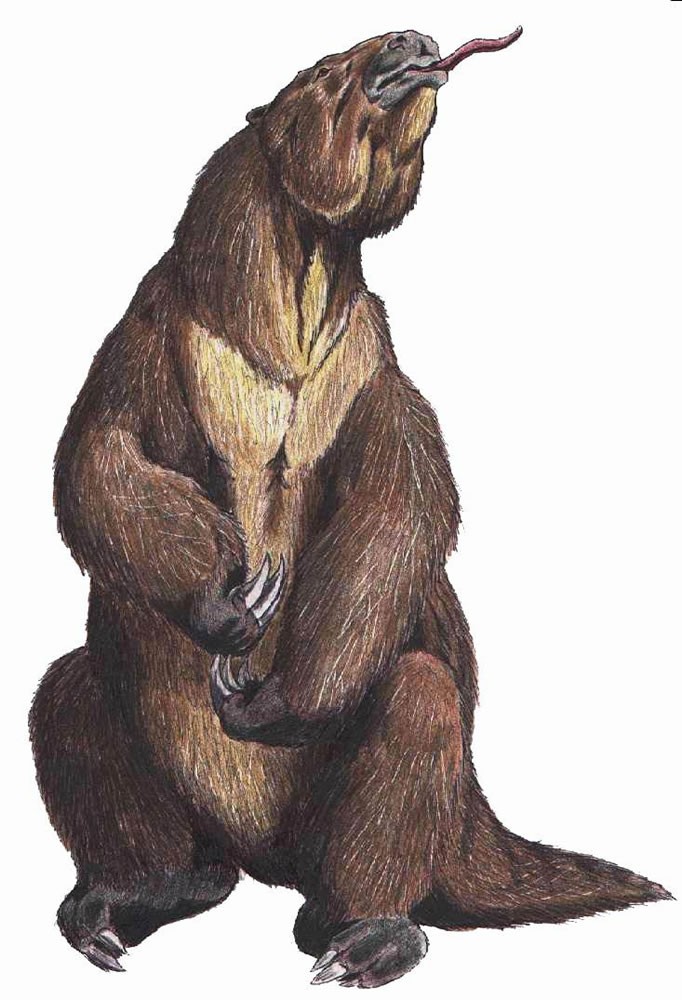
The xenarthrans, a group of mammals that includes anteaters, armadillos and sloths, arose in South America. Among xenarthrans of the past were Megatherium, a 7-metre (23-foot) ground sloth with large hooked claws and powerful limbs, and Glyptodon, an animal the size of a small car and almost entirely encased in bony armour.
Bats
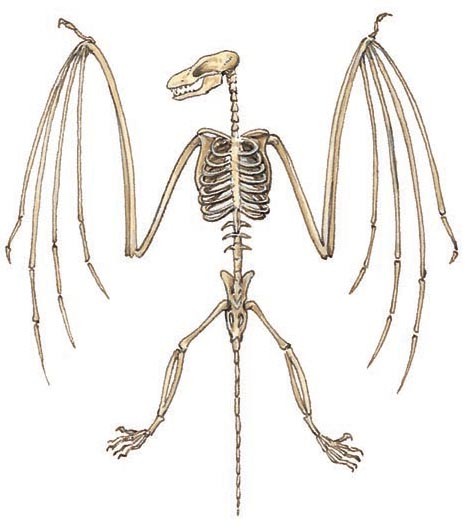
By 50 million years ago, bats had evolved to be very similar to those creatures we see today. Icaronycteris, from the Eocene, was a typical example. By this time, birds had become masters of the daytime skies, so bats flew at night instead. They evolved elongated fingers with wings made of skin stretched tightly between them, giving them the ability to fly. Bats' early ancestors were nocturnal, tree-climbing, shrew-like creatures, from which they inherited their excellent senses of smell and hearing.
To help them get about in the air at night, bats evolved a technique called echolocation. They gave out extremely high-pitched squeaks; the echoes they received back created a “sound picture” of their surroundings.
Rodents
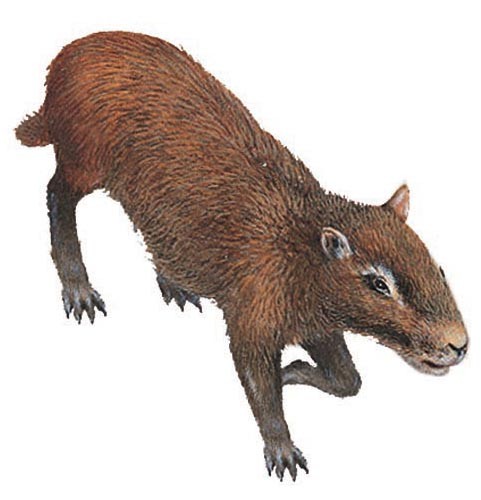
The largest mammal group of all is made up of the rodents. Like rabbits and hares, these are gnawing animals with continuously growing incisor (front) teeth. The modern rodents probably appeared in the late Palaeocene Epoch. They spread to all continents except Antarctica and lived in most habitats, from Arctic tundra to tropical forest.

Carnivores
The carnivore order consists largely of the meat-eating animals. Their common ancestor was probably a tree-dwelling insect-eater. Early members of the group, like Miacis, had developed a pair of slicing back teeth. Different families emerged as carnivores explored new ways of hunting down their prey and broadening their diet.
Primates
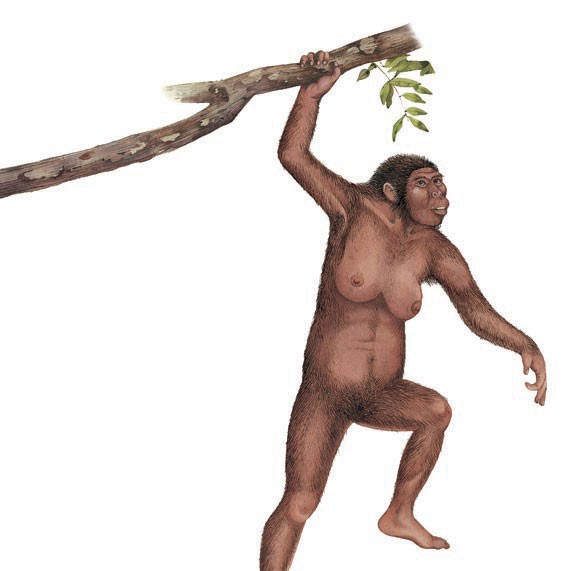
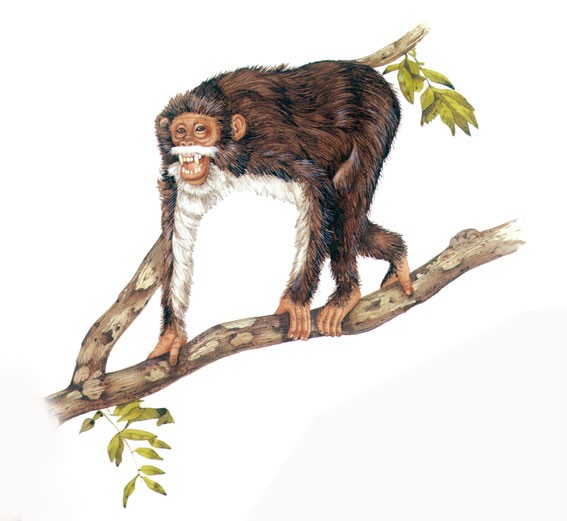
Throughout their history, most primates have been tree-dwellers. This style of life has certain demands: agility and the ability to grasp, forward-looking eyes and 3D vision (enabling movement from tree to tree), intelligence and careful rearing of the young. All these traits have been inherited by the most recently evolved primates: humans.


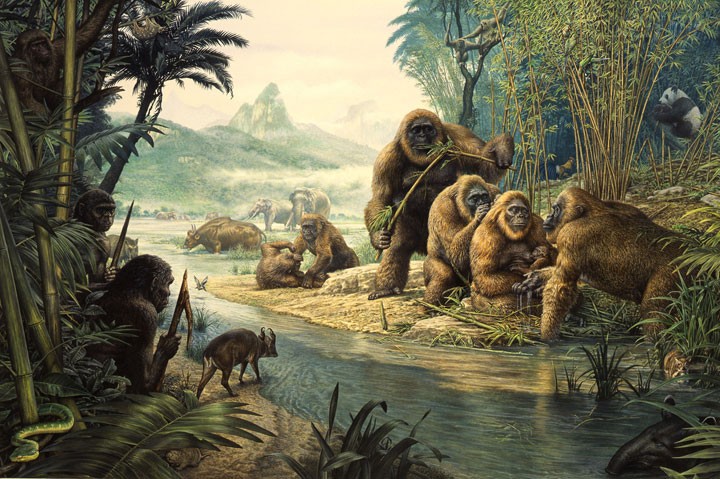
The first primates, which appeared in the Jurassic Period, during the Age of the Dinosaurs, were squirrel-like animals with sharp claws. Later these creatures developed more primate-like features (grasping hands, long tails, short snout and forward-looking eyes). They may have been ancestors of the modern prosimians: lemurs, tarsiers and bushbabies. Monkeys appeared in the Oligocene, the first apes in the Miocene.
Consultant: Chris Jarvis
pics
Without in any way limiting Q-files Ltd’s exclusive rights under copyright, any use of this publication to “train” generative artificial intelligence (AI) technologies to generate text is expressly prohibited. Q-files Ltd reserves all rights to license use of this work for generative AI training and development of machine learning language models.