
Age of Mammals

CITE
We have made every effort to follow citation style rules, but there may be some minor differences. If in doubt, please refer to the appropriate citation style manual.
First mammals. (2026). In Q-files Encyclopedia, Prehistoric, Age of Mammals. Retrieved from
https://www.q-files.com/prehistoric/age-of-mammals/first-mammals
"First mammals." Prehistoric, Age of Mammals, Q-files Encyclopedia, 11 Mar. 2026.
https://www.q-files.com/prehistoric/age-of-mammals/first-mammals.
Accessed 19 Nov. 2026.
First mammals 2026. Prehistoric, Age of Mammals. Retrieved 19 November 2026, from
https://www.q-files.com/prehistoric/age-of-mammals/first-mammals
Prehistoric, Age of Mammals, s.v. "First mammals," accessed November 19, 2026.
https://www.q-files.com/prehistoric/age-of-mammals/first-mammals


First mammals
Mammals are descended from mammal-like reptiles, called pelycosaurs, that lived on Earth about 300 million years ago. The first warm-blooded animals—being warm-blooded is a basic feature of all mammals—were probably the cynodonts, which first evolved about 260 million years ago. Small, fast-moving carnivorous reptiles from the therapsid group, the cynodonts probably had fur instead of scales. The first true mammals made their appearance about 210 million years ago. These tiny, shrew-like animals lived in a world already dominated by the dinosaurs, so they generally adopted a nocturnal lifestyle.

Mammal-like reptiles
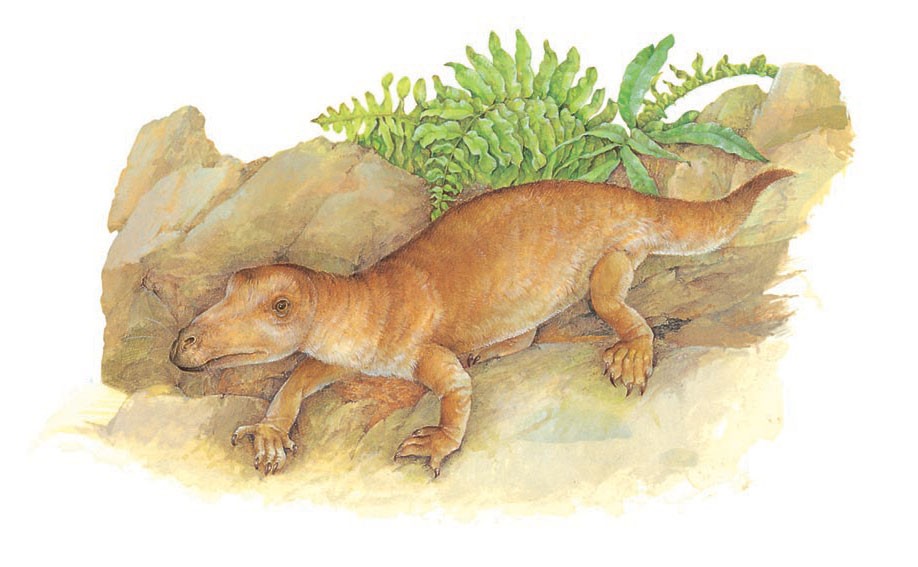
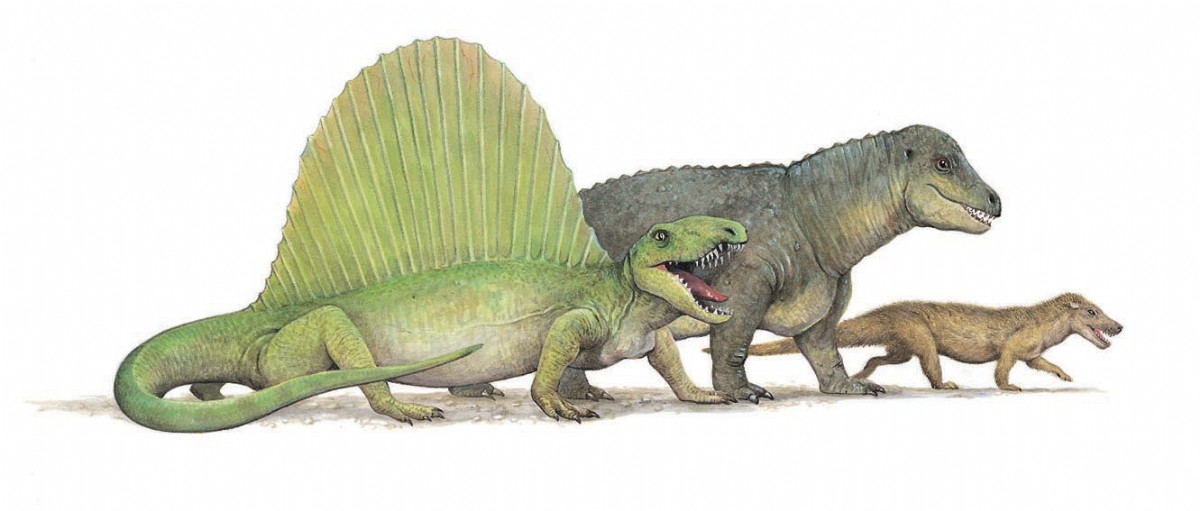
Thrinaxodon was a cynodont. A dog-sized carnivore with a very un-lizard-like, upright posture, it lived in southern Africa about 250 million years ago. Its ability to eat and digest its food quickly—using its efficient teeth—provided it with internal heat, meaning it was probably a warm-blooded animal. It is most likely Thrinaxodon had a fur coat as this would have helped prevent its internal heat from escaping and so keep its body at a stable temperature. In its skull there was a hard palate separating its mouth from the nasal passage, meaning it could eat and breathe at the same time.
Morganucodon
The first true mammals made their appearance about 210 million years ago. These tiny, shrew-like animals found a world already dominated by the dinosaurs. It was to remain so for the next 165 million years. To survive, the mammals ventured out only at night.
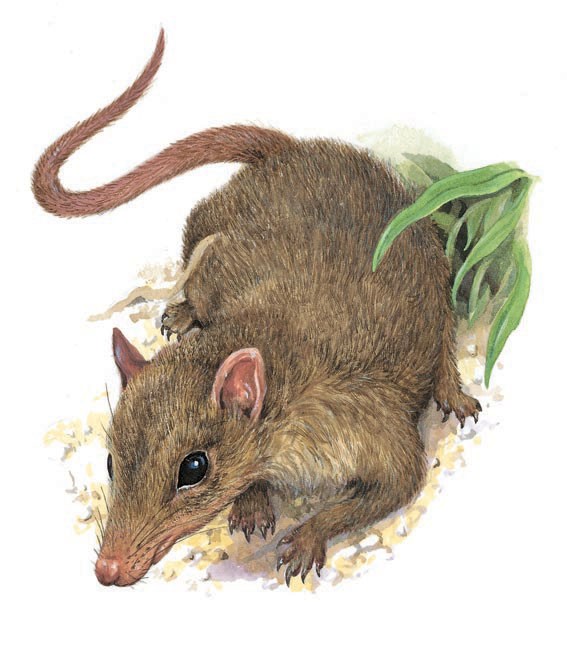
Morganucodon was one of the first known mammals. No more than 10 centimetres (4 inches) long, excluding its tail, it darted about in the undergrowth at night while the dinosaurs slept. It had whiskers and large eyes to help it see in the dark. It was covered with fur. Like most modern mammals, its young had milk teeth, so we know that Morganucodon probably suckled its young.
The extinction of the dinosaurs 66 million years ago meant that there was suddenly an absence of any large animals on land. This gave the mammals the opportunity they needed to spread rapidly and evolve into many different species.
Differences between mammals and reptiles
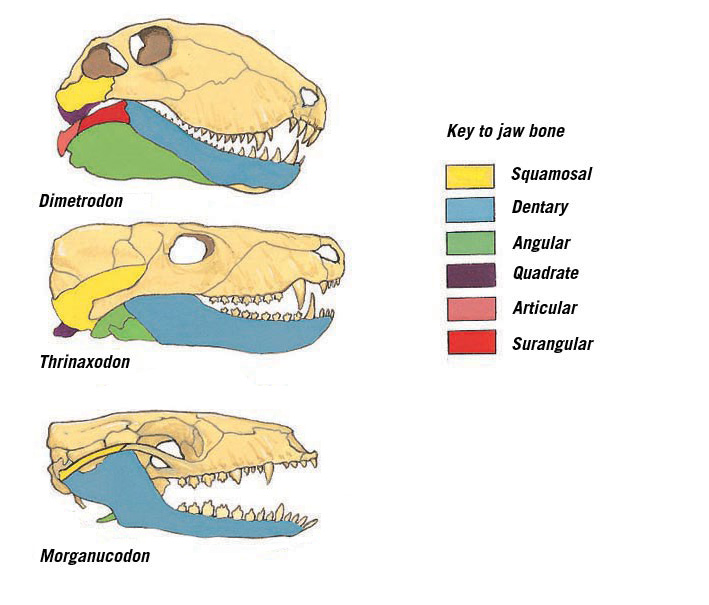
Besides suckling their young, mammals differ from reptiles in the way their jaws work. A reptile’s lower jaw (as in, for example, Dimetrodon) is made up of six separate bones. As mammal-like reptiles, and then mammals, evolved, a number of these bones seemed to “disappear.” A mammal’s lower jaw has only two bones, the dentary and angular bones. What happened to the others? Those “lost” bones are actually to be found in the mammal’s middle ear. The tiny bones that allow humans to hear so well once formed part of a reptile’s jaw.
Marsupials v. placentals
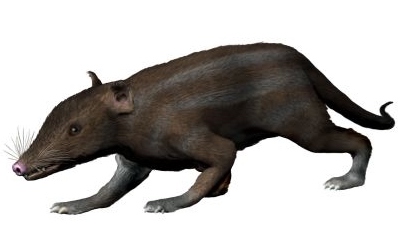
Marsupials and placentals (mammals that give birth to young that develop fully in the womb), the two main modern mammal groups, both evolved in the late Jurassic Period. Juramaia, a shrew-like creature 7–10 centimetres (3–4 inches) long that lived in China around 160 million years ago, was one of the earliest placental mammals.
At first, marsupials and placentals existed in almost equal numbers. But wherever the two types of mammal competed for food, marsupials tended to lose out to the stronger placentals and so went extinct.
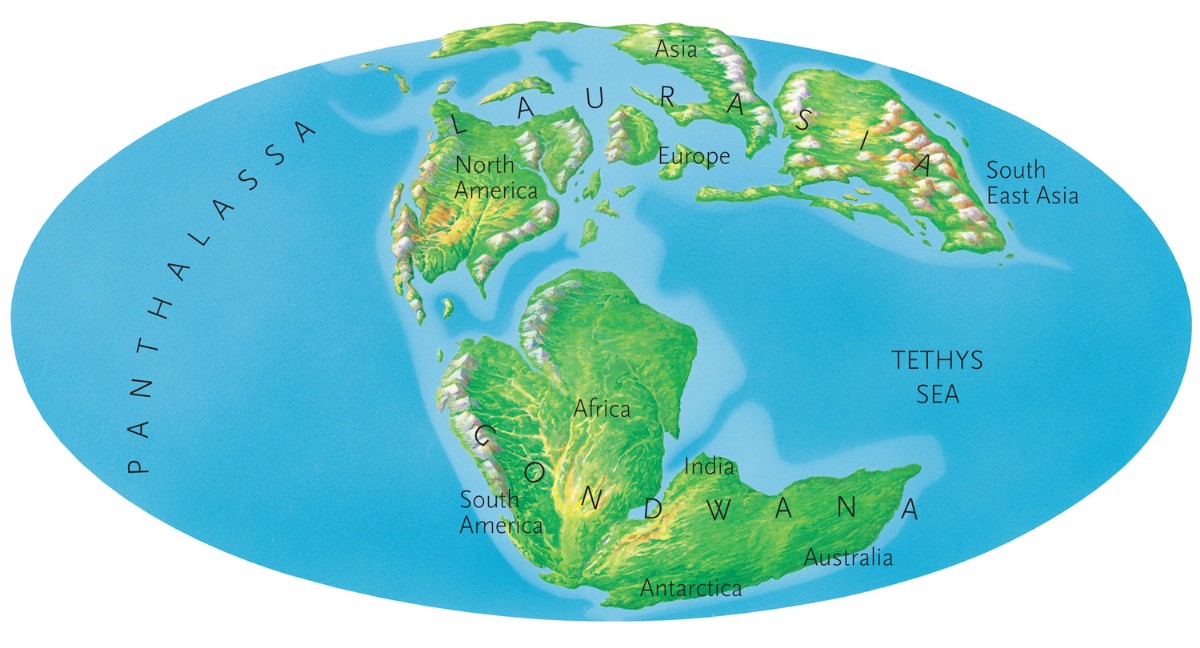
Marsupials did, however, manage to survive in South America (as they do today), and some crossed to Australia via Antarctica, while all three continents were still linked together in the supercontinent of Gondwana. Few, if any, placentals made the journey with them—or if they did, they died out. When Australia became separated from the rest of the world (beginning around 80 million years ago), a consequence of continental drift, many kinds of marsupial evolved there. Without competition from the placentals, they were able to thrive.
Consultant: Chris Jarvis
pics
Without in any way limiting Q-files Ltd’s exclusive rights under copyright, any use of this publication to “train” generative artificial intelligence (AI) technologies to generate text is expressly prohibited. Q-files Ltd reserves all rights to license use of this work for generative AI training and development of machine learning language models.