
EASY READ British history

CITE
We have made every effort to follow citation style rules, but there may be some minor differences. If in doubt, please refer to the appropriate citation style manual.
EASY READ What caused the Great Fire of London?. (2025). In Q-files Encyclopedia, History, EASY READ British history. Retrieved from
https://www.q-files.com/history/easy-read-british-history/easy-read-what-caused-the-great-fire-of-london
"EASY READ What caused the Great Fire of London?." History, EASY READ British history, Q-files Encyclopedia, 4 Dec. 2025.
https://www.q-files.com/history/easy-read-british-history/easy-read-what-caused-the-great-fire-of-london.
Accessed 28 Oct. 2026.
EASY READ What caused the Great Fire of London? 2025. History, EASY READ British history. Retrieved 28 October 2026, from
https://www.q-files.com/history/easy-read-british-history/easy-read-what-caused-the-great-fire-of-london
History, EASY READ British history, s.v. "EASY READ What caused the Great Fire of London?," accessed October 28, 2026.
https://www.q-files.com/history/easy-read-british-history/easy-read-what-caused-the-great-fire-of-london


What caused the Great Fire of London?
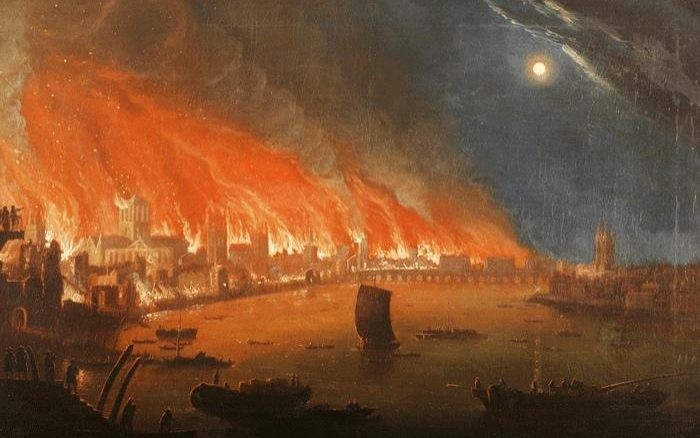
On 2nd September 1666, a fire broke out in a bakery in Pudding Lane in the City of London. Fanned by a breeze, the fire quickly spread throughout the whole city. Apart from pulling down buildings to create "firebreaks", there was no way of stopping it. The fire raged for four days until it finally burned itself out. More than 13,000 buildings, including St Paul’s Cathedral, were destroyed. Around 70,000 of the City of London’s 80,000 citizens had lost their homes in the blaze.

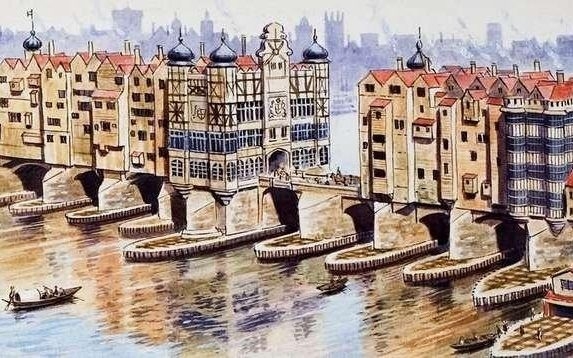
London in the 1600s
In the 1600s London was by far the largest city in Britain. The City, in the very heart of London, was an overcrowded warren of narrow alleys. Many of the houses were built with wood and had thatched roofing. They leant out over the narrow streets, almost touching the houses opposite.
With so many open fireplaces, candles and ovens, fires were common, There was no fire service, but a number of watchmen patrolled the streets at night. They sounded the alarm if a fire broke out.
Firefighting
In 1666 there were only two real ways to fight a fire. One was using fire squirts. These worked like large syringes. But they were slow to operate and contained only a few litres of water. The other way was to pull down the buildings ahead of the fire, by using special "fire hooks". This created a gap between the buildings, called a firebreak. It stopped the flames leaping from one house to another.

The fire breaks out
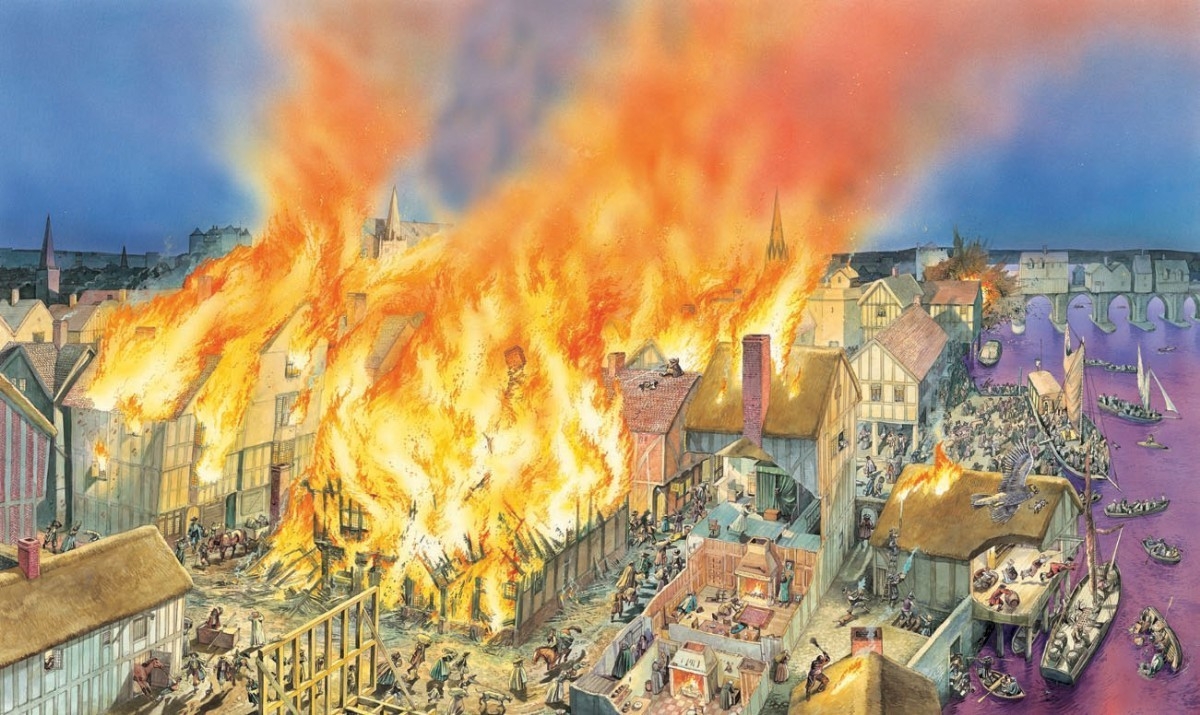
At about 2 a.m. on Sunday 2nd September 1666 a workman at the house of Thomas Farriner (also spelled Farynor), the king's baker in Pudding Lane, smelled smoke. He woke the rest of the household. Someone had failed to put out the ovens at night. Sparks set the wooden building alight. The family fled across the nearby roofs. With only narrow streets dividing the wooden buildings, the fire quickly took hold. The Lord Mayor, Sir Thomas Bloodworth, was woken with the news. But he decided that the fire was not a cause for concern, so did nothing.
By dawn, however, nearby London Bridge was alight. Fanned by a strong east wind, the fire was spreading fast.
The flames spread
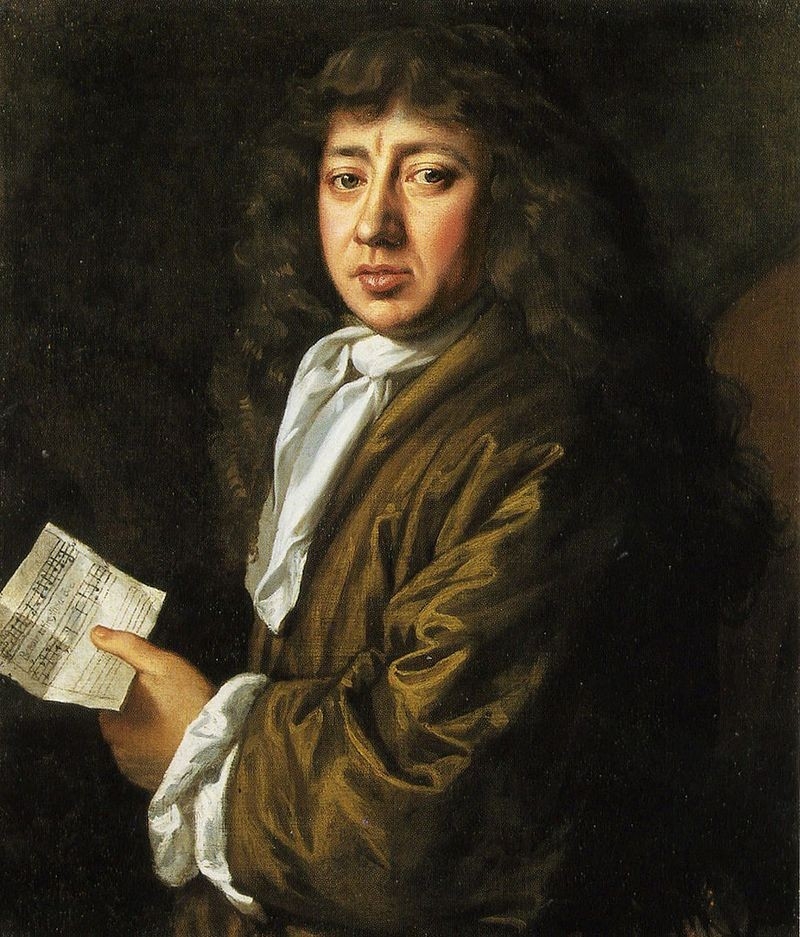
Very early on Sunday morning, Samuel Pepys (pronounced "Peeps"), Chief Secretary to the Admiralty, who lived only a few streets away, was woken by his maid. He went to the window to see for himself. The fire did not worry him especially, and he went back to bed. But his maid woke him again at 7.00 a.m. to tell him things had got much worse.
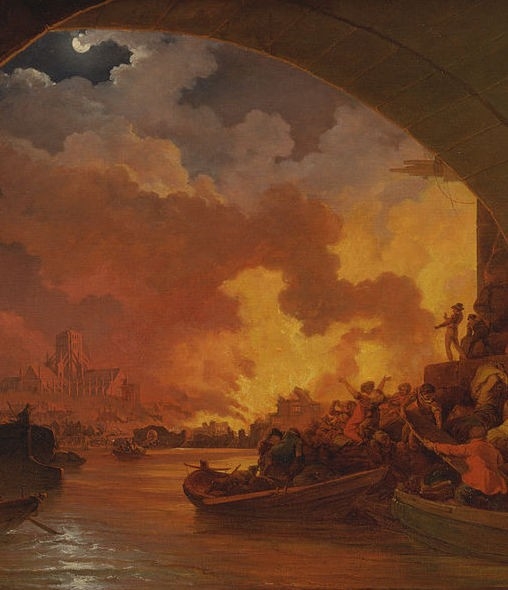
Pepys went to the Tower of London and took a boat out on to the River Thames to observe the fire. To his horror, he watched London's houses, churches and buildings being destroyed by flames. People scrambled to save their possessions, loading them into boats on the river.

The king takes charge
Pepys hurried to Whitehall to tell King Charles II about the fire. The king immediately commanded the Lord Mayor to order the destruction of as many houses as was needed to create firebreaks. Bloodworth had been reluctant to pull down houses of rich merchants without the owners’ consent. While the mayor dithered, the strong wind had enabled the fire to jump from house to house.
St Paul's is destroyed

Next morning, Monday, the fire was raging across different parts of London. Londoners were in a state of panic. By the evening, the streets were jammed with the carts of fleeing Londoners.
The following day, Tuesday, the demolition of buildings—sometimes whole streets—was now in full swing. This slowed the fire in the east, narrowly avoiding the Tower of London and its stocks of gunpowder. But in the west the fire had reached St Paul's Cathedral. Its timber roof beams caught fire. The lead roof melted. Within hours, the great cathedral was in ruins.
On Wednesday morning, the wind slackened and turned south towards the Thames. By Thursday, the fire had all but died down.
After the fire
After the fire, much of the City was destroyed. Tens of thousands of people were made homeless. But there were some good things that came out of the fire, too. It had wiped out the open sewers and slums that had made the City of London so unpleasant and disease-ridden. Now there was the opportunity to rebuild the City with safer, stronger buildings made of brick. The architect Sir Christopher Wren (1632–1723) oversaw a huge rebuilding project to restore London, including the reconstruction of St Paul's Cathedral.

Ready to find out more?
Here are some pages in other parts of Q-files you might like to explore:
Great Fire of London
Fire engines and firefighters
Stuarts
Consultant: Philip Parker
pics

Without in any way limiting Q-files Ltd’s exclusive rights under copyright, any use of this publication to “train” generative artificial intelligence (AI) technologies to generate text is expressly prohibited. Q-files Ltd reserves all rights to license use of this work for generative AI training and development of machine learning language models.