
Earthquakes
Seismology
Seismology is the study of earthquakes and how their shock waves travel through the Earth. Seismic waves produced by deliberate explosions are one of the main methods of underground exploration, used by seismologists to look for oil wells and geological faults. They can even help with finding long-buried meteorite craters. For example, the Chicxulub Crater, which was formed by an meteorite impact that probably caused the extinction of the dinosaurs 66 million years ago, was located using maps made by seismologists to find oil.


Probing the Earth
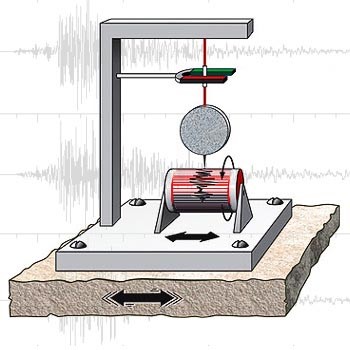
Shock waves from earthquakes provide a picture of the interior layers of the Earth. When there is a quake, two different kinds, P-waves (primary waves) and S-waves (secondary waves), travel all over the globe from the focus of the quake. Seismographs and seismometers are devices for measuring them.
Both kinds of waves travel through the Earth, but at different speeds according to the layers they travel through. P-waves travel through both the mantle and the core. Seismometers receive them on the far side of the globe about 20 minutes after the quake. S-waves are slower and cannot travel through the liquid outer core.
By noting times the waves take to travel from quakes to various seismometers around the world, seismologists have been able to work out the exact depth of the boundaries between the crust and the mantle and the mantle and core. They can also tell whether the rocks deep inside the Earth are solid or liquid.
Measuring earthquakes
In the past, seismographs were often used to measure the strength of shock waves caused by an earthquake. Vibrations were recorded by a pen on a paper trace rolled over a drum. Today, seismometers are more often used: they use electronics to record the shaking and its intensity. Earthquakes are measured either by their effects, or by how much energy they produce.

Mercalli Scale
The Mercalli Scale, written in Roman numerals, measures effects on a scale of one to twelve, where “one” is barely noticeable and “twelve” is total devastation. The Magnitude Scale (which has replaced the Richter Scale) is a measure of energy. A “moderate” earthquake—that is, one just strong enough to damage buildings—would measure about 5.5 on the Magnitude Scale.
I-II Felt only by a few
III-IV Vibration as if by passing lorry
V Buildings tremble, vases fall, trees shake
VI Bells ring, plaster cracks, people shaken
VII Loose tiles, old walls fall, chimneys crack
VIII Damage to buildings
IX Ground cracks, buildings collapse
X Landslides, bridges damaged, rails bent
XI Dams wrecked
XII Total devastation.
Predicting quakes
Although it is easy to see where earthquakes are likely to occur, it is much more difficult to predict when they might happen. The Chinese invented an earthquake detector in AD 132. When shaken, a rod inside it swings and opens one of the dragons’ mouths, releasing a ball into a toad’s mouth with a loud clang. It records the direction of the quake. Such vibration detectors can sense the slightest earth tremor, which might indicate that a larger shock is on the way. But more often than not, earthquakes give little warning of their arrival.

Consultant: Ian Fairchild