
Volcanoes

CITE
We have made every effort to follow citation style rules, but there may be some minor differences. If in doubt, please refer to the appropriate citation style manual.
Great volcanic eruptions. (2026). In Q-files Encyclopedia, Earth, Volcanoes. Retrieved from
https://www.q-files.com/earth/volcanoes/great-volcanic-eruptions
"Great volcanic eruptions." Earth, Volcanoes, Q-files Encyclopedia, 6 Mar. 2026.
https://www.q-files.com/earth/volcanoes/great-volcanic-eruptions.
Accessed 1 Nov. 2026.
Great volcanic eruptions 2026. Earth, Volcanoes. Retrieved 1 November 2026, from
https://www.q-files.com/earth/volcanoes/great-volcanic-eruptions
Earth, Volcanoes, s.v. "Great volcanic eruptions," accessed November 1, 2026.
https://www.q-files.com/earth/volcanoes/great-volcanic-eruptions


Great volcanic eruptions
Volcanic eruptions, the most powerful explosions on Earth, are incredibly destructive. During the eruption of Krakatoa (today called Krakatau), a volcano situated between the islands of Sumatra and Java in Indonesia, in 1883, about 20 cubic kilometres (5 cubic miles) of rock—nearly the entire exploded mountain—was blasted high into the sky. The noise of the explosion, the greatest in modern times, was heard 5000 kilometres (3000 miles) away in India, China and Australia. Probably three times as much debris was ejected during the eruption of Santorini around 1450 BC.

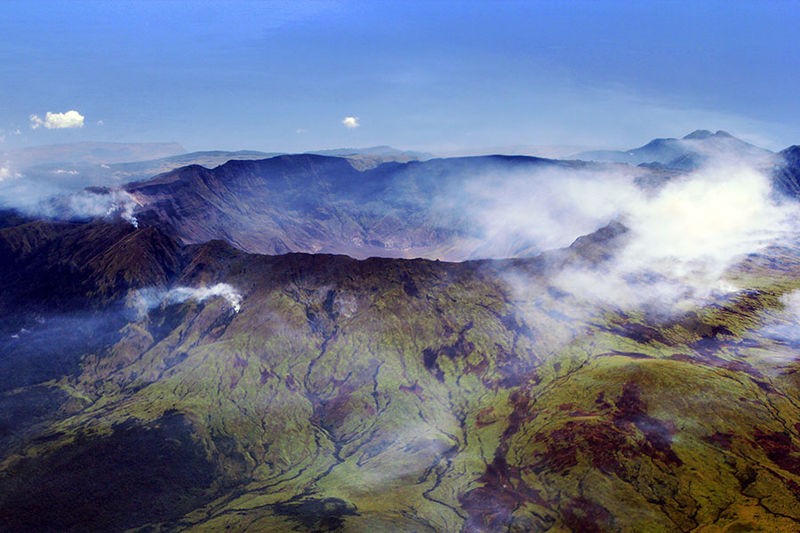
Tambora
Greater still was the eruption of Tambora, on the island of Sumbawa in Indonesia in 1815, when about 160 cubic kilometres (40 cubic miles) was blasted away. Pulverized rock was hurled at least 50 kilometres (30 miles) high into the Earth’s atmosphere. About 92,000 people perished locally. Dust blankets drifted around the globe, shutting off the Sun’s rays and causing temperatures to drop worldwide. The year after the Tambora eruption, 1816, was known as "Eighteen hundred and froze to death" and "the year without a summer".
Thera
Santorini was once a single Mediterranean island dominated by a dormant volcano around 1600 metres (more than 5000 feet) high. The land was very fertile and there was a city with a port. It was the time of the Minoan civilization, centred on nearby Crete, and the island’s inhabitants lived in peace. All this was to change around 1600 BC.
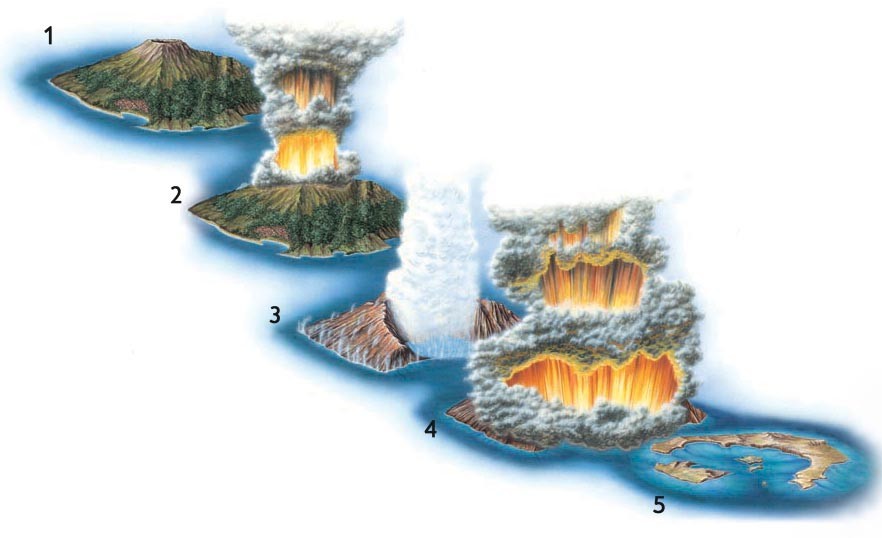
After years of dormancy (1) suddenly, Santorini’s volcano, Thera, blew its top. Violent gas explosions shot vast quantities of lava, ash and dust high into the sky at the speed of sound (2). The whole of the mountaintop was destroyed in what was probably one of the greatest explosions ever experienced by human beings.
The eruption went on for several days. Soon, the ever-widening crater collapsed below sea level. Water flooded in, triggering even more gigantic explosions as it washed over the red-hot lava (3). Eventually, nearly the whole island of Santorini was blasted into the sky (4).
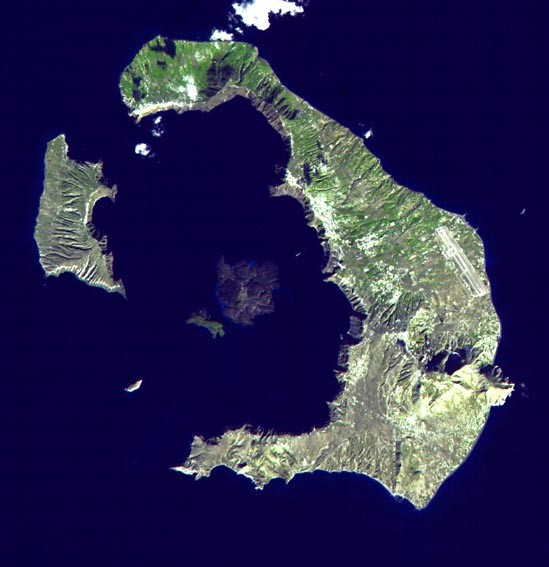
All that remains of Santorini (called Thira) today is a ring of five small islands (5). One day the volcanic islands in the centre of the bay may build up into a new, large volcano.
Mount St Helens
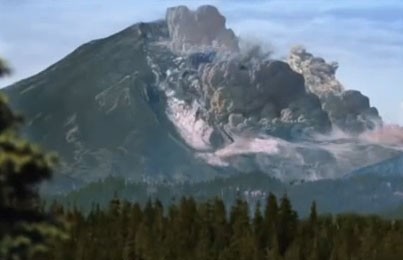
The eruption of Mount St Helens in Washington state, USA, on 18th May 1980 was the deadliest and most destructive in US history. Fifty-seven people were killed. By the end of April, the north side of the mountain had started to bulge, until on the morning of 18th May an earthquake triggered a massive collapse of the entire north face of the mountain.
It was the largest known landslide in recorded history. Magma inside the volcano burst out and mixed with ice, snow and water to create lahars—volcanic mudflows. This pyroclastic flow flattened vegetation and buildings over 600 square kilometres (230 square miles). The eruption continued for nine hours, with the plume of ash reaching 27 kilometres (16 miles) into the sky. It drifted eastwards at about 100 km/h (60 mph), reaching Edmonton, Canada by the following morning. Soon after the eruption, a new lava dome emerged inside the caldera, the collapsed crater.
Famous volcanic eruptions
Santorini, Greece c. 1600 BC
Vesuvius, Italy AD 79
Taupo, New Zealand c. AD 150
Tambora, Sumbawa 1815
Krakatoa, Java 1883
Mont Pelée, Martinique 1902
Katmai, Alaska 1912
- Mount St Helens, USA 1980
Nevado del Ruiz, Colombia 1985
Mount Pinatubo, Philippines 1991
Eyjafjallajökull, Iceland 2010
- Hunga Tonga–Hunga Haʻapai, Tonga 2022
pics
Without in any way limiting Q-files Ltd’s exclusive rights under copyright, any use of this publication to “train” generative artificial intelligence (AI) technologies to generate text is expressly prohibited. Q-files Ltd reserves all rights to license use of this work for generative AI training and development of machine learning language models.