
Ancient Greece
Seven Wonders of the World
By the fourth century BC, the Greek World had expanded due to Alexander the Great’s conquests. Greek scholars took the opportunity to explore the new world. As they travelled around the Mediterranean through Egyptian, Babylonian and Persian lands, they wrote about the incredible sights they had come across. From these accounts, a list of seven emerged as the top “must-see” sights of the Ancient World, known as the Seven Wonders. Some places were included because of their beauty; others for the skill shown in their construction—or simply for their sheer size.

Great Pyramid of Giza

Soon after the Egyptian Pharaoh Khufu ascended to the throne in 2551 BC, work began on the pyramid that would house his burial chamber. At 147 metres (482 feet) tall, it became known as the Great Pyramid. A long passageway inside leads to the King’s Chamber and the pharaoh’s sarcophagus. Alongside pyramids built for Khufu’s son and grandson, the Great Pyramid stood on a desert plateau overlooking the Nile Valley below. It is the only Wonder of the Ancient World that has survived intact to the present day.

Hanging Gardens
of Babylon
According to legend, the Hanging Gardens were created by the King of Babylon, Nebuchadnezzar (ruled 604–562 BC). He wanted to remind his wife, Amytis, of her homeland, the green hills of Media (in modern-day Iran). The lush gardens are thought to have been built on arched terraces. Water was pumped up from the river and ran down through the gardens as cooling streams.
In fact, no archaeological evidence has ever been found that confirms the existence of the Hanging Gardens in Babylon, although it is known that similar gardens were definitely built in the Assyrian city of Nineveh in the early 7th century BC.
Colossus of Rhodes
The Colossus of Rhodes was a huge bronze statue of Helios, the Greek god of the Sun. It was built on the island of Rhodes between 294 and 282 BC to celebrate its victory over Syria at the Siege of Rhodes (Helios was the patron god of the island). Illustrations of the Colossus often show it with the statue's legs on either side of the harbour entrance. In reality, a bronze statue of this size could never have been built like that: it would have collapsed under its own weight. The statue probably stood on a pedestal somewhere near the harbour entrance.
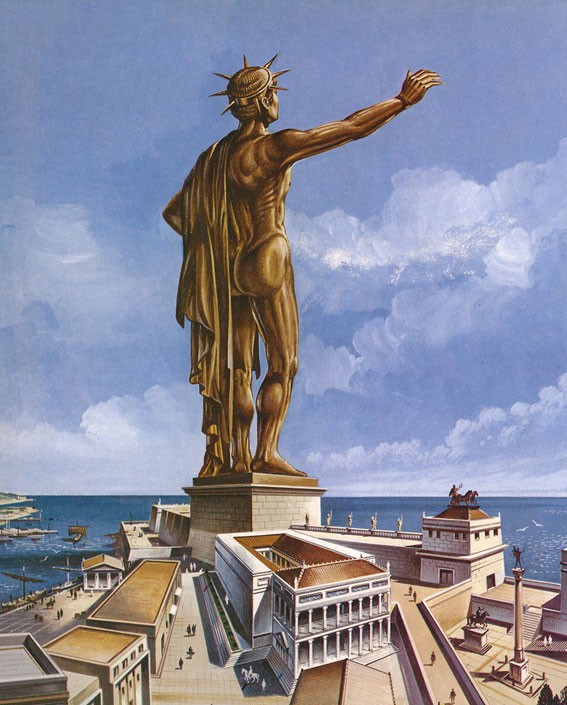
The statue stood over 30 metres (98 feet) high until it was destroyed by an earthquake in 226 BC. Even after its collapse, its ruins were so impressive that tourists travelled to see them for 800 years afterwards.

Statue of Zeus
at Olympia
The Statue of Zeus at Olympia, Greece, was a colossal figure of the Greek king of the gods, Zeus, seated on his throne. Built in about 435 BC by the Greek sculptor Phidias, who claimed to be the only person who knew what the gods looked like, the statue measured 13 metres (43 feet) tall, filling the temple built to house it. The throne was decorated with gold and precious stones.
It is thought that the statue was either stolen and destroyed by fire, or that it was burned down along with the rest of the temple in AD 462.
Temple of Artemis

The Temple of Artemis was built in about 550 BC at Ephesus, Turkey, to honour the Greek goddess Artemis. It was over 100 metres (328 feet) long and nearly 55 metres (180 feet) wide. Its marble columns stood 13 metres (40 feet) tall. Visitors left gold and jewellery as gifts for the goddess. The temple was burned down in 356 BC by a reckless criminal, Herostratus, but it was rebuilt and made even bigger and grander. The new temple survived for just under 90 years, however, before it was once again destroyed by a raiding party of Goths.
Lighthouse of Alexandria
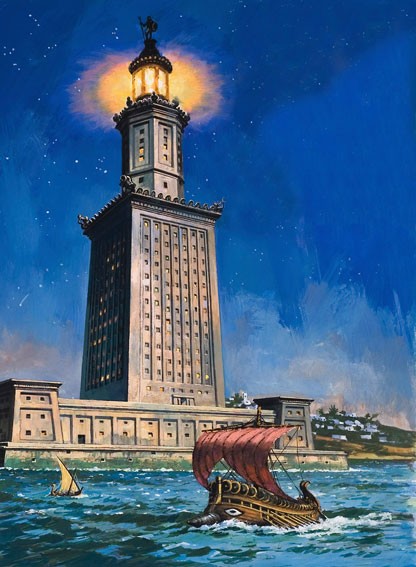
Standing between 120 and 137 metres (393–450 feet) tall, at the time of its construction the Lighthouse (or Pharos) of Alexandria was one of the tallest structures on Earth. At the orders of Pharaoh Ptolemy I, the lighthouse was built just off the coast of Alexandria in northern Egypt between 297 and 283 BC.
During the day, the lighthouse used a mirror at the top of the tower to relect a beam of light from the sun. At night, a fire was lit at the top. By the early 1300s, the lighthouse had been completely destroyed by a series of earthquakes. The Lighthouse of Alexandria is considered to be the model for the modern lighthouses of today.

Mausoleum at Halicarnassus
The Mausoleum was a tomb built at Halicarnassus, in southwestern Turkey, for Mausolus, a general in the Persian Empire in around 350 BC. Its construction was overseen by his wife, Artemisia. The Mausoleum was covered with beautiful sculptures of people and animals. On top stood was a sculpture of a chariot pulled by four horses. The beauty of the tomb drew visitors for centuries, before it was destroyed by earthquakes in the 13th century.

Consultant: Philip Parker