
Ancient Greece

CITE
We have made every effort to follow citation style rules, but there may be some minor differences. If in doubt, please refer to the appropriate citation style manual.
Life in ancient Athens. (2026). In Q-files Encyclopedia, History, Ancient Greece. Retrieved from
https://www.q-files.com/history/ancient-greece/life-in-ancient-athens
"Life in ancient Athens." History, Ancient Greece, Q-files Encyclopedia, 15 May. 2026.
https://www.q-files.com/history/ancient-greece/life-in-ancient-athens.
Accessed 6 Aug. 2026.
Life in ancient Athens 2026. History, Ancient Greece. Retrieved 6 August 2026, from
https://www.q-files.com/history/ancient-greece/life-in-ancient-athens
History, Ancient Greece, s.v. "Life in ancient Athens," accessed August 6, 2026.
https://www.q-files.com/history/ancient-greece/life-in-ancient-athens


Life in ancient Athens
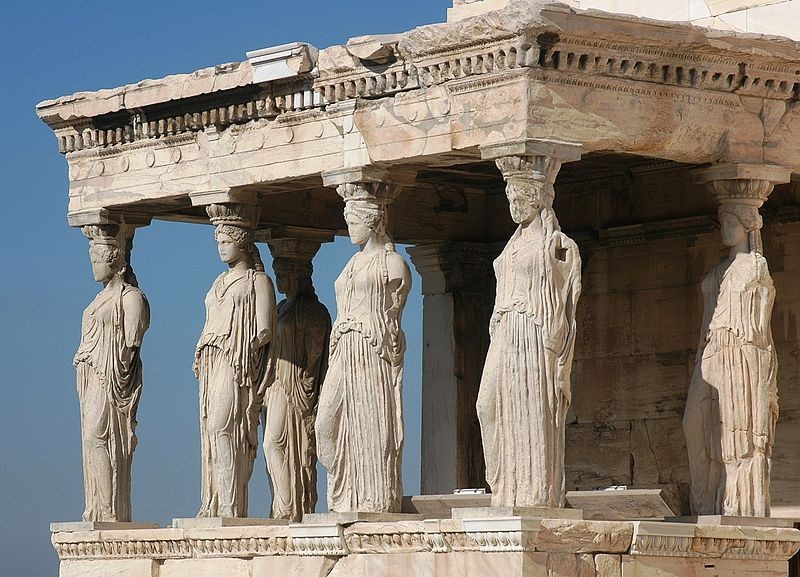
During the 5th and 4th centuries BC, Greek thinkers and artists made huge progress in the arts, philosophy and science. Historians call this the Classical Age of ancient Greece. The city-state of Athens was at its most powerful during this period. The city had been destroyed by the Persians in 480 BC, but it was rebuilt in great splendour. One of the most magnificent projects was the group of buildings on the Acropolis, the rocky outcrop that still dominates Athens today. At the heart of the Acropolis was the Parthenon, a temple dedicated to the city’s goddess, Athena.
Politics and democracy
In ancient Greece, people spoke out against being ruled by rich citizens and having no say in how they were governed. A new system of government, called demokratia, which means “government by the people”, was introduced in Athens in around 508 BC. Our English word “democracy” comes from demokratia.

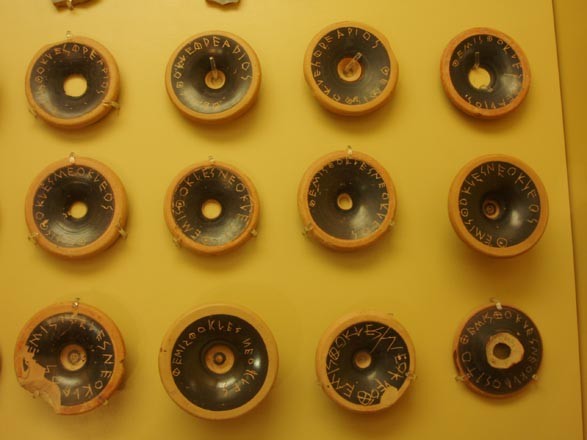
In Greek democracies, all citizens could vote for their leaders and have a say in how the city-state was run, much as people have a say in democracies today. Women and slaves were not considered citizens, so they could not vote. If people were dissatisfied with a member of their government, they could vote for him to be removed from office. Athenian citizens made their feelings known by writing his name on pieces of broken pottery, called ostraka. If a person was ostracized (removed from office—the English word comes from ostraka), he would be exiled for 10 years.
Agora
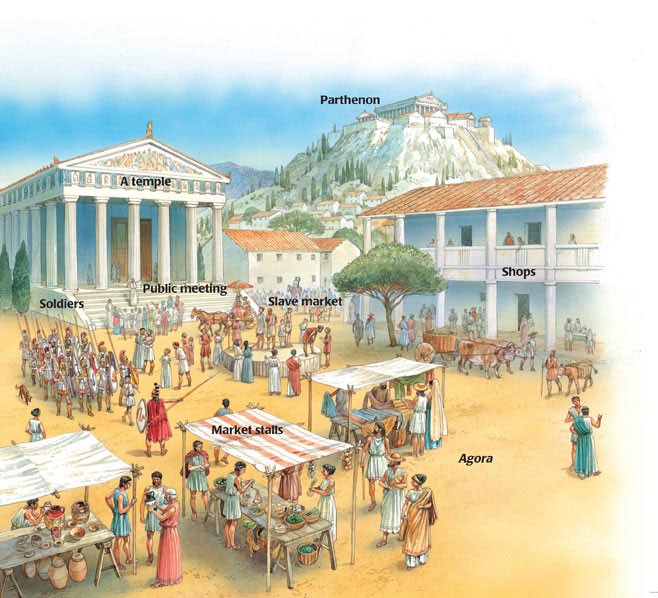
The Greeks prized freedom of speech. In the centre of Athens, and most other Greek cities, was an open space, called an agora. Its chief use was as a marketplace, where goods and slaves were bought and sold, but it was also where meetings were held and political speeches were made. The agora was surrounded by temples and law courts.
Assembly
All Athenian citizens were members of the city’s assembly, which met once a week. Any citizen could speak at these meetings. The assembly was run by a council of 500 people, who were chosen by drawing lots.
Arts
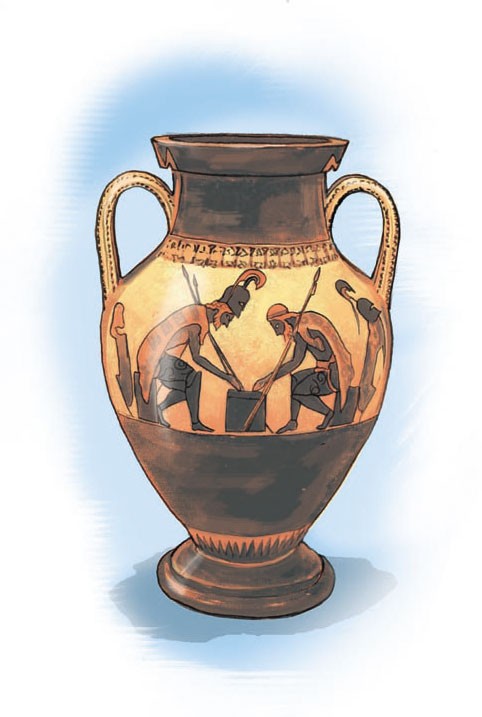
Much of what we know about the ancient Athenians comes from the arts and literature of the time. Pottery was often decorated with tales of gods, goddesses and heroes, but there were also many scenes of everyday life, showing musicians, sportsmen and warriors. Sculptors created beautiful statues, philosophers wrote down their thoughts and ideas, and dramatists created plays based on real-life events.
Gods and goddesses
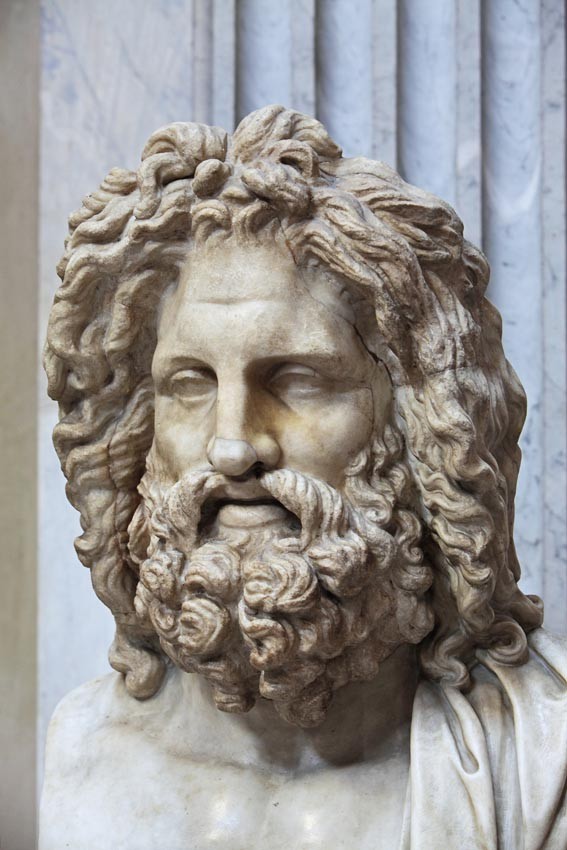
The ancient Greeks worshipped dozens of gods and goddesses. The 12 most important gods were said to live on Mount Olympus, the highest mountain in Greece. Zeus was the king of the Olympian gods, and also god of the sky, thunder and lightning. Hera was queen of the gods and goddess of women and childbirth. Other gods included Poseidon, who ruled the oceans, and Athena, who was goddess of science and wisdom, crafts and war. The ancient Greeks worshipped the gods by praying to them and offering them gifts, which ranged from cakes to sacrifices of animals. The most important gods and goddesses had great temples built in their honour.
Theatre
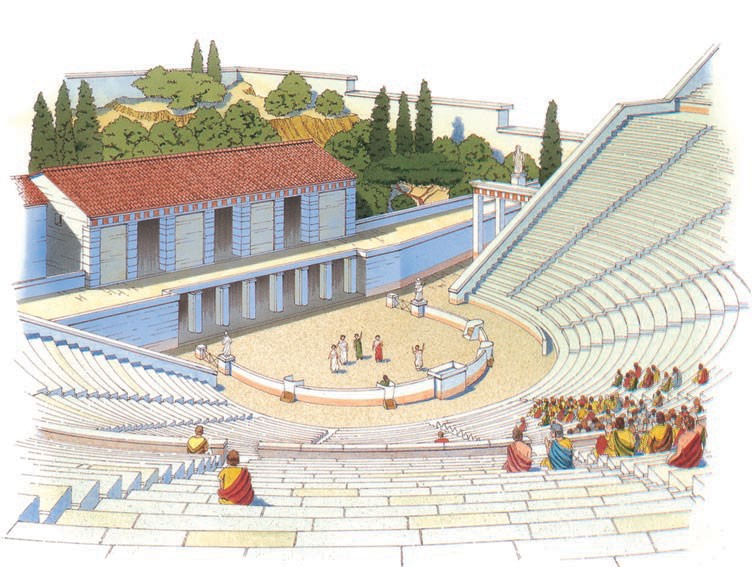
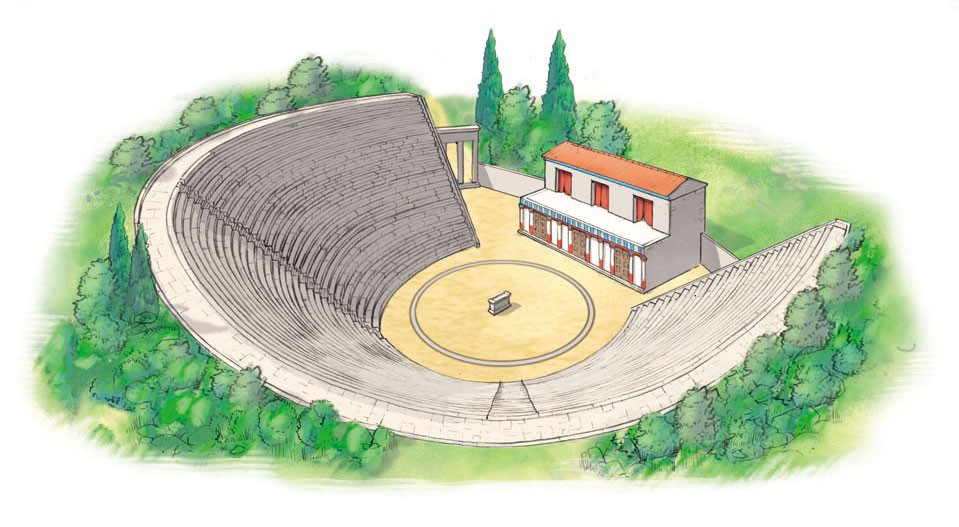
Drama was popular entertainment, and every large city had a theatre. The earliest form of theatre was a festival of songs and dances. Later, playwrights such as Sophocles (497/6– 406/5 BC) and Aristophanes (446–c.386 BC) began to write plays that actors could perform. There were two main types, comedies and tragedies. Many of these plays are still famous today. Plays were performed on 10 days of each year. Audiences went to the theatre for the whole day. They would usually see three tragedies or three comedies and a short play called a satire, which poked fun at a serious legend or event.
The audience sat on stone seats in a semi-circular, open-air auditorium called an amphitheatre. All the actors were men. The actors wore large comedy or tragedy masks so that even people sitting right at the back could tell who was who. Modern theatre has its roots in ancient Greece, and these masks are still the symbol of the theatre today.
Olympic Games
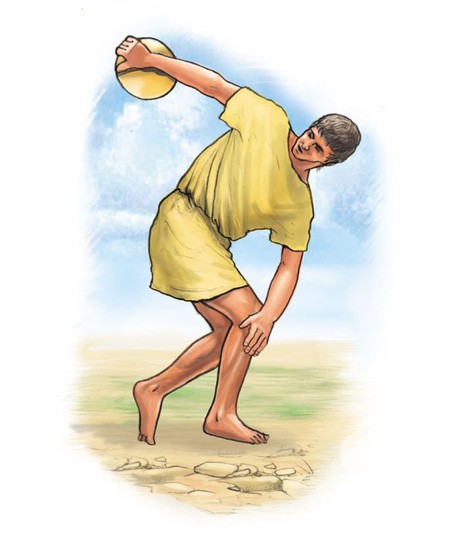
The ancient Greek Olympic Games were the forerunner of the Olympic Games held today. The original Olympics were held near Olympia, in southern Greece, every four years from 776 BC. At this time, Greece was made up of several warring city-states, who declared a truce for the duration of the Games, and sent their best athletes to compete. To begin with, the only event was a 192-metre (630-feet) race for up to 21 runners. Later Games included fight contests and chariot racing as well as early versions of modern track and field events. The Olympics were stopped in around AD 400 by the Romans.

Medicine
Modern medicine has its roots in ancient Greece. During the Classical Age, a man called Hippocrates (c.460–c.377 BC) founded a school of medicine on the Greek island of Kos. Diagnosis of illness was based on examination of patients, which was a groundbreaking idea at the time. Doctors had to take the Hippocratic Oath, which outlined their duties and responsibilities. Doctors still have to take this oath today.
Temples
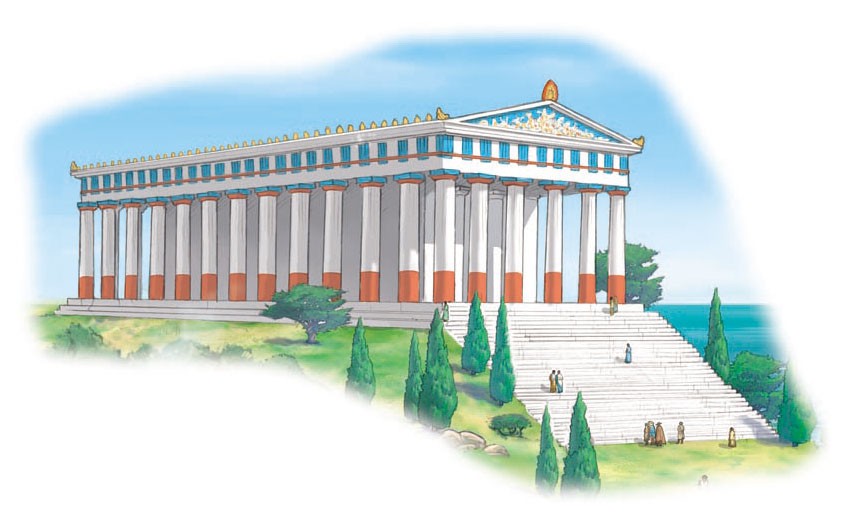
Temples were the most important buildings in Athens. The ruins of the Acropolis temples can still be seen in Athens today. The Greeks used columns like the ones supporting the Parthenon (447–438 BC) for many of their temples and public buildings. Columns were made by standing one block of stone on top of another. The top of the column was usually decorated with carvings. Inside each temple were statues of the temple’s god.

The Oracle at Delphi
The Oracle at Delphi, called the Pythia, was the name given to the High Priestess of the Temple of Apollo at Delphi. By the 8th century BC the priestesses had become famous for their prophetic powers. People came from all over Greece and beyond to have their questions about the future answered by the Pythia.
Sitting on a three-legged bronze bowl, she inhaled the gases seeping out of the ground inside the temple. Falling into a trance, she muttered Apollo’s answer in words that were not easy to understand. The oracles were always open to different interpretations. During the Persian invasion in 480 BC, for example, the Pythia predicted that a “wooden wall” would save them. This was interpreted by some to mean the wooden fence that surrounded the Athenian Acropolis. But the Athenian general Themistocles understood it to refer to their ships—made of wood—and that a naval battle would save them. The Greeks gained a decisive victory at the Battle of Salamis shortly afterwards.
A wealthy Athenian home
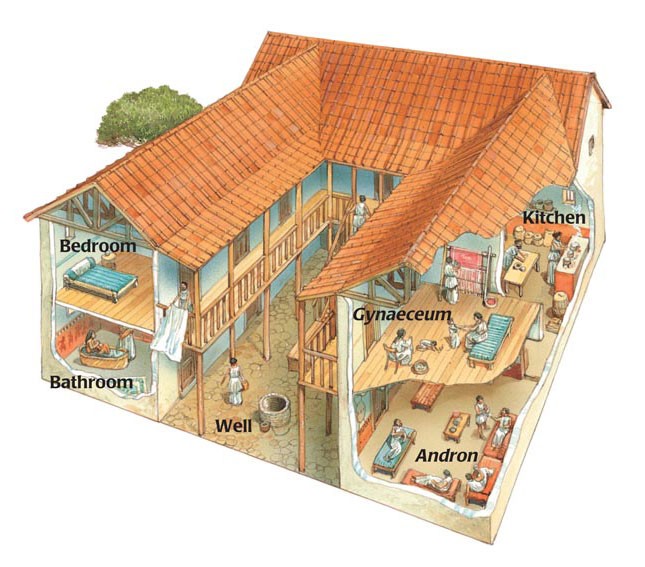
A typical home of a wealthy Athenian family was built round an open courtyard, which probably had a well for fresh water. The house was usually two storeys high with bedrooms and a room for women, called the gynaeceum, upstairs.
Men and women normally kept to different parts of the home. The kitchens, a bathroom and the men’s dining area, or andron, were downstairs. Symposia, or drinking parties, would often be held in the andron. Slaves would prepare the food, and do all the domestic work around the house.
Consultant: Philip Parker
pics
Without in any way limiting Q-files Ltd’s exclusive rights under copyright, any use of this publication to “train” generative artificial intelligence (AI) technologies to generate text is expressly prohibited. Q-files Ltd reserves all rights to license use of this work for generative AI training and development of machine learning language models.