
Art

CITE
We have made every effort to follow citation style rules, but there may be some minor differences. If in doubt, please refer to the appropriate citation style manual.
Sculpture. (2026). In Q-files Encyclopedia, Culture, Art. Retrieved from
https://www.q-files.com/culture/art/sculpture
"Sculpture." Culture, Art, Q-files Encyclopedia, 13 May. 2026.
https://www.q-files.com/culture/art/sculpture.
Accessed 6 Aug. 2026.
Sculpture 2026. Culture, Art. Retrieved 6 August 2026, from
https://www.q-files.com/culture/art/sculpture
Culture, Art, s.v. "Sculpture," accessed August 6, 2026.
https://www.q-files.com/culture/art/sculpture


Sculpture
Sculpture is a three-dimensional form of art, in contrast to the flat, two-dimensional style of painting. You can sometimes walk all around a sculpture to see it from different angles. Statues and carvings are types of sculpture. The first sculptures were for worship and ceremony, and were of animals and gods. Early Europeans made small sculpted figures, called figurines, from bone, antler, stone or ivory around 25,000 years ago. The creation of very large sculptures, perhaps to impress people with the power of a ruler, dates back to the Great Sphinx of Giza, ancient Egypt, about 4500 years ago. There are several ways of making a sculpture: carving, casting, modelling from clay, joining items together, or simply arranging them in groups in interesting ways.


Carving
When carving a statue, the artist starts with a block of solid material, such as wood or stone, and chips away pieces using a hammer or chisel to leave the required shape. It is as if the sculpture is hidden inside, and requires only the skill of the sculptor to reveal it. Very often the sculptor uses a small model, called a "maquette", of the finished work first. Marble is a commonly used type of stone, because it is easy to work and produces a beautiful, smooth surface after a final polish.
The carver begins by removing, or "pitching", large chunks of unwanted stone with a pitching tool, a chisel with a broad, flat edge, together with a mallet, a hammer with a large, barrel-shaped head.
Once the general shape is achieved, the sculptor uses other tools to refine the sculpture. A rasp, a flat tool with a rough surface, is used to remove stone as small chips or dust. Finally, emery stone, harder and rougher than the stone used in the sculpture itself, is used to polish the work, along with sandpaper or sand cloth.
Modelling and casting

Another method of sculpting is modelling, in which a soft substance such as clay is moulded into a shape, then heated in a kiln (like cooking it in an oven) to make it hard. Alternatively, when casting a sculpture the soft clay (or wax or plaster of Paris) can be sculpted to make a mould. The mould is then filled with liquid metal and allowed to set, the hardened metal taking on the exact form of the mould. Bronze, an alloy of copper and tin, is commonly used because it is easy to work.
Reliefs
Relief carvings are generally classified as either high-relief or low-relief (bas-relief). High-relief sculpture is carved deep into the background so the subjects stand out from the stone or metal. The Parthenon Marbles (from around 465–425 BC) made by sculptors in ancient Greece are some of the best examples of high-relief carving.
Bas-relief carvings are shallower, and stand out only a little way from the background. Trajan’s Column in Rome is a fine example of bas-relief carving, with war scenes spiralling up the column.
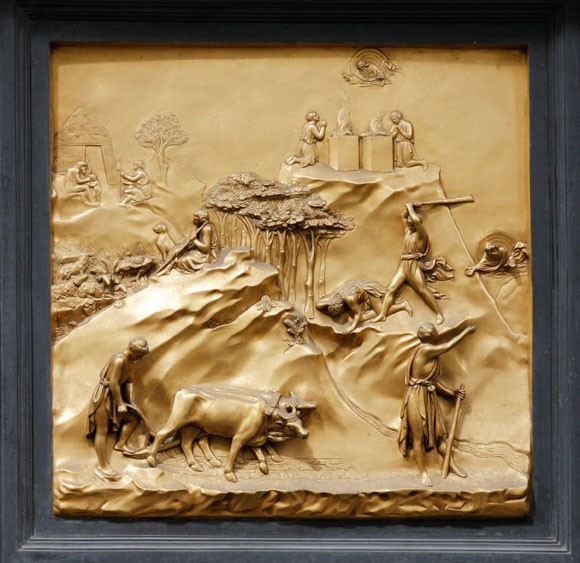
The Italian Renaissance artist Lorenzo Ghiberti (1378–1455) used a mixture of high-relief and bas-relief in his bronze panels for the doors of the Florence Baptistery, known as the Gates of Paradise, produced in 1425–1452.
Classical period
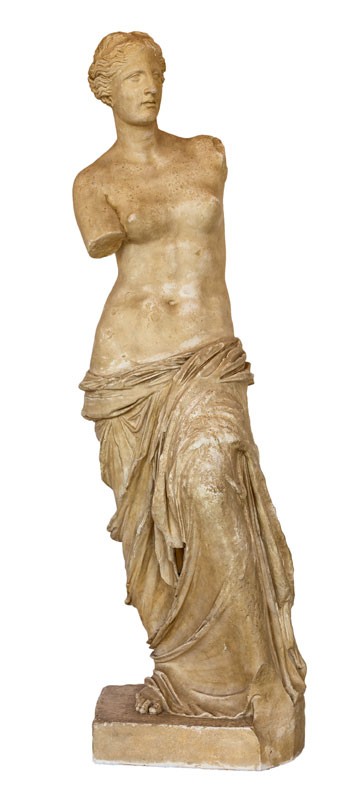
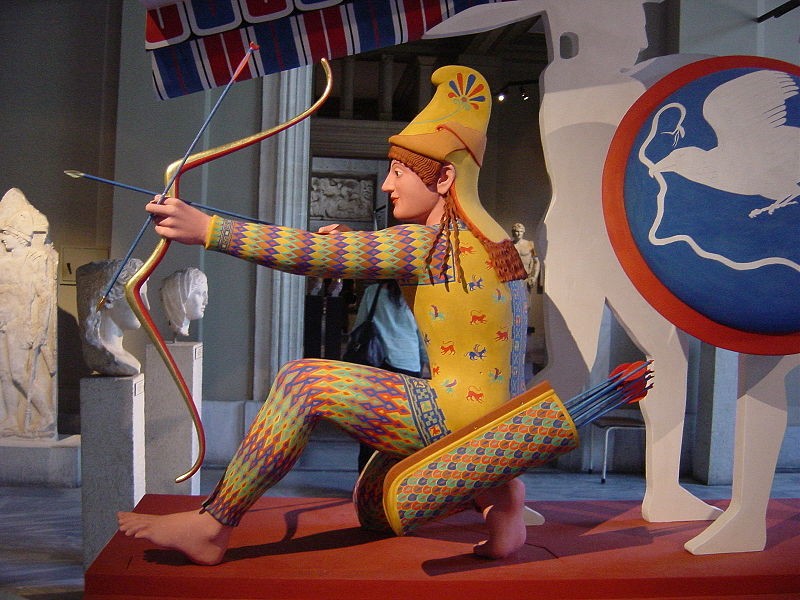
The sculptures of ancient Greece and Rome, known as the Classical period in Europe, were often representations of gods and other mythical figures, made in a lifelike style. The graceful Venus de Milo (by Alexandros of Antioch, sculpted c.150 BC) is a good example. The best sculptors were able to create flowing curves so they could show draped clothes and natural poses. Many Classical period sculptures were made of bronze or marble.
Renaissance
The Renaissance in Europe, between 1400 and 1600, was a time when the arts flourished. Many rich people commissioned sculptures for their homes and for public spaces. The sculpture of the Renaissance took its inspiration from the Classical period.
One of the first great Italian Renaissance sculptors was Donatello (c.1386–1466), who produced marble and bronze figures that were both lifelike and characterful. A statue of David was sculpted in bronze by Donatello in about 1430. It was the first free-standing nude statue produced since the days of ancient Greece and Rome. It is often described as the first major Renaissance sculpture.

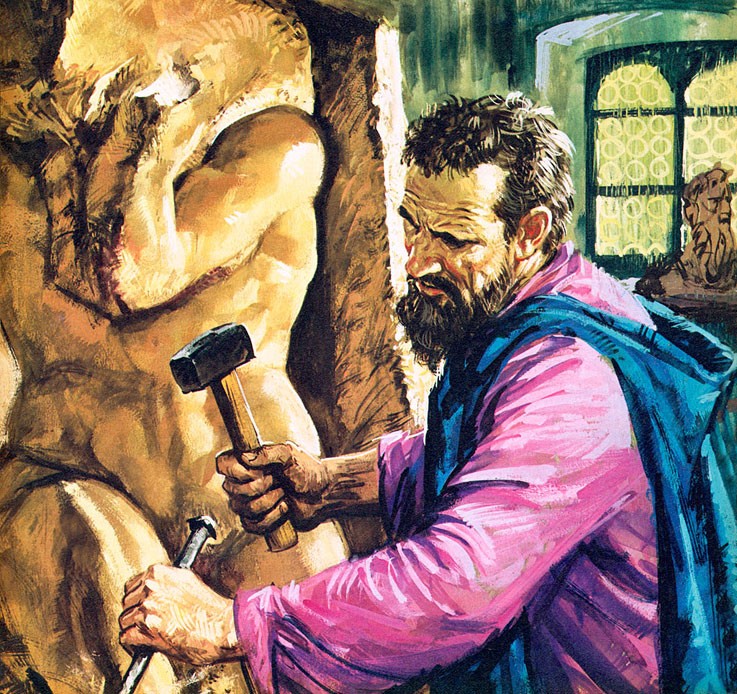
The great Renaissance artist Michelangelo (1475–1564) was a talented sculptor as well as a painter, architect and poet. He borrowed poses from Classical statues but tried to make them look even more realistic. He wanted to show how powerful the human body could be. His David (1504), the biblical figure who conquered the giant Goliath, is a good example of this.
Later periods
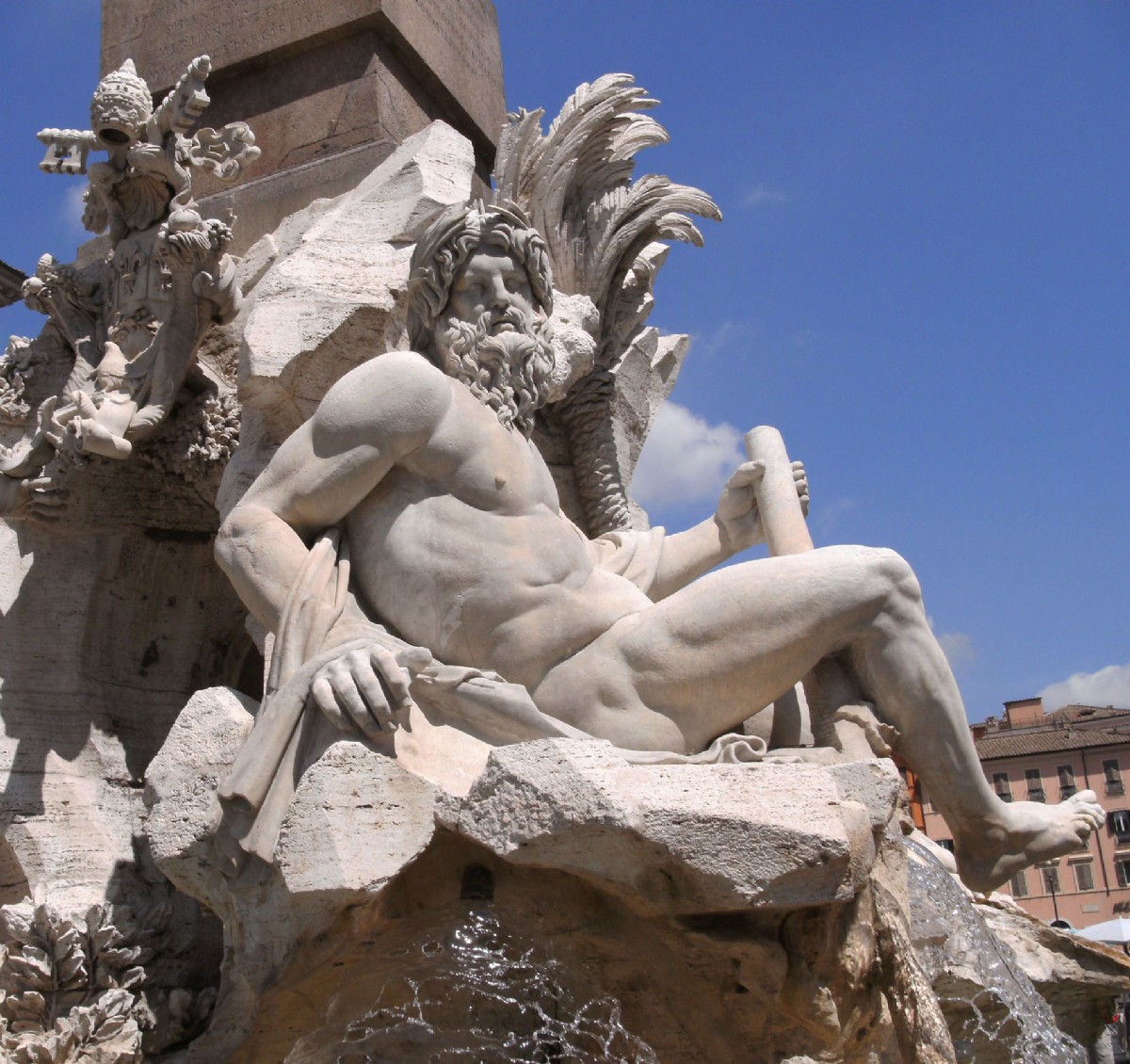
The Baroque period followed the Renaissance. Many sculptures at this time were of groups of figures, often shown as if frozen in the process of movement. They could be viewed from lots of different angles, and were often displayed in large open areas. An example is The Fountain of the Four Rivers, Rome (1651), sculpted by Gianlorenzo Bernini (1598–1680).

Later sculptors experimented with feelings, nature and ideas. One of the greatest sculptors of the 19th century and early 20th century was French artist Auguste Rodin (1840–1917). Rodin was interested in the way light and shadows worked in his sculptures. He attempted to capture fleeting moments in normal life, such as in The Kiss and The Thinker. Rodin wrote of his own work: "What makes my Thinker think is that he thinks not only with his brain with his knitted brow ... but with every muscle of his arms, back and legs, with his clenched fist and gripping toes."
Sculpture in society
Sculptures are often produced for display in public places. Statues are made as memorials to great people, such as war heroes and leaders. Well-known examples include Nelson’s Column in London, made in 1867 with its statue by E.H. Baily (1788–1867) and the Statue of Liberty (1886), designed by French sculptor Frédéric Auguste Bartholdi (1834–1904), which stands on an island in New York Harbor.
The Marine Corps Memorial (also called the Iwo Jima Memorial) by Felix de Weldon was unveiled in 1954 in Washington, D.C. The sculpture was based on a photograph of the raising of the US flag, the Stars and Stripes, by five US marines during the Battle of Iwo Jima, Japan, towards the end of World War II.

Around the world
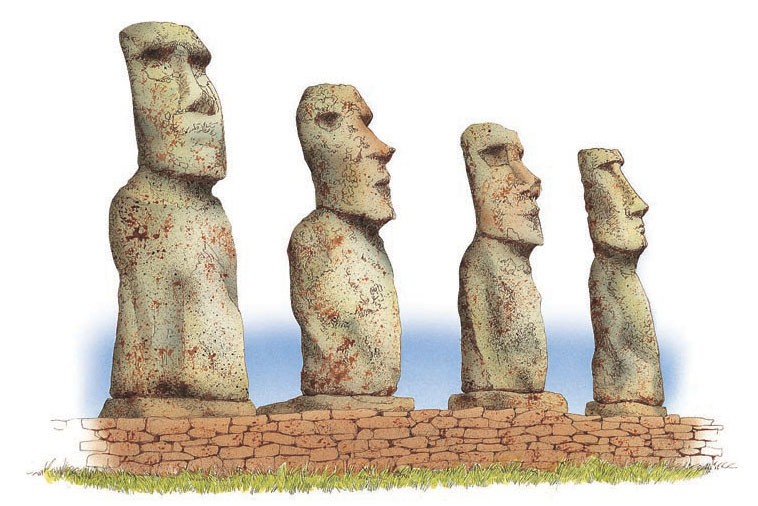
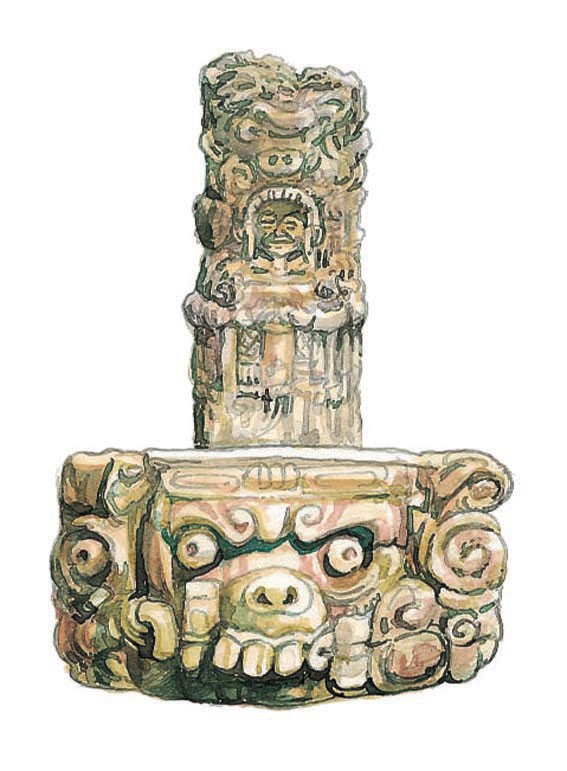
Sculpture of some kind is found in nearly every civilization around the world, for example the Polynesian Tangaroa statues (2000 BC–AD 1000) and the giant Moai, groups of human figures carved in stone on Easter Island (AD 1250–1500). Stone carvings and pottery models have survived better than sculptures made of materials that decompose more easily, such as wood. Many wooden ancient carvings, such as African masks, have been lost for this reason.
Wood was used in North America for making totem poles, which were carved by Native American sculptors, incorporating designs of people and animals. The Maya and Aztecs made intricate stone carvings of their animal gods. A popular subject for Asian sculptures is Buddha.
Modern sculpture
Various artistic movements of the 20th and 21st centuries took sculpture in different directions. Sculptors of the Dadaist "anti-art" movement, for example, produced works from everyday, or "found", items. The French Dadaist artist Marcel Duchamp (1887–1968) produced "Readymade" sculptures such as Fountain (1917), which is a disconnected urinal turned on its side. Another group, known as Constructivists, preferred to build, rather than carve, their sculptures. These included the mobiles—sculptures that move, known as "kinetic art"—of Alexander Calder (1898–1976).
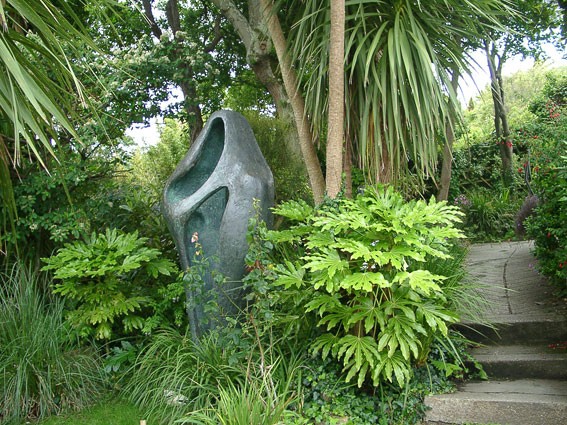
Cubist sculptors were influenced by other cultures. Head of a Woman, by Pablo Picasso (1881–1973), for example, was inspired by African wood carvings. Constantin Brancusi (1876–1957), a Modernist, was one of the first sculptors to make abstract shapes. Henry Moore (1898–1986) and Barbara Hepworth (1903–1975) produced large outdoor sculptures, many of which were abstract shapes based on the human figure.
Raw materials
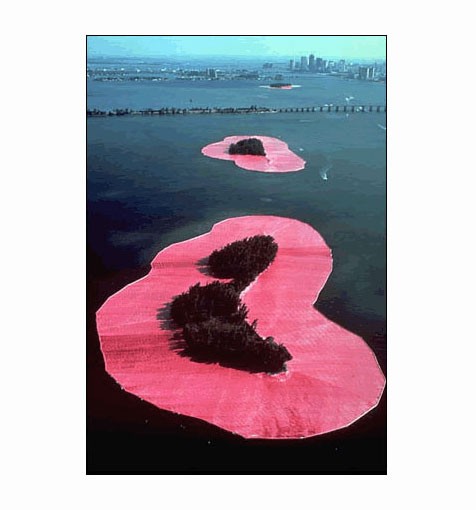
Traditionally, sculptures are made from naturally occurring materials such as wood, stone, clay and metal. More modern artists make sculptures from just about anything: ice, bricks, fibreglass, plastic and recycled items. Christo (1935–2020) and Jeanne-Claude (1935–2009), made sculptures from nature and structures in their actual surroundings. These "landscape sculptures" include wrapping whole coastlines or islands, as well as buildings and bridges, in fabric.
Land art uses the materials of the Earth such as soil, rocks and water. City, begun in 1972 but not finished until 2022, is a land art sculpture by Michael Heizer (born 1944). Located in the Nevada desert, it consists of a complex of mounds, glyphs and concrete pyramids. At 2.4 km (1.5 miles) long, it is the largest contemporary artwork ever built.
Consultant: Philip Wilkinson
pics
Without in any way limiting Q-files Ltd’s exclusive rights under copyright, any use of this publication to “train” generative artificial intelligence (AI) technologies to generate text is expressly prohibited. Q-files Ltd reserves all rights to license use of this work for generative AI training and development of machine learning language models.