
EASY READ Measurements

CITE
We have made every effort to follow citation style rules, but there may be some minor differences. If in doubt, please refer to the appropriate citation style manual.
How do we measure volume and capacity?. (2025). In Q-files Encyclopedia, Maths, EASY READ Measurements. Retrieved from
https://www.q-files.com/maths/easy-read-measurements/how-do-we-measure-volume-and-capacity
"How do we measure volume and capacity?." Maths, EASY READ Measurements, Q-files Encyclopedia, 10 Nov. 2025.
https://www.q-files.com/maths/easy-read-measurements/how-do-we-measure-volume-and-capacity.
Accessed 1 Nov. 2026.
How do we measure volume and capacity? 2025. Maths, EASY READ Measurements. Retrieved 1 November 2026, from
https://www.q-files.com/maths/easy-read-measurements/how-do-we-measure-volume-and-capacity
Maths, EASY READ Measurements, s.v. "How do we measure volume and capacity?," accessed November 1, 2026.
https://www.q-files.com/maths/easy-read-measurements/how-do-we-measure-volume-and-capacity


How do we measure volume and capacity?
Volume is the space that something takes up. When we measure the volume of water in a cup, we are measuring how much space the water takes up inside the cup. Capacity is the amount that something can hold. We might need to measure a cup's capacity so that we know how much water it can hold.


Volume
We measure the volumes of solids in cubic units, such as cubic millilitres (mm³), cubic centimetres (cm³) and cubic metres (m³). The ³ tells us that the unit of measurement is cubed, which means we can imagine each unit taking up a cube (one square block) of space at that size.
The imperial system of measurement uses cubic inches (in³), cubic feet (ft³) and cubic yards (yd³).
Liquid volume
When we measure the volume of liquids, we use millilitres (ml), centilitres (cl) and litres (l).
Using imperial measurements, the volumes of liquids are measured in fluid ounces (fl oz). 8 fluid ounces make up one cup. 2 cups make up a pint, while 8 pints make a gallon.

How do we measure volume?
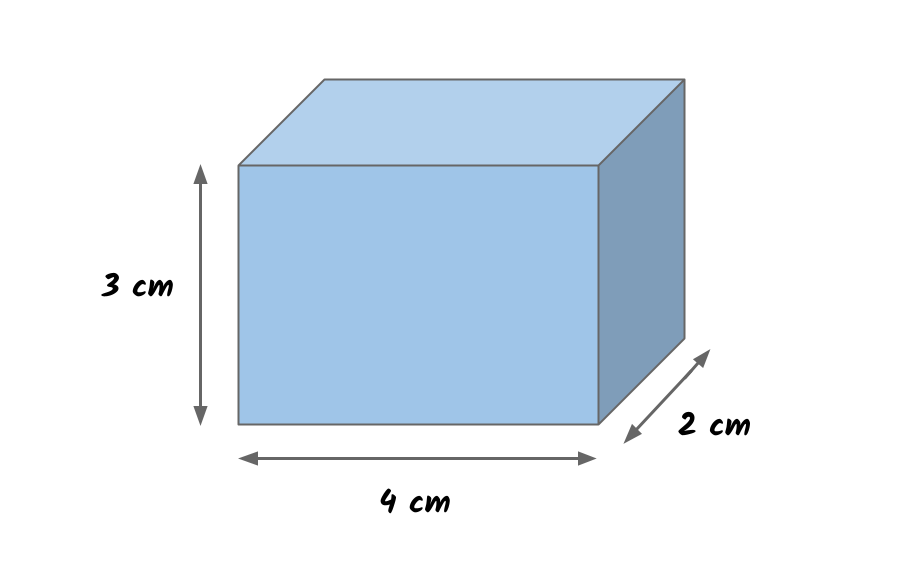
To measure the volume of a solid shape, multiply height x width x depth.
The volume of this block is 3 cm x 4 cm x 2 cm.
3 x 4 x 2 = 24
We took the measurements in centimetres, so the volume is measured in cubic centimetres (cm³). The volume is 24 cm³.

Measuring capacity
We can use the same formula, height x width x depth, for measuring capacity.
We need to find out the capacity of a shipping container (how much space there is inside). The height is 2 m, width is 2 m and the depth is 8 m.
2 x 2 x 8 = 32
So the total capacity of the container is 32 m³.
Less than or greater than?

The symbols < and > are used to show that something is smaller (less) or bigger (greater) than something else.
The symbol < means “less than”. The symbol > means “greater than”.
The symbol’s wider end always faces the side with the bigger number or amount. Imagine it as the jaws of a hungry crocodile. The crocodile always opens its jaws towards the bigger number.

We can write that 3 < 6, which means 3 is less than 6. And we can write that 4 > 1, which means 4 is greater than 1.
If two amounts are the same, we use the equals sign (=). So if cup A and cup B both hold the same amount of water, we can say that the water in cup A = the water in cup B.
Consultant: Adam Larking
Key words
capacity the largest amount that a container can hold
cubic units units of measurement for measuring volume, such as cubic centimetres (cm³) and cubic metres (m³)
formula a set of mathematical instructions to produce a specific result
volume the space that something takes up
pics


Without in any way limiting Q-files Ltd’s exclusive rights under copyright, any use of this publication to “train” generative artificial intelligence (AI) technologies to generate text is expressly prohibited. Q-files Ltd reserves all rights to license use of this work for generative AI training and development of machine learning language models.