
Sport

CITE
We have made every effort to follow citation style rules, but there may be some minor differences. If in doubt, please refer to the appropriate citation style manual.
American football. (2026). In Q-files Encyclopedia, Culture, Sport. Retrieved from
https://www.q-files.com/culture/sport/american-football
"American football." Culture, Sport, Q-files Encyclopedia, 13 May. 2026.
https://www.q-files.com/culture/sport/american-football.
Accessed 6 Aug. 2026.
American football 2026. Culture, Sport. Retrieved 6 August 2026, from
https://www.q-files.com/culture/sport/american-football
Culture, Sport, s.v. "American football," accessed August 6, 2026.
https://www.q-files.com/culture/sport/american-football


American football
American football, or gridiron football, known simply as “football” in the US and Canada, is played by two opposing teams of 11. The object of the game is to move the oval-shaped ball across the opponent's goal line, thus scoring a touchdown, which is worth six points. A touchdown occurs when a player runs with the ball across the goal line, or passes it to a player who is already in the end zone beyond the goal line. A team has four plays, called downs, to gain 10 yards (9 metres) nearer the opponent’s goal line. If the team succeeds—which it may do on any play—it gains four further plays. A touchdown can be scored from anywhere on the field, and on any down. If the team fails to gain 10 yards or score a touchdown, it yields possession to the opponent. The defending team tries to stop the player with the ball by tackling him—forcing him to the ground. Defenders can gain possession before all four downs are played by intercepting a pass or by knocking the ball from a ball-carrier's grasp (called a fumble) and recovering the dropped ball.

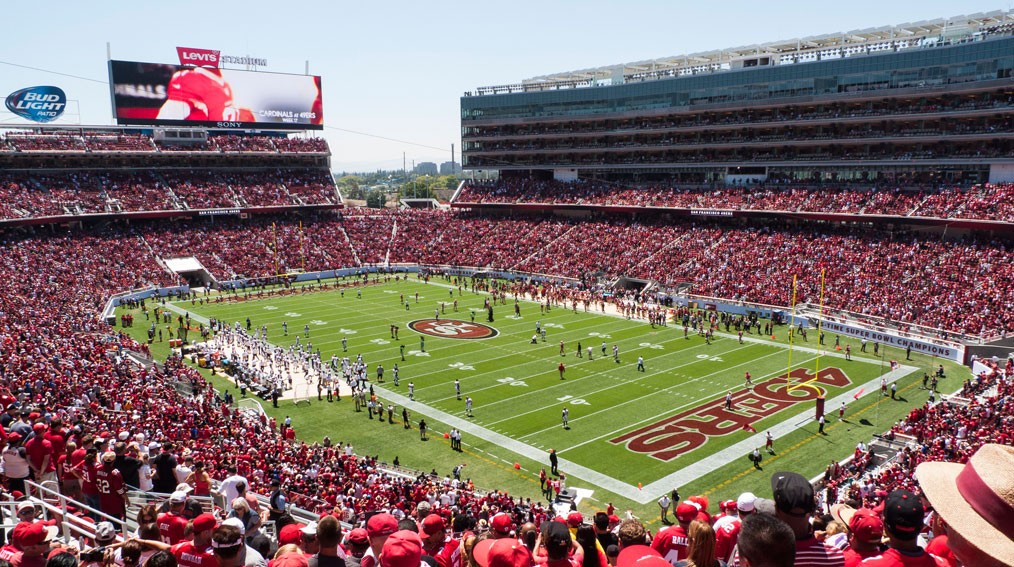
Football field
The football field, 120 yards long by 53.33 yards wide (91.4 by 48.8 metres), has horizontal lines marked off every 5 yards (4.57 metres). Inbound lines, or hash marks, are short lines that mark off 1 yard (0.91 m) divisions. A goal line is marked 10 yards (9.14 metres) in from either end line. The area between the goal line and the end line is called the end zone.
Standing in the centre of each end zone are goal posts no more than 20 feet (6.10 metres) in height, 18 feet 6 inches (6 metres) apart, and with a crossbar 10 feet (3.05 metres) from the ground.
Offense and defense
Most football clubs have offensive and defensive players, forming "platoons", that take to the field as possession of the ball changes. Although there are only 11 players from each side allowed on the field at any one time, a complete football team is in fact made up of 45 players. The offensive platoon often consists of a quarterback, a fullback, two halfbacks and seven linemen—a center, two guards, two tackles and two ends. A typical defensive platoon has two tackles and two ends, who play on the line, as well as three linebackers, two cornerbacks and two safeties.


Placekicker
Special players come on to the field to attempt field goals or extra points, or when the team decides to punt the ball downfield on fourth down. There are three players involved: the placekicker, holder and long snapper. The long snapper snaps the football to the holder, who catches it and positions it for the placekicker.
Line of scrimmage
Plays are called by the head coach or quarterback, who is the attacking decision-maker of the team. At each down, the opposing teams face each other along an imaginary line, called the line of scrimmage, determined by the exact position of the ball where play ended on the previous down. A modern down indicator box is mounted on a pole and is used to mark the line of scrimmage.


Plays
The players on the offensive team often take up a T formation, with the quarterback standing behind the center (the central player in the line), the other backs positioned behind the quarterback. On the quarterback's signal, the centre passes the ball back between his legs to the quarterback (the snap). The quarterback either runs with the ball, hands it to a running back—normally the halfback, also known as the tailback—or throws it downfield to one of his receivers. He usually informs the rest of his team what the play will be in the huddle before the team lines up.

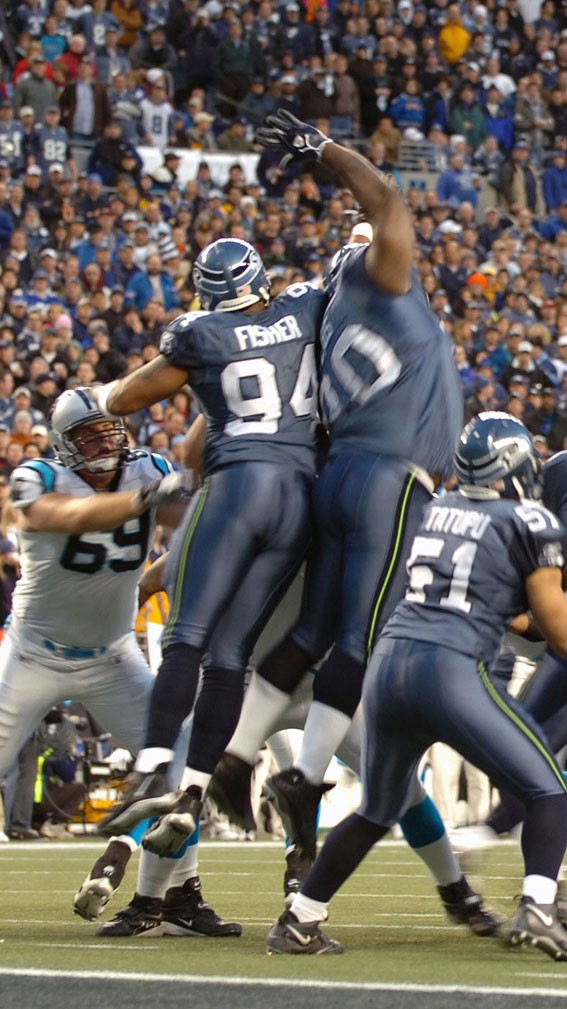
The role of the defensive players is to stop the other team from scoring by tackling the ball-carrier, intercepting passes or causing fumbles. The defense is made up of a combination of big, powerful players, who try to stop their opponents from running the ball, and fast, athletic players, who try to prevent the opposing quarterback's passes from reaching his receivers. The defense also attempts to tackle, or sack, the quarterback before he has thrown the ball. The players in the offensive line, meanwhile, attempt to block their opponents from tackling the ball-carrier on running plays, or from sacking the quarterback.
Blocking and tackling make American football a tough, physical game. All players must therefore wear heavy protective gear, including helmets, shoulder pads and thigh pads.
The play ends when the player with the ball is tackled or goes out of bounds (off the field), or a pass hits the ground without a player having caught it—an incomplete pass. Play continues with the next down, taken from the place where play broke down on the previous down, or from the same place as before if the pass was incomplete, unless the opposition intercepts the pass or they recover the ball after a fumble.

When a team decides it is unlikely to gain 10 yards in four downs, on the fourth down it usually kicks, or punts, the ball downfield. If they are in range of the goal posts, they might attempt to score a field goal.

Points
As well as from a touchdown (worth six points), points can also be scored by kicking the ball over the crossbar between the goal posts (a field goal, three points) and by tackling a player in possession of the ball behind his own goal line (a safety, two points). Extra points, known as conversions, also known as points-after-touchdown (PAT), are scored after a touchdown is scored. A conversion can either be kicking the ball between the posts and over the crossbar (one point), or by running or passing the ball over the goal line from 2 yards (1.83 metres) away (two points).
The extra point from a kick is almost always successful in the professional game, while the two-point conversion is a much riskier play. Single extra point attempts are therefore much more common than two-point ones.
After a PAT attempt or successful field goal the scoring team kicks the ball off to the other team. The team that concedes a safety must kick the ball to the scoring team via a free kick.
Playing time and officials
There is 60 minutes of playing time per game, divided into two halves, each in turn divided into two quarters. In practice, games last much longer because of stoppages in play—the average NFL game lasts slightly over three hours. At the end of the first and third quarter, the teams switch goals. Each half begins with a kickoff. There is also a kickoff after each score (except a safety). There are three time-outs per half for each team, and a half-time lasting 12 minutes. If scores are tied at the end of the game, a 15-minute sudden-death overtime period is played.

Five officials—the referee, umpire, field judge, linesman and clock operator—control a game. Penalties, which usually take the form of moving the next down to a certain number of yards back from a team's object goal, are imposed for violations of the rules. All officials carry a whistle and wear black-and-white striped shirts and black hats, except for the referee, who wears a white hat.

College football
The Intercollegiate Football (Soccer) Association, which consisted of Columbia, Princeton, Rutgers and Yale universities, was created in 1873 to standardize the rules of the game. But Harvard refused to join the group, instead choosing to play against McGill University of Montreal with rugby rules. Rugby soon caught on at the other universities, and over the next few years the distinctive game of American football evolved as a series of rule changes was introduced. The game became extremely popular as a collegiate sport.
In 1902 the first Rose Bowl game was played at Pasadena, California, a tournament that has taken place every year since 1916. The Heisman trophy, begun in 1935, is awarded annually to the nation's outstanding college football player.

Most college teams play in what are known as conferences. Among the best known are the Ivy League, Big Ten, Atlantic Coast, Southeastern and Pacific 10 conferences. Some big games are played before crowds of 100,000 people in university-owned stadiums.
Professional football
Although professional football was first played in 1895, it was not until 1920 that a national organization began, with the formation of what was to become the National Football League (NFL). Professional football grew in popularity after World War II. The champions of the American Football League (AFL), which was formed in 1959, competed with the NFL champions at the first Super Bowl championship game in 1967. Four years later, the two leagues were merged into the present NFL, which now consists of 32 teams divided into two conferences (the National Football Conference, or NFC, and the American Football Conference, or AFC). At the end of each NFL season, the champions of the NFC and the AFC play one another in a match known as the Super Bowl. Its winner is awarded the Vince Lombardi Trophy.


Flag football
Flag football is a non-contact variant of gridiron football. Instead of attempting to tackle players to the ground, the defensive team must try to remove a flag from the waist belt of the ball carrier to end a down. Other principles of gridiron football are the same. Invented in America during World War II, to help military personnel stay fit without risking becoming injured, the sport now has a strong amateur following—especially among children, both boys and girls. It is set to become even more popular following the sport’s inclusion in the 2028 Summer Olympics in Los Angeles.
pics
Without in any way limiting Q-files Ltd’s exclusive rights under copyright, any use of this publication to “train” generative artificial intelligence (AI) technologies to generate text is expressly prohibited. Q-files Ltd reserves all rights to license use of this work for generative AI training and development of machine learning language models.