
Sport

CITE
We have made every effort to follow citation style rules, but there may be some minor differences. If in doubt, please refer to the appropriate citation style manual.
Football. (2026). In Q-files Encyclopedia, Culture, Sport. Retrieved from
https://www.q-files.com/culture/sport/football
"Football." Culture, Sport, Q-files Encyclopedia, 13 May. 2026.
https://www.q-files.com/culture/sport/football.
Accessed 6 Aug. 2026.
Football 2026. Culture, Sport. Retrieved 6 August 2026, from
https://www.q-files.com/culture/sport/football
Culture, Sport, s.v. "Football," accessed August 6, 2026.
https://www.q-files.com/culture/sport/football


Football
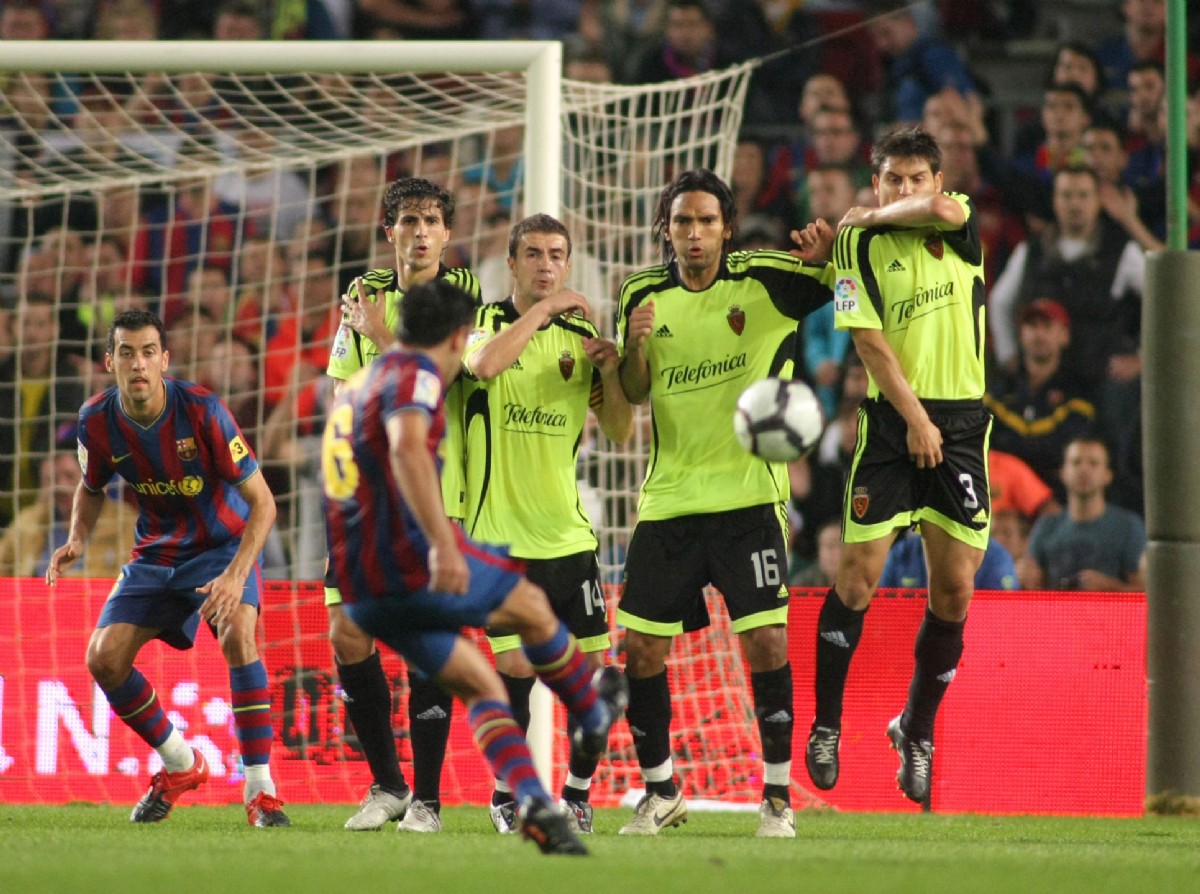
Football (also known as soccer) is a sport in which two teams of 11 players try to put the ball into the opposition’s goal. It is played on a grass pitch with the goals set in the centre at each end. Both teams have 10 outfield players who may play the ball with any part of the body other than their arms and hands, plus a goalkeeper who can touch it with any part of the body. Teams can swap a player for a substitute (out of seven "on the bench") up to three times in a match. A match lasts for 90 minutes, divided into two halves of 45 minutes each. Goals are scored when the ball crosses the line under the crossbar, and the team that scores the most goals wins.
History

People have played ball games for thousands of years. Games similar to football were played in China 2000 years ago and in ancient Greece and Rome. In medieval England, whole villages battled to get a ball through the gate of their rival’s church. The Cambridge University Football Club wrote a set of rules in 1848 and these were taken up by a group of clubs in London when they formed the Football Association in 1863. These rules banned carrying the ball, a decision that resulted in some clubs abandoning Association Football, as it was called, for the sport of Rugby Football, where handling was allowed.
The pitch
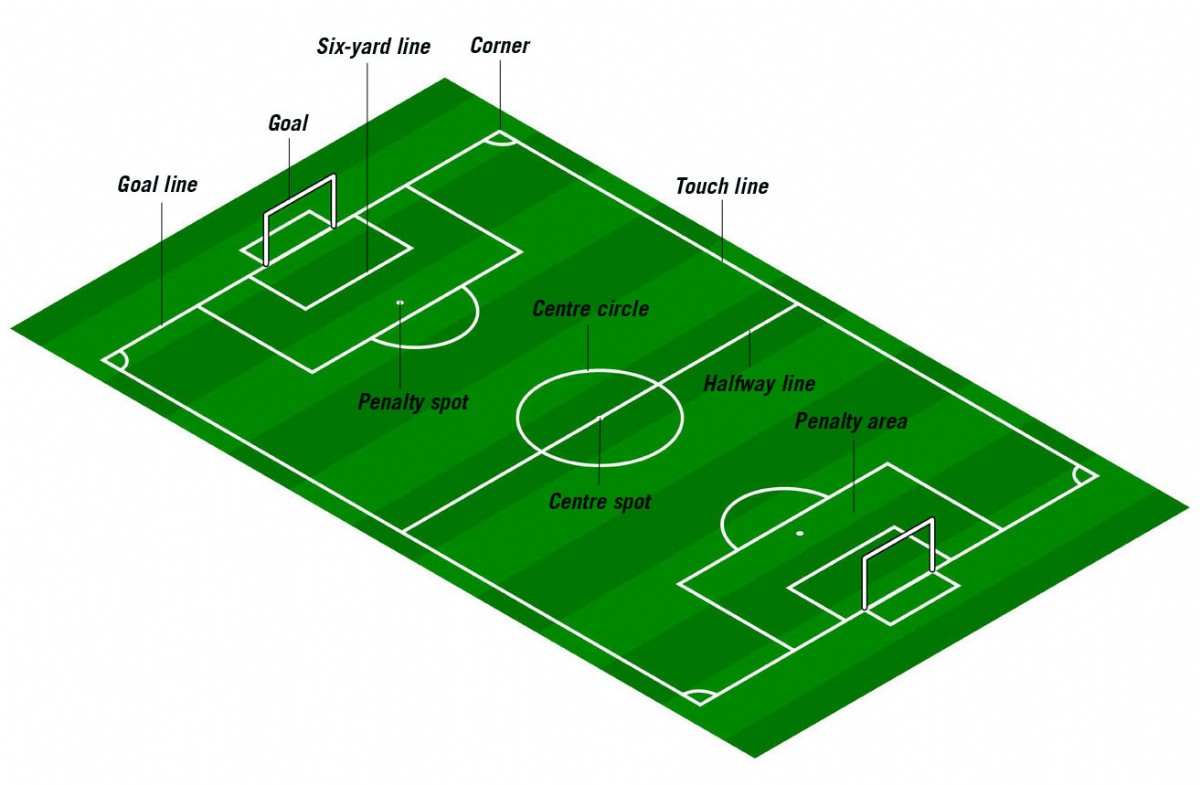
Football is played on a grass pitch of no fixed size, although it must be at least 100 yards (90 metres) long and 50 yards (45 metres) wide. Most pitches measure about 115 yards (105 metres) long by 70 yards (64 metres) wide. The longer boundary lines are the touchlines, the shorter ones goal lines. The goals are the space between posts set 8 yards (7.3 metres) apart and a crossbar 2.6 yards (2.4 metres) high with a net behind them.
There is a large rectangle marked out in front of each goal, called the penalty area, 44 yards (40 metres) wide and 18 yards (16.5 metres) deep, inside which the goalkeeper is allowed to handle the ball.
Out of play
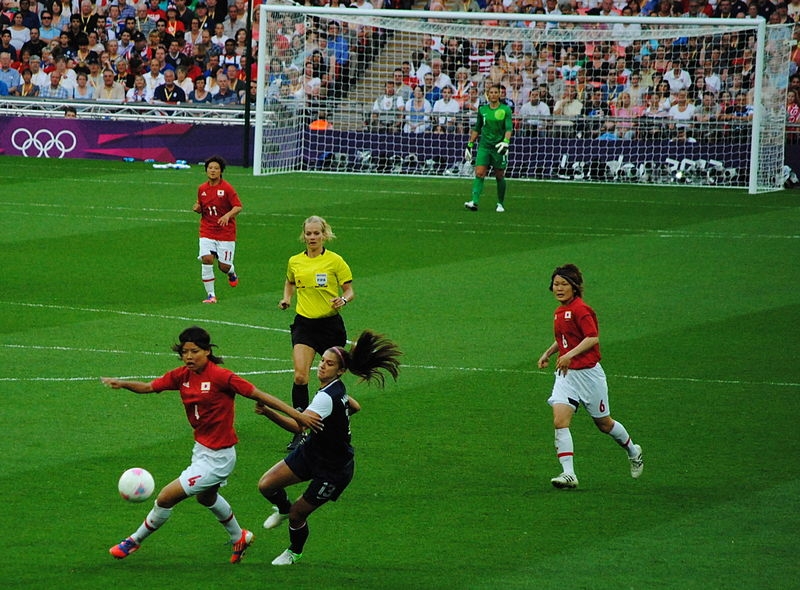
Play stops if the ball crosses the lines at the edge of the pitch, and possession goes to the team that did not touch it last. When this is over a touchline, a player throws the ball back in using two hands from above the head: a "throw-in". If the ball crosses the goal line to either side of the goal, play is restarted either by a goal kick if possession has passed to the defending team, or a corner kick if possession is given to the attacking team. Goalkeepers take a goal kick from the "six yard" (5.5-metre) box around their goal. A corner kick is taken from the corner between the touchline and goal line.


Offside
When a pass is hit to a player with fewer than two opposing players between him and the goal line (most often, one of those players is the goalkeeper), that player is offside. The responsibility for spotting an offside offence is taken by the assistant referees. The referee stops play and a free kick is given to the defending team.
Referee and foul play
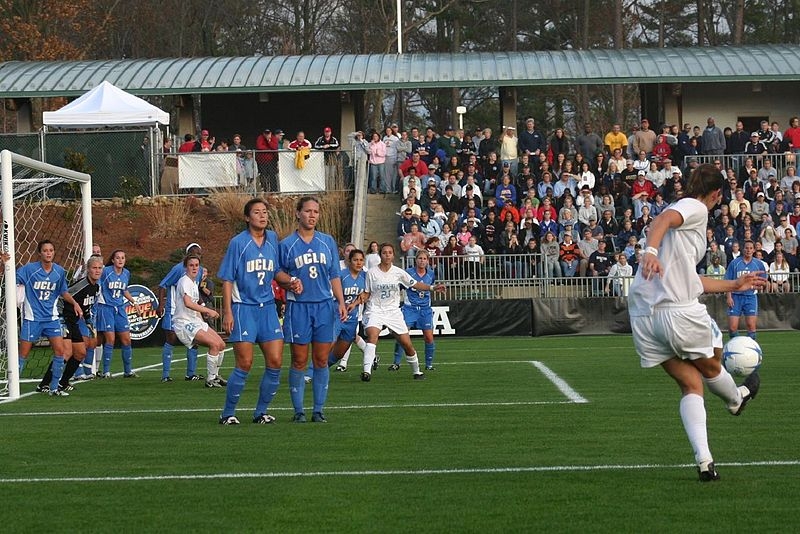
The referee, on the pitch itself, along with two assistants on the touchlines, follows play to make sure it is fair and to enforce the rules. Players are not allowed to kick, trip or push other players and no one can handle the ball except the goalkeeper when inside his or her penalty area. If a foul is committed, the referee stops play with a blow of a whistle, and gives the team of the player who was fouled a free kick. A foul committed inside the penalty area is penalized by a penalty kick, a free shot taken by a player from a spot 12 yards (11 metres) from the goal defended by the goalkeeper alone. For serious foul play, the referee may "book" a player by showing the offending player a yellow card, or, in extreme cases, send them off, indicated by holding up a red card. If a player receives two yellow cards in a single game, he or she is sent off.

Stoppage time
The referee is the official timekeeper for the match, and may make allowances for time lost through stoppages, for example, if injured players require attention or for substitutions. This added time, called stoppage time or injury time, is added at the end of each half.

Skills and tactics
A number of roles have developed in the game apart from the goalkeeper. A defender's main job is stopping opponents from scoring. Midfielders help in this but also aim to move the ball forward to the attackers or forwards. A striker’s main task is to score goals. Important skills include the ability to pass accurately, to head the ball powerfully, to tackle to get the ball from an opponent, and dribbling—running with the ball at your feet.
Formations

The manager of the team decides their tactics, which might include making fast, short passes; sending long, high balls into the penalty area; or allowing opponents to attack so that you can launch a quick counter-offensive against a weakened defence. To help with this, the manager decides the team formation for the outfield players. So a 4-4-2 has four defenders in a line across the pitch, the same number of midfielders in front of them, and a pair of strikers. Other formations include 4-3-3, 3-4-3, 4-4-1-1 (or 4-3-2-1) with a split strike force, and 3-5-2 with a reinforced midfield section.
World Cup
In 1904 the Federation Internationale de Football Association (FIFA) was set up to run the game, and in 1930 it organized the first World Cup tournament, held in Uruguay. The World Cup has been held every four years ever since, apart from during wartime. The Women’s World Cup was established in 1991.
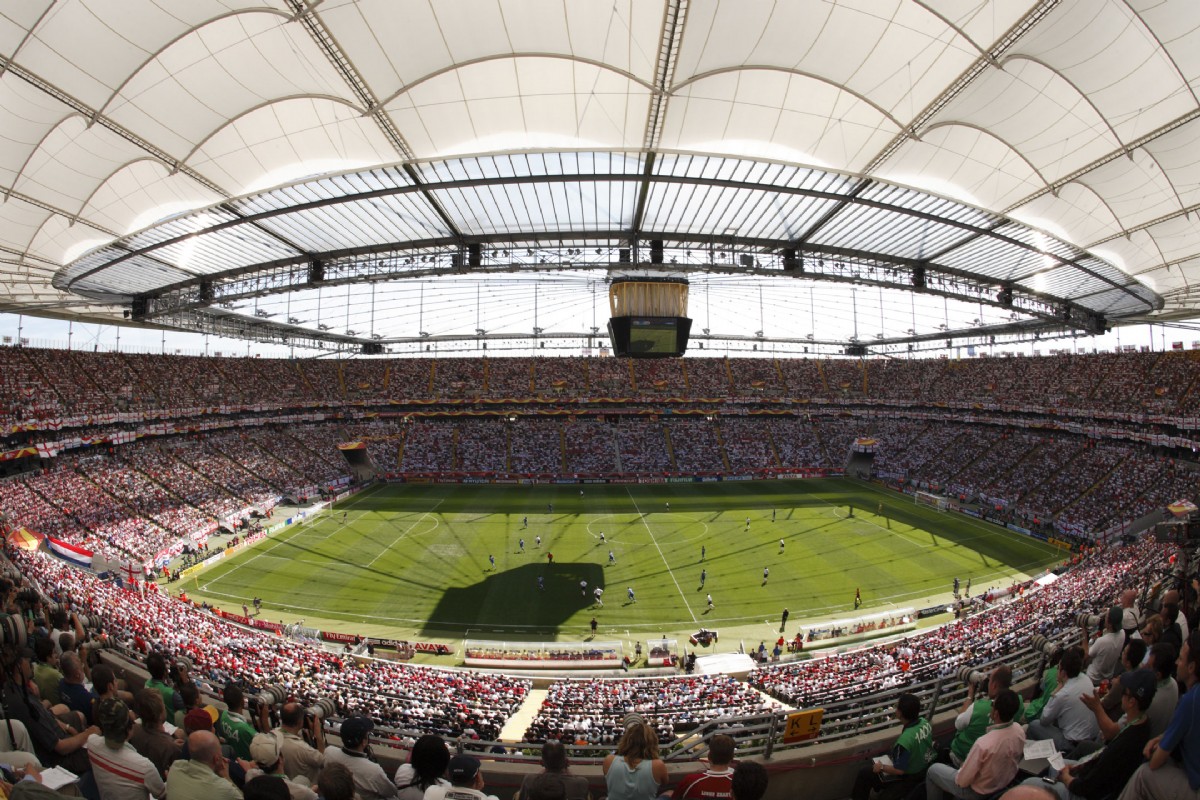
Nowadays, 32 teams, who have qualified via competitions between groups of nations from the same continent, take part in the tournament. As with other international tournaments, there is a "group stage" in which groups of teams play each other as if in a small league, with the winners and runners-up progressing to the "knockout" phase of the tournament.

Leagues
Most football clubs play in league competitions in their own countries throughout the world. The first football league for clubs to play each other was founded in 1888 in England. In a league, every team plays each other twice, home and away, in a season, gaining points for wins or draws.
The top European clubs compete each year in the Champions League, which grew out of a European Cup competition in 1992. This is run in stages in a similar way to the World Cup.
Cup competitions

Most national football associations hold knockout competitions, such as the FA Cup in England, which dates from the 1871–2 season. Matches are played in ties where only the winner goes through to the next round. Drawn games are either replayed (as in the FA Cup) or two 15-minute periods of extra time are played in addition to the 90 minutes' normal time. If scores are still level after extra time, the matches are decided by penalty shoot-outs. The team that scores the most penalties out of five kicks each wins the game.
Consultant: Sean Callery
pics

Without in any way limiting Q-files Ltd’s exclusive rights under copyright, any use of this publication to “train” generative artificial intelligence (AI) technologies to generate text is expressly prohibited. Q-files Ltd reserves all rights to license use of this work for generative AI training and development of machine learning language models.