
Sport

CITE
We have made every effort to follow citation style rules, but there may be some minor differences. If in doubt, please refer to the appropriate citation style manual.
Gymnastics. (2026). In Q-files Encyclopedia, Culture, Sport. Retrieved from
https://www.q-files.com/culture/sport/gymnastics
"Gymnastics." Culture, Sport, Q-files Encyclopedia, 13 May. 2026.
https://www.q-files.com/culture/sport/gymnastics.
Accessed 6 Aug. 2026.
Gymnastics 2026. Culture, Sport. Retrieved 6 August 2026, from
https://www.q-files.com/culture/sport/gymnastics
Culture, Sport, s.v. "Gymnastics," accessed August 6, 2026.
https://www.q-files.com/culture/sport/gymnastics


Gymnastics
Gymnastics is a sport made up of various events in which athletes run, jump, tumble, somersault and balance using equipment such as bars, beams, rings and vaults. Its origins are in the military training of the ancient world. Today, three groups of gymnastic events are included in the Olympic Games: artistic, rhythmic and the trampoline.

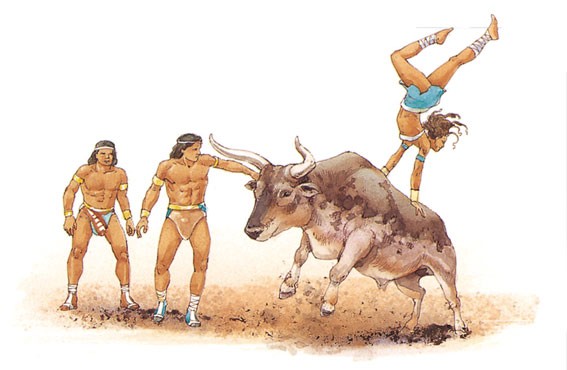
History
The word "gymnastics" comes from the Greek meaning "exercise naked". Gymnastics events such as running with weights, climbing ropes and jumping hurdles were part of the ancient Greek Olympic Games. For centuries, armies practised similar skills to train soldiers for the battlefield. Gymnastic display of strength and agility gradually became a sport, and it was included in the first modern Olympics of 1896, with women’s events being added in 1928.
Artistic gymnastics
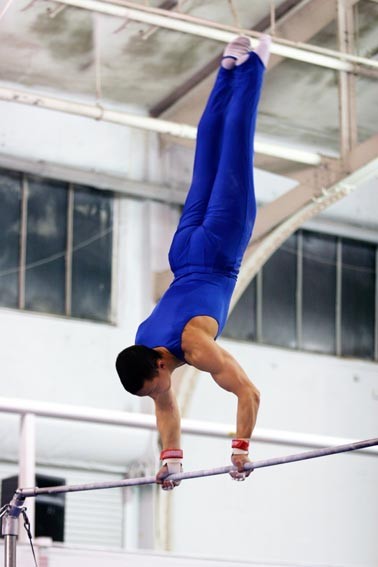
Both men and women perform the floor exercise and the vault. Men also work on rings, pommel horse, parallel bars and the horizontal bar, while women perform routines on the asymmetrical (or uneven) bars and the balance beam. All these events except the floor exercise must finish with the gymnast landing in a standing position. The athletes often rub chalk on their hands to get better grip on some of the apparatus.
Vault, pommel horse and rings
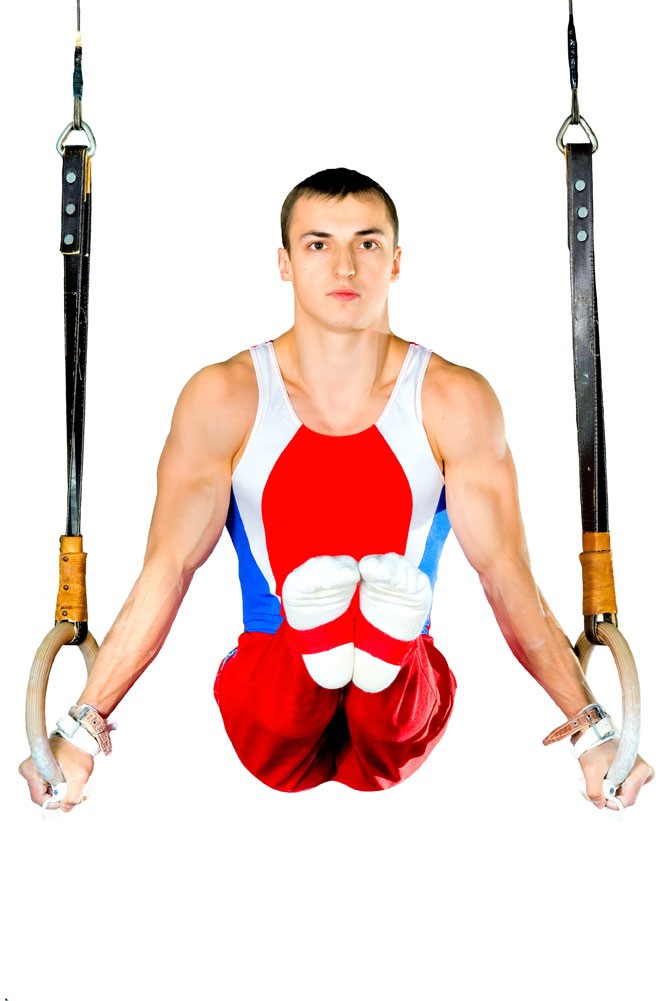
The vault is a padded table 1.2 metres (about 4 feet) high. Gymnasts run to launch themselves off a springboard. They push up with their hands from the vault, performing twists, somersaults or flips as they fly through the air. The pommel horse is a padded box on legs with two curved handles on top—the pommels. Gymnasts support themselves on the pommels and perform leg swings and crosses, and whole body turns and twists in a test of upper-body strength and overall agility. The rings are two small hoops tied to straps to hang 2.75 metres (9 feet) above the floor. Gymnasts hold the rings and perform their routine of swings and holds in mid-air. A routine must include at least one movement where they hold themselves motionless.
Floor exercise
This takes place on a 12-metre (40-foot) square padded mat that gives the gymnasts extra bounce and a soft landing. The men perform sequences including tumbles, leaps and handstands among other acrobatic moves. The women’s routines are accompanied by music and include elements of dance to show grace as well as strength.

Men’s bar events
The parallel bars are two 3.5-metre (11.5 feet) long bars set 2 metres (6.5 feet) high. The routine includes swings, handstands and balances. The horizontal (or high) bar is a thick bar set about 3 metres (10 feet) high, which the gymnast holds using leather grips. They perform mid-air leaps, twists and swings around the bar, usually building up to a spectacular dismount.
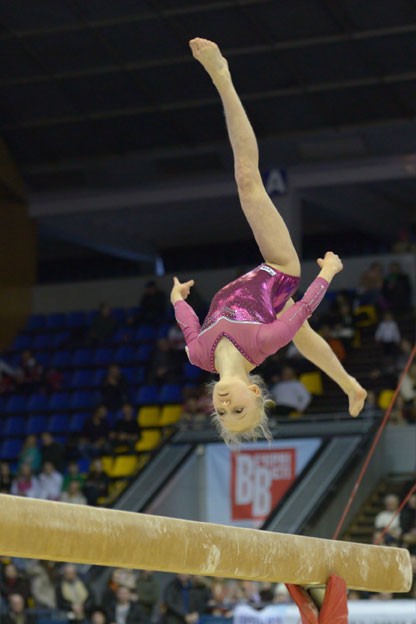
Women’s beam
and bars
The beam is 5 metres (16.5 feet) long, 10 centimetres (4 inches) wide and set 1.25 metres (4 feet) above the floor. The gymnast jumps, turns, flips and balances while moving to and fro along it in a routine lasting up to 90 seconds. The asymmetrical (or uneven) bars are positioned about 1 metre (3.3 feet) apart with one about 80 centimetres (2.6 feet) higher. Gymnasts swing back and forth between each bar.
Rhythmic gymnastics

Rhythmic events are a blend of dance, acrobatics and juggling as gymnasts use equipment such as ropes, hoops, balls, clubs or ribbons in routines set to music. They are a women-only event at the Olympics, for both individuals (since 1984) and teams (since 1996).
Trampoline
The trampoline is a 5 by 3 metre (16 by 10 feet) metal frame supporting stretchy material for gymnasts to bounce off. They perform acrobatic moves such as flips and twists while they are in the air. Trampolining became an Olympic event in 2000, with two events for individual men and women.
Consultant: Sean Callery
pics

Without in any way limiting Q-files Ltd’s exclusive rights under copyright, any use of this publication to “train” generative artificial intelligence (AI) technologies to generate text is expressly prohibited. Q-files Ltd reserves all rights to license use of this work for generative AI training and development of machine learning language models.