
Sport

CITE
We have made every effort to follow citation style rules, but there may be some minor differences. If in doubt, please refer to the appropriate citation style manual.
Hockey. (2026). In Q-files Encyclopedia, Culture, Sport. Retrieved from
https://www.q-files.com/culture/sport/hockey
"Hockey." Culture, Sport, Q-files Encyclopedia, 13 May. 2026.
https://www.q-files.com/culture/sport/hockey.
Accessed 6 Aug. 2026.
Hockey 2026. Culture, Sport. Retrieved 6 August 2026, from
https://www.q-files.com/culture/sport/hockey
Culture, Sport, s.v. "Hockey," accessed August 6, 2026.
https://www.q-files.com/culture/sport/hockey


Hockey
Hockey (known as field hockey in the USA and Canada where the word “hockey” is used for ice hockey) is a game in which two teams of 11 players attempt to strike a small, hard ball into the opponent's goal using a hockey stick. Hockey is played in two 35-minute halves. The team that scores the most goals by the end of the match wins. The game is popular among both sexes in many parts of the world. Men's hockey has been played at the Olympic Games since 1908 (except for 1912 and 1924), while the women's game has been an Olympic sport since 1980.


Pitch
Once played on grass, nowadays hockey is usually played on synthetic surfaces made from densely packed artificial fibres. The dimensions of the hockey pitch and goals were originally measured in yards and feet, but now their metric equivalents have been officially adopted. The pitch is 91.4 by 55 metres (100 by 60 yards). At each end is a goal 2.14 metres (7 feet) high and 3.66 metres (12 feet) wide. There are lines across the field 23 metres (25 yards) from each end-line and in the centre of the pitch. A penalty spot is positioned 6.4 metres (7 yards) from the centre of each goal. The shooting circle (actually a semicircle), also known as the D, extends a maximum of 15 metres (16 yards) from each end-line.

Sticks
Modern hockey sticks are made from wood, fibre glass or carbon fibre, or a combination of these. They are J-shaped, with the curved end the playing end. The playing side has a flat surface, while the rear side is rounded. All sticks are right-handed; left-handed sticks are not permitted.

Play
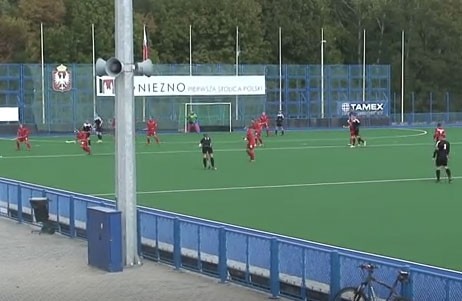
At the beginning of each half, and after a goal has been scored, play begins with a pass from the centre spot. Players pass the ball between each other to progress it up the field into a position where they can attempt a shot on goal. The ball must be touched within the shooting circle to count as a goal.
The ball may be hit, pushed or lifted. Outfield players are allowed to play the ball only with the flat side of their stick, and without the use of hands or feet. Although players are assigned positions—forwards, midfielders and defenders (fullbacks)—they typically move between these lines according to whether their team is attacking or defending, just as in football.
A corner is awarded if the ball goes over the end-line after last being touched by a defender—provided they do not play it out deliberately, in which case a penalty corner is awarded. The corner is actually taken from the 23-metre line, at the point in line with where it went out.

Goalkeeper
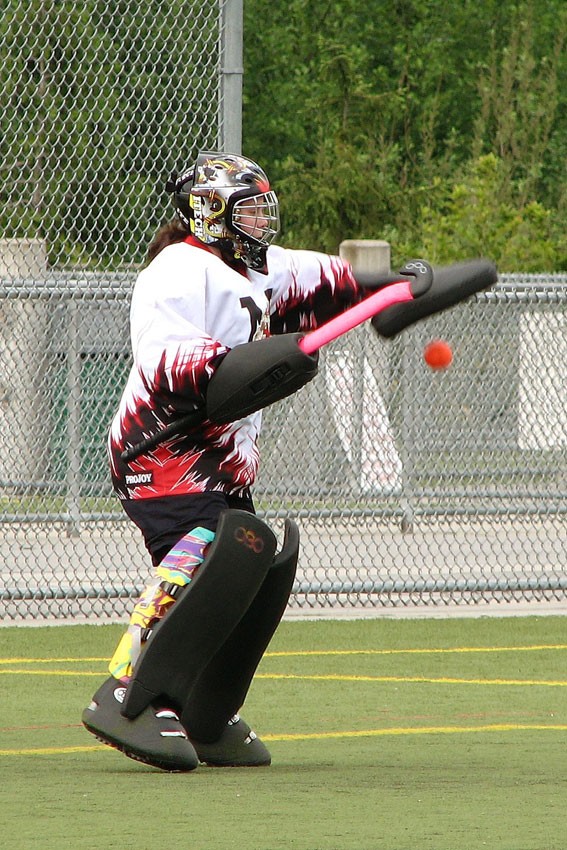
Goalkeepers (goalies) have to defend their goal from shots that may be struck at high speed towards them, so for their protection they are heavily padded from head to toe. They wear helmets, leg guards, kickers, hand protectors and a mouth guard. Their stick has a special shape. Provided they are inside the shooting circle, goalkeepers are permitted to use their stick, kickers, leg guards or any part of their body (including their hands) to stop the ball or deflect it away from goal.
Free hit
Free hits are awarded when offences are committed outside the shooting circles. Opponents must move 5 metres (5.5 yards) from the ball when a free hit is awarded. The most common foul is a foot foul: the ball is not allowed to hit a player’s feet on the field (excluding the goalkeeper) intentionally—or even unintentionally if the player gains an advantage from it.


Other offences include obstruction and dangerous play, for example, hitting the ball with a high back swing, or hitting the ball into an opponent’s body. The ball is allowed to be struck into the air as long as it is not dangerous. This usually means either no higher than a player’s knee, or above head height.
Penalty corner
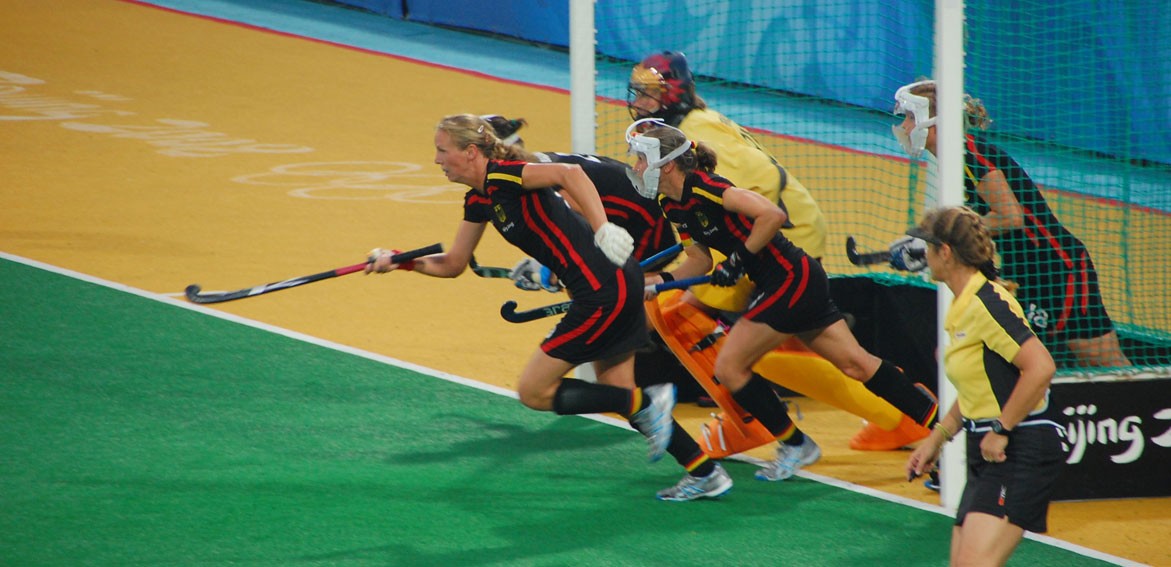
A penalty corner, or short corner, is awarded to the attacking team when a defender commits a foul inside the shooting circle. The attacking team can have as many players around the shooting circle as it likes, but the defending team is only allowed five players (including the goalkeeper) to defend the goal; the others must stand beyond the centre line until the ball is put into play.
The penalty corner is played from a mark 10 metres (11 yards) either side of the goal. The ball is pushed or hit to the other attackers outside the circle. It must then be put back into the circle before the attackers can take a shot which counts as a goal.

Penalty stroke
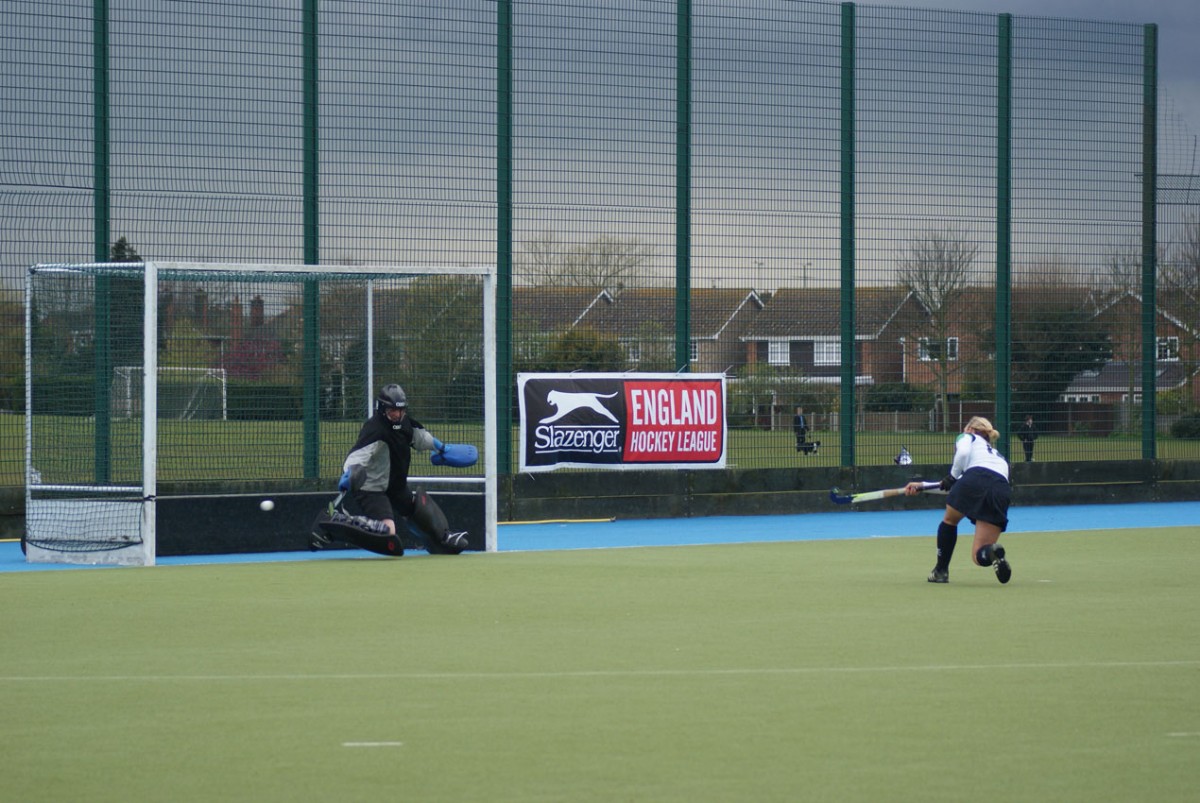
A penalty stroke is awarded to the attacking team if one of its players is judged by the umpire to be severely fouled inside the shooting circle. A player chosen by that team takes a single shot at goal, one-on-one against the goalkeeper.
Cards
Hockey uses a three-level penalty card system, according to the seriousness of the offence. A green card is similar to a yellow card in football: a warning. A yellow card is like a sin-bin penalty in rugby, although the duration is decided by the umpire. It is normally a minimum of five minutes. A red card, just like in football or rugby, means permanent exclusion from the rest of the game—and it usually results in the player being banned for a certain period. Green cards are normally triangular, yellow cards rectangular and red cards circular. A player may receive more than one green or yellow card in the same match, yet be allowed to play on.


History
The origins of hockey date back to the Middle Ages in Europe, although hockey-like games were played in ancient Greece. Hockey in its current form first appeared in mid-18th century England, and became established, mostly in schools, by the mid-19th century. The first club to be formed was Blackheath in southeast London, which was founded in 1849.
pics
Without in any way limiting Q-files Ltd’s exclusive rights under copyright, any use of this publication to “train” generative artificial intelligence (AI) technologies to generate text is expressly prohibited. Q-files Ltd reserves all rights to license use of this work for generative AI training and development of machine learning language models.