
Sport

CITE
We have made every effort to follow citation style rules, but there may be some minor differences. If in doubt, please refer to the appropriate citation style manual.
Winter sports. (2026). In Q-files Encyclopedia, Culture, Sport. Retrieved from
https://www.q-files.com/culture/sport/winter-sports
"Winter sports." Culture, Sport, Q-files Encyclopedia, 13 May. 2026.
https://www.q-files.com/culture/sport/winter-sports.
Accessed 22 Sep. 2026.
Winter sports 2026. Culture, Sport. Retrieved 22 September 2026, from
https://www.q-files.com/culture/sport/winter-sports
Culture, Sport, s.v. "Winter sports," accessed September 22, 2026.
https://www.q-files.com/culture/sport/winter-sports


Winter sports
Winter sports take place on snow or ice. Once only possible in winter, they can now be practised all year in any climate on artificial surfaces. Major individual sports include skiing, skating and snowboarding, while team sports include ice hockey, curling and bobsleigh. Each sport has its own events, but the major winter sports tournament is the Winter Olympics, begun in 1924 and now held every four years on a separate cycle to the Summer Olympics.

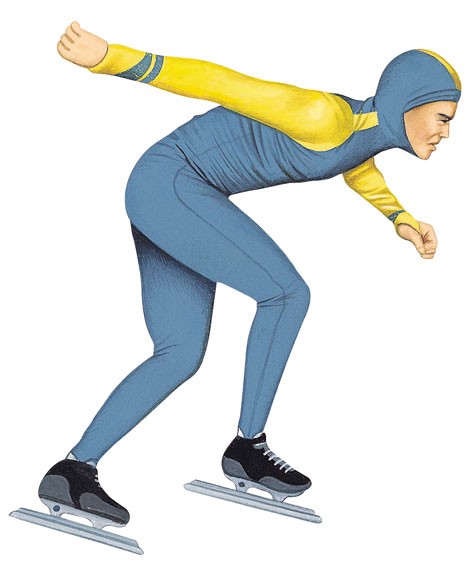
Ice skating
Ice skating includes three sports: speed skating, figure skating and ice dancing. All of them use skates: shoes with metal blades on the bottom to slide along ice. The first skating competition was in 1676.
Speed skaters race round an oval track for distances between 500 metres (1640 feet) and 5000 metres (16,400 feet) for women and up to 10,000 metres (32,800 feet) for men. Speed skating was part of the Winter Olympics from the beginning, in 1924.
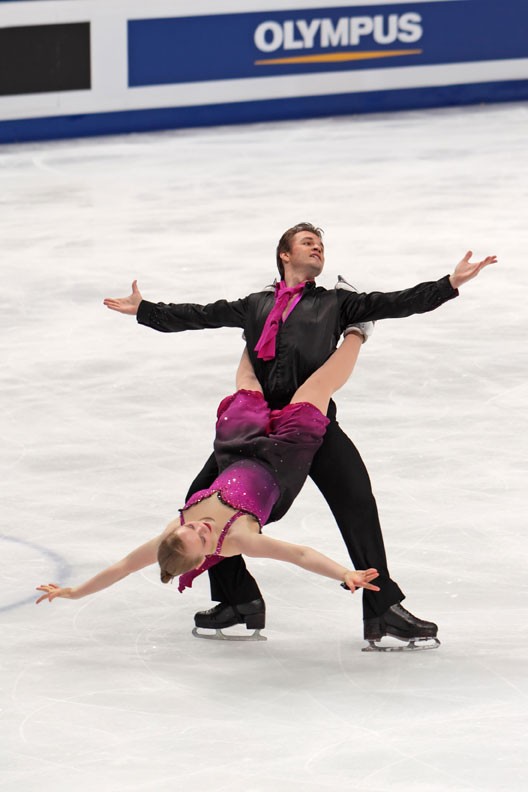
The first figure skating championships were held in America in 1864. Figure skating joined the Olympics in 1908, before the birth of the Winter Olympics. Music accompanies figure skaters as individuals or pairs perform jumps, spins and sequences in a short programme, followed by a longer set of moves of their own choice. A panel of judges scores them to decide a winner. In ice dancing, individuals and pairs perform a "dance" routine on ice, involving spins, lifts and other moves in time to music. It became an Olympic sport from 1976.

Ice hockey
In ice hockey, two teams of six heavily padded and helmeted skaters use sticks to push or pass a black rubber disc called a puck around the ice. They score by shooting it into a net, which is protected by a goaltender. The rules for the game were devised in 1879. A player who breaks a rule can be sent to the penalty box for 2 or 5 minutes, leaving their team one short. Top players compete in the National Hockey League, which has 30 teams from the US and Canada, in matches that last three periods of 20 minutes each.
Alpine skiing
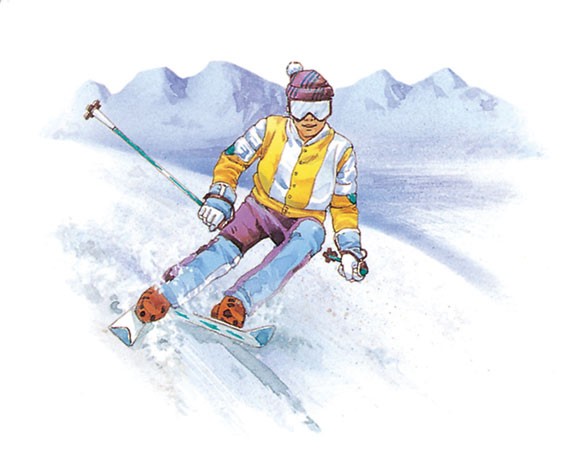
There are two main types of skiing: alpine and Nordic skiing. Alpine skiers hurtle down a course, called a run, on a mountain slope. The difficulty of each run is colour-coded: green for shallow slopes, blue for steeper and bumpier runs, and black for the most challenging. The sport started in about 1850 in Norway, where the first competition was held in 1868. The object is simply to be fastest down a run marked with poles, which the competitors must pass on the correct side.


The downhill race is the simplest and fastest: racers regularly exceed speeds of 130 km/h (80 mph), sometimes reaching 150 km/h (93 mph). In the super G, giant slalom and slalom events, turns are progressively tighter with the poles positioned closer and closer together. Freestyle skiers perform spectacular jumps, tricks and somersaults, or ski over a series of bumps (mogul skiing).

Nordic skiing
Nordic skiing includes cross-country skiing, where skiers use poles to help push them on long routes across snowy land, and ski jumping. This is where skiers zoom down a ramp on a hill, take off and land as far away as possible. They are judged on the distance travelled and the jump style.
Snowboarding
This sport combines skateboarding, surfing and skiing. Snowboarders attach their feet to a flat board and slide downhill. There are two positions: right foot at the back (regular) and left foot at the back (goofy). The sport developed in the USA in the 1960s and made its Olympic debut in 1998. Events include slalom races and competitions in which competitors do tricks, such as somersaults on a U-shaped high-sided ramp called a half-pipe.
Bobsleigh

Bobsleigh is a sport where teams of two or four ride a sled down a narrow, twisting and banked ice track. The event starts with the teams pushing their sleds to build up speed before jumping in. The pilot at the front uses ropes to steer it while the rear member of the team works the brake lever. The sport began in Switzerland, where the first club was founded in 1897. Women’s bobsleigh joined the Winter Olympics in 2002.
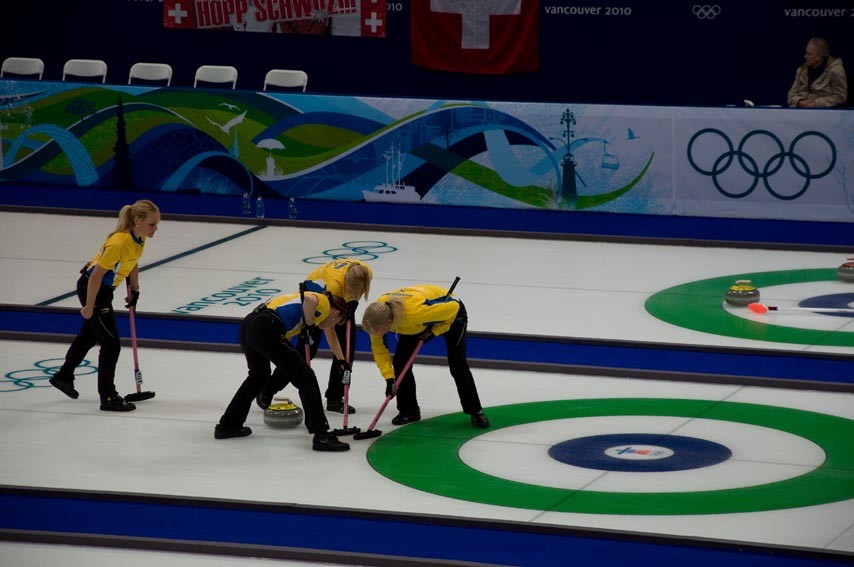
Curling
Curling is a game where two teams of four players slide heavy, polished granite stones, also called "rocks", towards a circle marked in the ice. It was first played on frozen ponds and lochs in Scotland and the earliest-known stones date from 1511. Curling joined the Winter Olympics in 1998. Each team has eight stones and team members brush the ice to help steer each stone as it slides towards its target. Points are scored by getting the most stones nearest the centre of the circle.
Consultant: Sean Callery
pics
Without in any way limiting Q-files Ltd’s exclusive rights under copyright, any use of this publication to “train” generative artificial intelligence (AI) technologies to generate text is expressly prohibited. Q-files Ltd reserves all rights to license use of this work for generative AI training and development of machine learning language models.