
Sport

CITE
We have made every effort to follow citation style rules, but there may be some minor differences. If in doubt, please refer to the appropriate citation style manual.
Tennis. (2026). In Q-files Encyclopedia, Culture, Sport. Retrieved from
https://www.q-files.com/culture/sport/tennis
"Tennis." Culture, Sport, Q-files Encyclopedia, 13 May. 2026.
https://www.q-files.com/culture/sport/tennis.
Accessed 6 Aug. 2026.
Tennis 2026. Culture, Sport. Retrieved 6 August 2026, from
https://www.q-files.com/culture/sport/tennis
Culture, Sport, s.v. "Tennis," accessed August 6, 2026.
https://www.q-files.com/culture/sport/tennis


Tennis
Tennis is played between individuals (singles) or pairs (doubles)—which can include mixed pairs of men and women. The first tennis tournament was at Wimbledon, England, in 1877. Championships began in the USA in 1881, in France in 1891 and Australia in 1905. These four events are today’s top tournaments, known as the Grand Slams or majors. Tennis is also an Olympic sport.

History
A form of tennis existed in France as long ago as the 13th century. Players struck a ball with their hands in a game called jeu de paume (game of the palm). Racquets were introduced in the 16th century in an indoors game in which the ball bounced off walls. Known as real tennis, it is still played today.
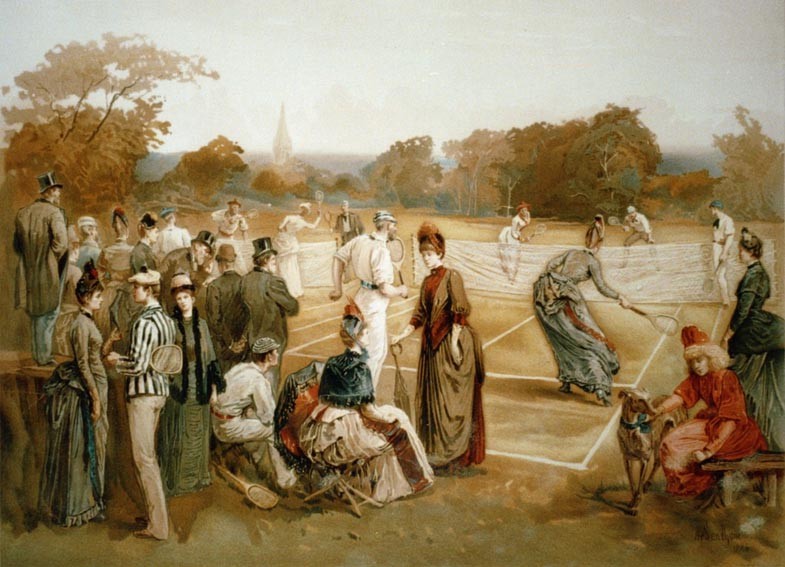
The modern game, more properly known as lawn tennis, dates from 1873 with a game called Sphairistike (from the ancient Greek, meaning "skill at playing the game"), soon abbreviated to "sticky". The court was hourglass-shaped and players used wooden racquets to hit a rubber ball over a high badminton net. The rules and scoring were similar to those of real tennis. Soon the court became a rectangle, and the balls were covered with white felt.

Court
There are four main types of surface. Rubber-based asphalt and cement are called hard courts, on which the ball bounces higher than on a grass surface, which is fast with a low bounce. Red clay or synthetic clay make a soft court that slows the ball down and allows more spin, so games often have longer rallies. The US and Australian Open tournaments have hard courts, the French Open has clay courts, while Wimbledon has grass.
Service
A point can start and finish with the serve as this can be a very powerful shot—the fastest recorded blasted at 263 km/h (164 mph) from the racket of Australian player Sam Groth in 2012. The server hits the ball into the service box diagonally opposite. If the ball strikes the top of the net but lands in the service box, the server takes this serve again. If it lands outside the service box or in the net, he or she takes a second serve, but if that fails, the point is lost.

Rallies
The returner hits the ball back before it bounces twice. If this return is within the court, play goes on (a rally) until a ball lands in the net or outside the boundary. The player who hit that ball loses the point, and play restarts with a new serve. The advantage usually lies with the server. Top players hope to win their opponent’s service game to achieve a "break of serve".
Shots
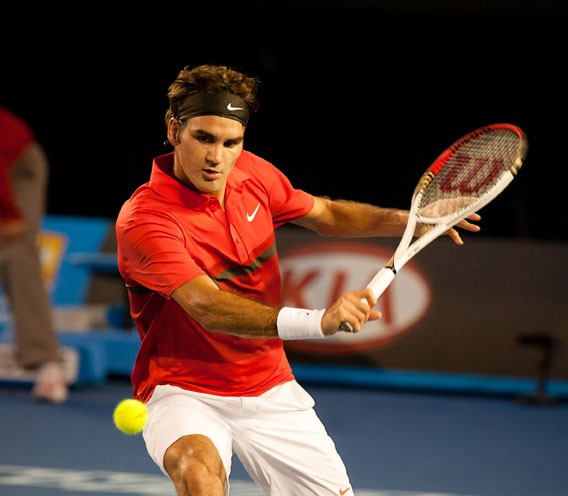
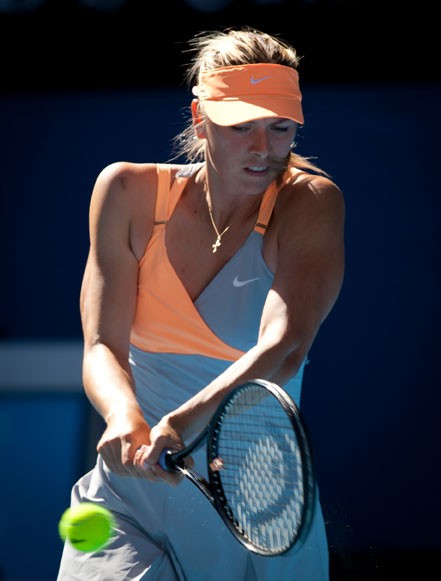
There are eight types of shot: the serve, forehand, backhand, volley, half-volley, drop shot, lob and smash. Forehands are hit by swinging the racket across the body, while backhands swing away from the body. Players often alter the angle at which the racket face strikes the ball to apply spin.
Hitting the ball before it bounces is called volleying and is usually done close to the net. A half-volley is hit just as the ball comes off the ground. A drop shot is hit with back spin to bounce low just beyond the net, forcing the opponent to rush to reach the ball. A lob is a ball struck high in the air over an opponent to try to force them to the back of the court. A lob that is not hit high or long enough is likely to be smashed—hit hard on the volley from above the head for a winner.
Scoring
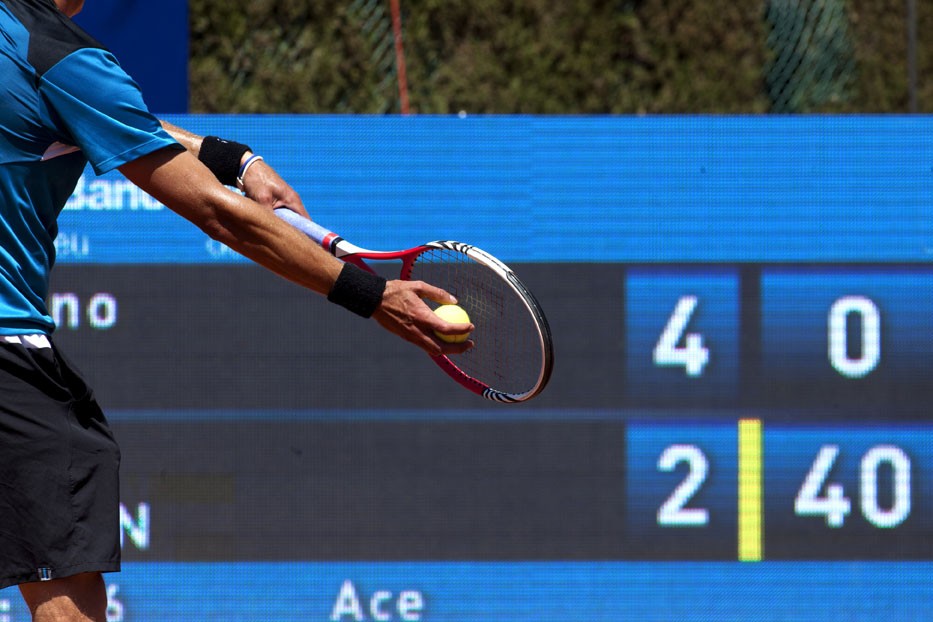
A tennis match is divided into sets, which are played as a series of games. A game is won when one player gains four points—so long as they are at least two ahead. The score is called love for zero, 15 for one, 30 for two and 40 for three. If both players reach 40, it is called deuce and a player must score two points in a row to win the game. Winning the first point earns an advantage but if they lose the next point, the score goes back to deuce. Once a game is over, the other player serves.
Players change ends after an odd number of games. The aim is to win the set by winning six games and being at least two games ahead. If the score reaches 5–5, play continues until one player is ahead by two. In Grand Slam and other major events, a match is the best of three sets for women and best of five for men.
Tie breaks
Since 1974, a tie break is played if the score reaches 6–6 in all sets except the final one, which continues to be played out in games. Tie break points are called one, two, and so on. A player wins when he or she wins seven or more points and is ahead by two.
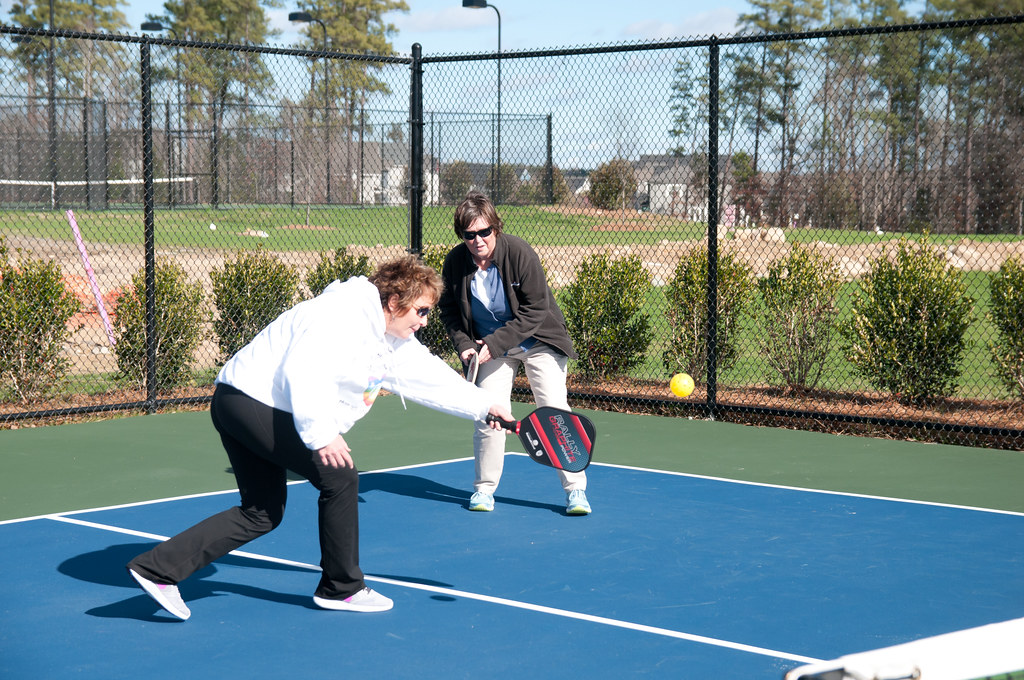
Pickleball
Rapidly growing in popularity worldwide, pickleball is a racket sport that resembles tennis. Two players (singles) or four players (doubles) hit a ball over a net until one side is unable to return the ball. But pickleball differs from tennis in several key ways. It has its own court, which is 44 feet (13.4 metres) long and 20 feet (6.1 metres) wide. On each side of the net is a 7-foot (2.1-metre) area known as the non-volley zone or "kitchen", where a player may not strike the ball until it has bounced. Players use smooth-faced paddles (similar to, but larger than, table tennis rackets) to hit the hollow plastic ball. Only the serving side—all serves are underarm—can score points.
Padel
Padel is a racket sport invented in Mexico, played in doubles (usually) on an enclosed court slightly smaller than a doubles tennis court with a net 0.88 metres (34.6 inches) high in the middle. Although padel shares the same scoring system as tennis, the rules, strokes, and playing technique are different. The court has walls, made of glass or brick, and the balls can be played off them in a similar way as in squash. Padel rackets are made of a composite material without strings. The height of the ball being served must be at or below the waist level.

Consultant: Sean Callery
pics
Without in any way limiting Q-files Ltd’s exclusive rights under copyright, any use of this publication to “train” generative artificial intelligence (AI) technologies to generate text is expressly prohibited. Q-files Ltd reserves all rights to license use of this work for generative AI training and development of machine learning language models.