
Sport
Water sports
Water sports include any sport practised on, in or under water. Many surface water sports (performed on the surface of water) use equipment, such as boats, boards, skis, paddles, oars or sails, to travel over the water. Other water sports include swimming, diving and snorkelling. In many surface water sports, participants aim to travel over a set distance, or over a course, at speed. Some sports demand strength to power through the water, while others require skill to use the currents or winds.
Canoeing
and kayaking
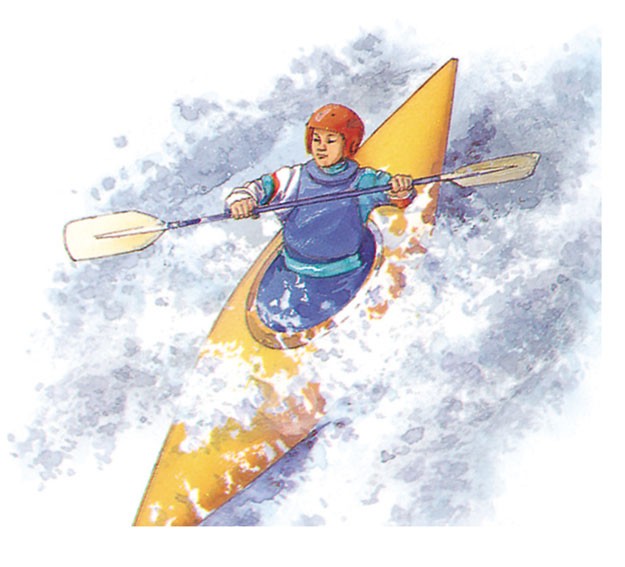
A canoe is a narrow, light, open-topped boat with sharp ends and curved sides. Kayaks have a frame over the top—originally made by stretching animal skins to keep out icy Arctic waters—with a gap for the cockpit, where the paddler sits. Paddlers face forward in both craft, but canoeists use a single-bladed paddle, while kayaks use double-bladed ones.
Canoe sports have been organized since 1866. There are two main events: sprints, which became an Olympic event in 1936, and the slalom, which has been included in the Olympics since 1972. Sprint boats are long and streamlined. Competitors races as individuals, pairs or teams of four. The slalom involves steering down a 300- to 500-metre (980–1640-feet) course of water rapids, passing through 25 "gates" formed by two hanging poles. Slalom boats are smaller and lighter to cope with the quick changes of direction. Time penalties are added for touching the poles or missing a gate.

Rowing
Rowers use fixed oars as levers to pull their open boat, called a shell, through the water. Racing became popular in the early 19th century. The first Boat Race between crews from Oxford and Cambridge universities took place on the River Thames in 1828.
The two main types of rowing are sweep rowing, with one oar, and sculling, using two. Rowers race as individuals, in pairs or in crews of four or eight. A boat with a crew of eight carries a coxswain (cox) to steer. The standard course distance is 2000 metres (about 1.25 miles).
The 2028 Olympics will have 15 rowing events, with 12 classic rowing medals and three new beach sprint coastal rowing events.
Beach sprint rowing
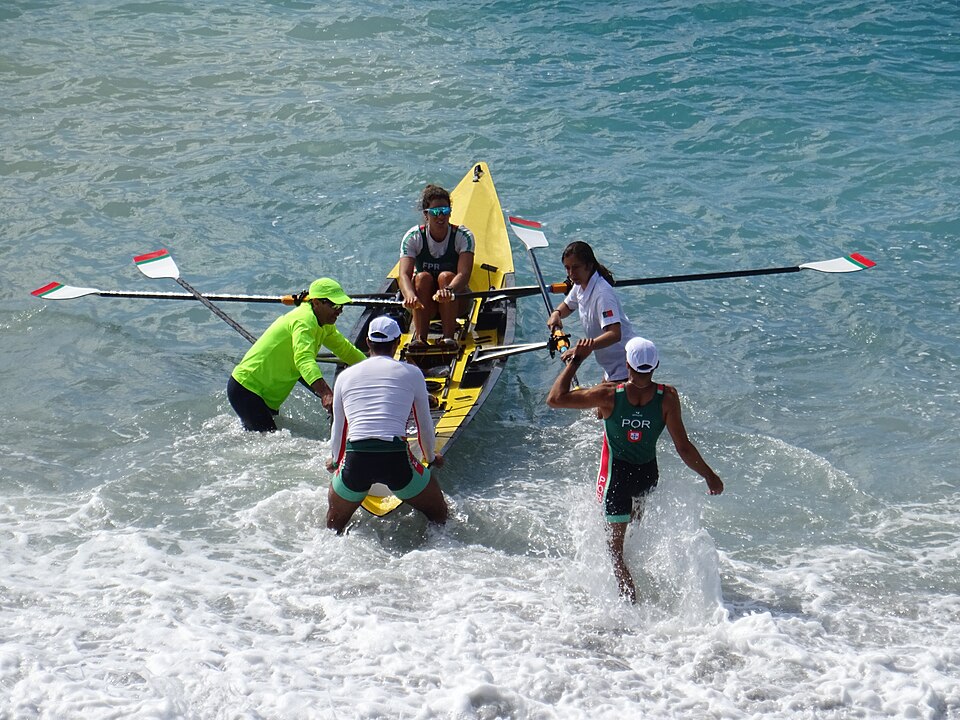
Coastal rowing (also called open water rowing) is a sport in which crews race along a coastline. It will be included for the first time at the 2028 Summer Olympics in the form of beach sprint rowing. The racing begins on land with athletes running down the beach and jumping into their boats at the water’s edge. They then row out around a buoy before turning back to shore, leaping out of their boats and sprinting up the beach—frequently hurling themselves through the air to get to the finish line ahead of their rivals. The event lasts just a few minutes.
Sailing
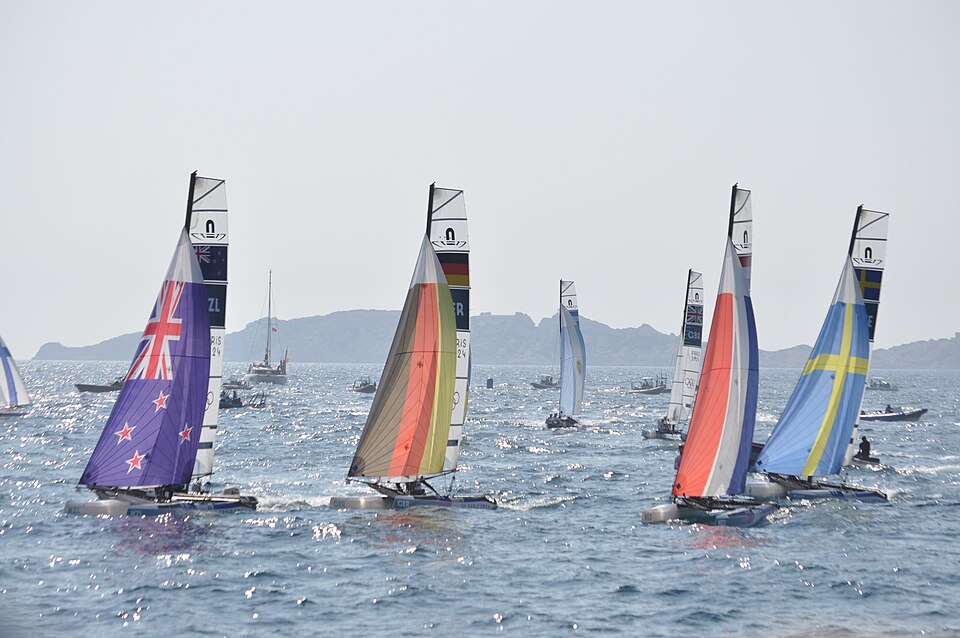
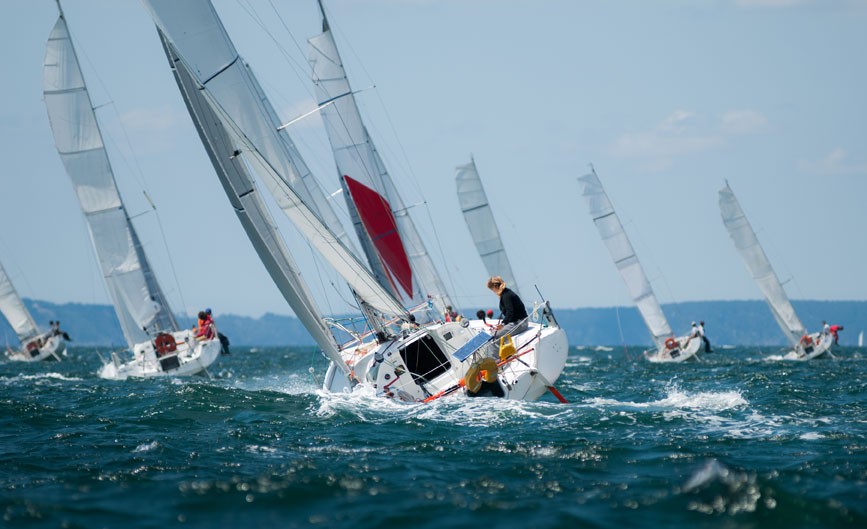
Sailing boats, or yachts, vary in size from small dinghies to twin-hulled catamarans (with two parallel hulls, or boat bodies, of equal size).
International yacht racing started in 1851 when members of the New York Yacht Club built a boat called America and won a trophy which they named the America’s Cup. This is an example of a head-to-head contest between two boats, in this case over the best of seven races. To win, strategy rather than speed is often required—for example, by positioning your boat to block the wind from reaching the opposition’s sails. Similar events are among the ten Olympics sailing events. Other events involve a number of competing teams racing equally matched boats along the same course at the same time. This type of race is called fleet racing.
Water skiing
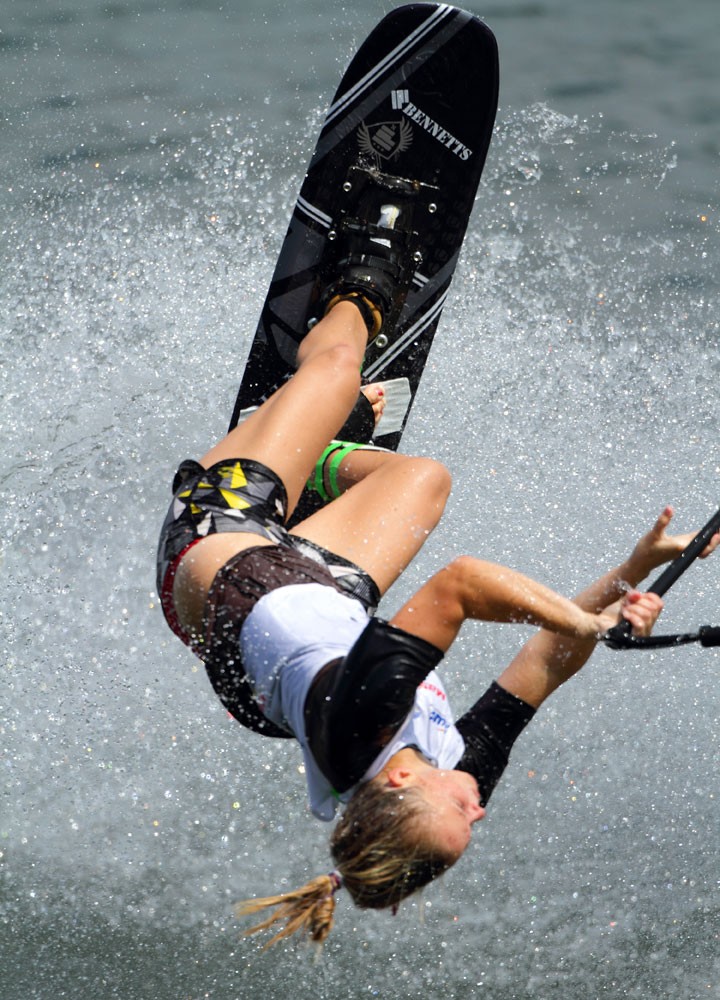
American Ralph Samuelson invented water skiing in 1922, when he stood on a pair of boards and held on to a clothesline as he was towed by a motorboat in a lake in Minnesota. It became a competitive sport in 1939 with the first National Water Ski Championships at Jones Beach, Long Island, New York.
Nowadays, skiers use carbon fibre skis to compete in three events: slalom, tricks and jumping. The slalom involves steering a zigzag course around six buoys. Tricks require two 20-second routines of tricks each with a given point value, the winner gaining the most points. Jumping involves taking off from a jump ramp at about 100 km/h (60 mph) with the aim of making the longest jump. The top men achieve about 75 metres (250 feet).
Surfing and windsurfing
Surfing is a sea sport where riders use a board to roll with a wave towards the shore. Competitive surfers perform sequences of moves such as turns and cutbacks and are scored out of 10 on the variety, difficulty and quality as well as the speed and power of their performance.
Windsurfing (also known as sailboarding) was invented in England in 1959 when Peter Chilvers attached a sail to his surfboard. Windsurfing became an Olympic sport at the 2012 London Games. Here competitors raced courses set to include upwind and downwind legs, with each race lasting around 45 minutes.

Consultant: Sean Callery