
Folds and faults

CITE
We have made every effort to follow citation style rules, but there may be some minor differences. If in doubt, please refer to the appropriate citation style manual.
Rift valley lake: Lake Baikal. (2026). In Q-files Encyclopedia, Earth, Folds and faults. Retrieved from
https://www.q-files.com/earth/folds-and-faults/rift-valley-lake-lake-baikal
"Rift valley lake: Lake Baikal." Earth, Folds and faults, Q-files Encyclopedia, 6 Mar. 2026.
https://www.q-files.com/earth/folds-and-faults/rift-valley-lake-lake-baikal.
Accessed 6 Aug. 2026.
Rift valley lake: Lake Baikal 2026. Earth, Folds and faults. Retrieved 6 August 2026, from
https://www.q-files.com/earth/folds-and-faults/rift-valley-lake-lake-baikal
Earth, Folds and faults, s.v. "Rift valley lake: Lake Baikal," accessed August 6, 2026.
https://www.q-files.com/earth/folds-and-faults/rift-valley-lake-lake-baikal


Rift valley lake: Lake Baikal
Millions of years ago, Asia split apart and the floor of the Baikal valley in southern Siberia, Russia, dropped away along a series of giant faults, cracks in the Earth’s crust. The bedrock plunges to a depth of at least 9 kilometres (nearly 6 miles), the deepest point on any of the continents. For many millions of years, parts of the lake bottom remained dry, but eventually all of the basin became flooded, forming the lake we know today as Lake Baikal. Mud and gravel have been settling for at least 16 million years and are now more than 7 kilometres (more than 4 miles) thick. The water level has been slowly rising since a dam was built on the Angara, the only river to flow out of the lake, in 1959.


World's largest body of fresh water
Lying in the far east of Russia amidst Siberia’s mountains and forests, Lake Baikal, the world’s deepest lake, is sometimes known as the Blue Eye of Siberia. By area only the ninth largest lake, it is easily the largest body of fresh water in the world. It holds one-fifth of the world total—more than all five of the Great Lakes of North America put together. If all the world’s drinking water ran out, Lake Baikal could supply the world’s population for a further 40 years.
As many as 336 rivers and streams feed into Baikal, but because most of the surrounding mountains are extremely hard rock, very little dissolved substances find their way into the water. The lake is crystal clear and very pure. Only in the south is there man-made pollution, although this is still very slight.
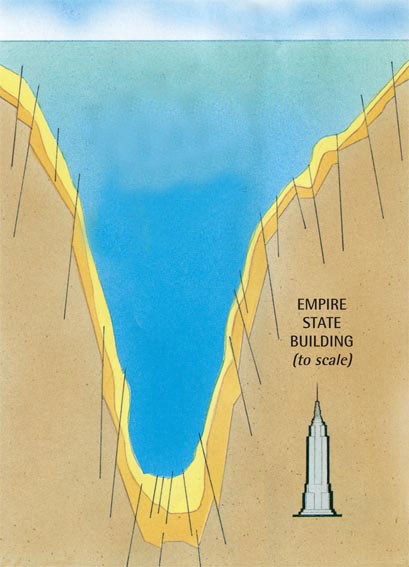
Deepest point
In the Olkhon Crevice, the bottom plunges to more than 1600 metres (one mile) below the surface. Here, the average depth of the lake floor lies much deeper than the shores of the Dead Sea (400 metres / 1300 feet below sea level), the lowest point on land in the world. In this cross-section, the lighter areas show sediments, the black lines underground faults. The deepest point of Lake Baikal is more than four times the height of the Empire State Building (381 metres / 1250 feet) in New York City.
Unique habitat
Crescent-shaped Lake Baikal is about 620 kilometres (385 miles) long and about 74 kilometres (46 miles) at its widest. It lies close to the centre of the Asian continent. The enormous amount of water in the lake causes the local area to have milder winters and cooler summers than other parts of Siberia, with its extremely cold winters and hot summers. Even so, about three metres (10 feet) of ice covers Baikal in winter.

Lake Baikal is probably the oldest lake in existence, dating back perhaps 25 million years. It has its own special forms of wildlife: hundreds of kinds of creatures living in its waters that are not found anywhere else. These include the Baikal seal, which lives 3000 kilometres (nearly 2000 miles) away from its nearest relatives on the shores of the Arctic Ocean.
Consultant: Ian Fairchild
pics
Without in any way limiting Q-files Ltd’s exclusive rights under copyright, any use of this publication to “train” generative artificial intelligence (AI) technologies to generate text is expressly prohibited. Q-files Ltd reserves all rights to license use of this work for generative AI training and development of machine learning language models.