
United States history

CITE
We have made every effort to follow citation style rules, but there may be some minor differences. If in doubt, please refer to the appropriate citation style manual.
American West. (2025). In Q-files Encyclopedia, History, United States history. Retrieved from
https://www.q-files.com/history/united-states-history/american-west
"American West." History, United States history, Q-files Encyclopedia, 5 Mar. 2025.
https://www.q-files.com/history/united-states-history/american-west.
Accessed 21 Sep. 2026.
American West 2025. History, United States history. Retrieved 21 September 2026, from
https://www.q-files.com/history/united-states-history/american-west
History, United States history, s.v. "American West," accessed September 21, 2026.
https://www.q-files.com/history/united-states-history/american-west


American West
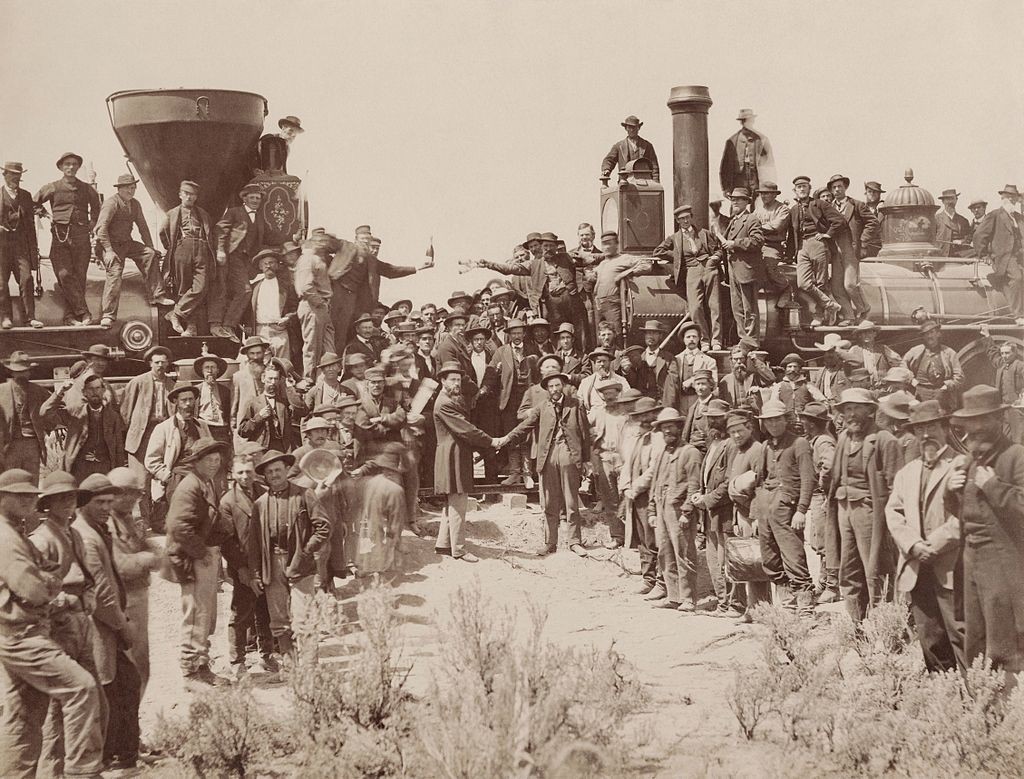
In 1783, following their Declaration of Independence seven years earlier, the United States won independence from Britain. The new nation extended inland from the Atlantic coast as far as the Mississippi River. The French still owned the land to the west of the river, known as Louisiana (having re-acquired it from Spain in 1800) but their leader, Napoleon Bonaparte, agreed to sell it to the United States in 1803. The Louisiana Purchase, as it was known, gave Americans a vast new territory in which to establish farms. Many Native American peoples still lived in this land, the American West. This did not stop the government from passing the Homestead Act of 1862, which encouraged people to move westwards. Soon railways were being built to link the West with the cities in the East.

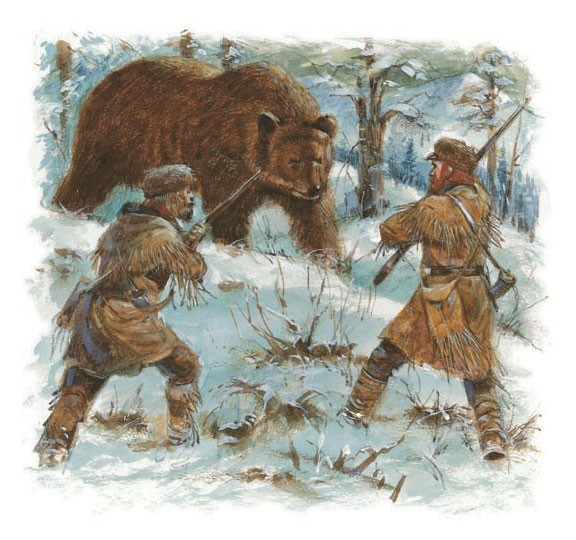
Lewis and Clark
In 1803, President Thomas Jefferson ordered Meriwether Lewis and William Clark to explore the territory west of the Mississippi River that the government had just purchased from the French. Their objective was to map the region and find a route to the western half of the continent. In 1804, Lewis, Clark and their team canoed up the Missouri River and crossed the Rocky Mountains on horseback. Then they journeyed down the Columbia River to the Pacific coast, returning to St Louis in 1806, a round trip of more than 12,000 kilometres (7500 miles).
Oregon Trail
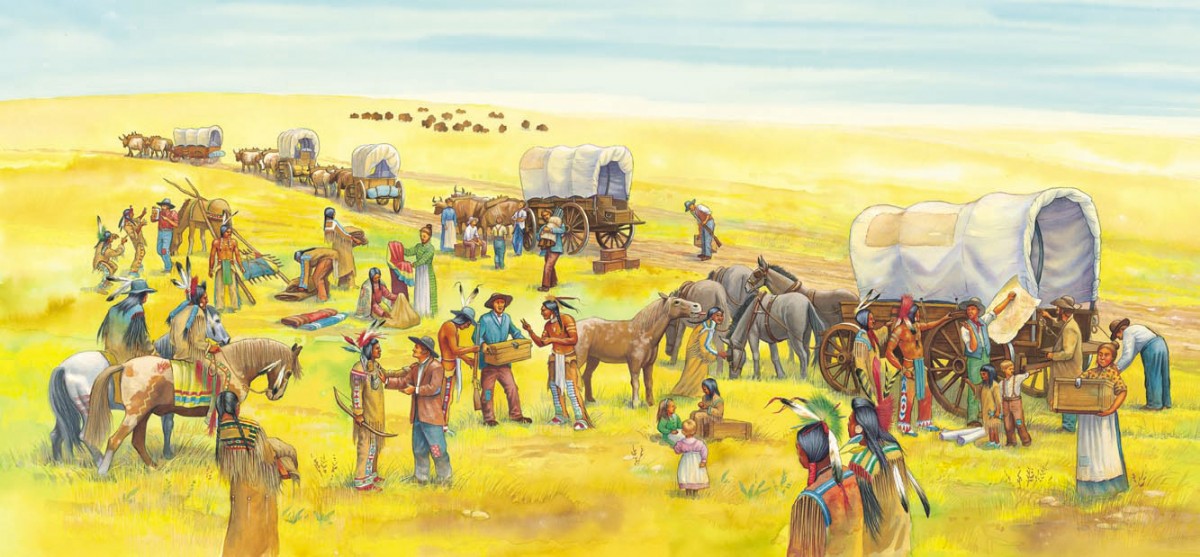
In the 1840s the USA gained control of Oregon on the northwest coast. It also acquired New Mexico following victory in a war with Mexico. The possibility of starting a new life in the West encouraged many people to set out on the dangerous journey westwards. Many took the Oregon Trail, which started at the Missouri River and ended in the lush Willamette Valley. The journey was very hazardous, and many died.
Homestead Act
By 1850, American settlers had reached the Mississippi River. In the West, farmers were beginning to move into Oregon and California. But much of the central part of the country, the Great Plains, remained unsettled by Europeans—although the land was home to the Plains Indians, among them the Sioux, Comanche and Cheyenne tribes. In 1862 the government passed the Homestead Act, which encouraged Europeans to move there and farm the land. It set aside large areas of land, and gave people a plot of 160 acres free as long as they built a house and lived there for five years.
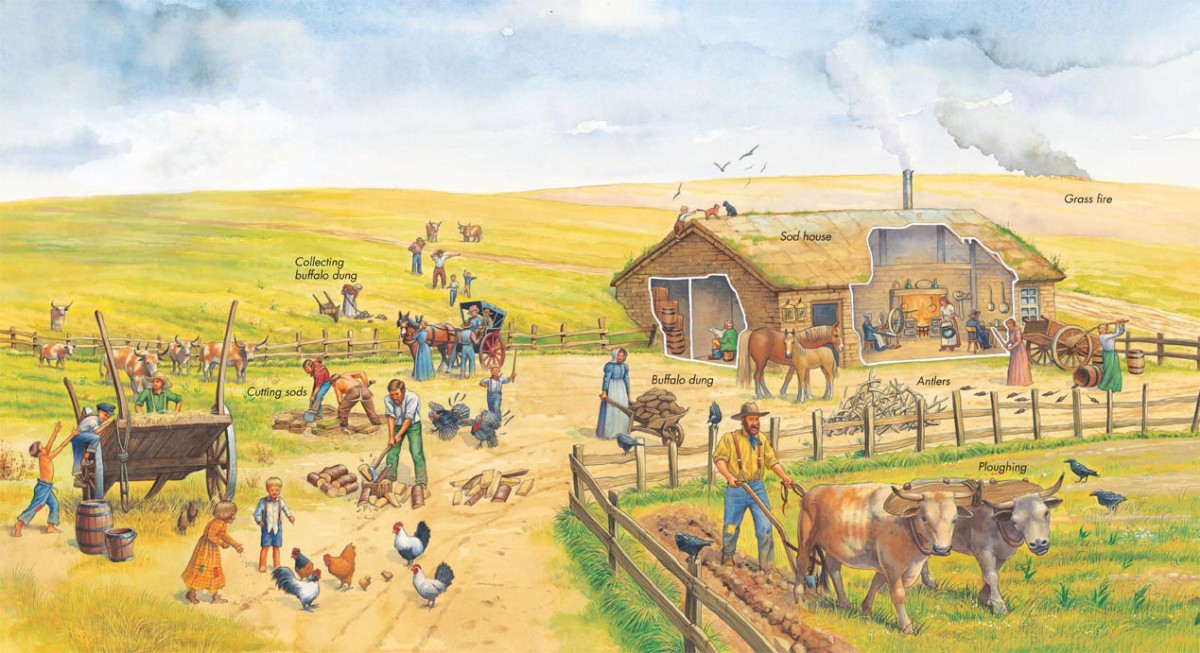
Hundreds of thousands of settlers eagerly took up this opportunity, among them African Americans who had once been slaves. The homesteaders, as they were called, were now able to build their own homes and farms. At the same time, the railway was being built across the continent. All of this spelt disaster for the Plains Indians.

A hard life
Life on the Great Plains was much harder than the homesteaders had expected. There were floods and snow in the winter, and droughts, fires and tornadoes in summer. Worst of all were the insects. Thick swarms of grasshoppers could suddenly settle on a homestead and eat all the crops in a matter of hours, leaving the homesteaders with nothing.
Conflict with Native Americans

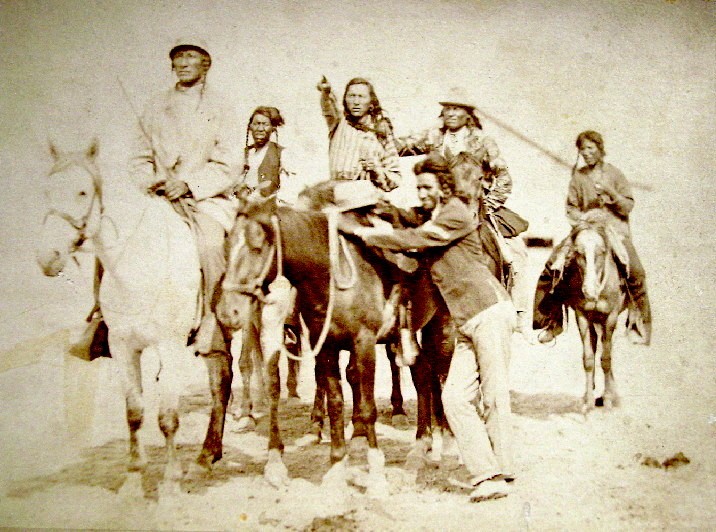
When people began to settle in the fertile West, the US Government promised the Native Americans that the Great Plains would always belong to them. However, as more people moved West, more land was needed. The government moved the Native Americans into smaller and smaller territories, and finally into reservations, areas of land occupied by one tribe, but run by white traders and settlers. This began years of terrible wars in which many people from both sides were killed. The cavalry (soldiers on horseback) of the US army protected settlers in the vast areas of land between the eastern USA and the new west. Cavalry soldiers were based at forts sited along the westward trails. People often settled near a fort for protection from Native Americans.
Cowboys
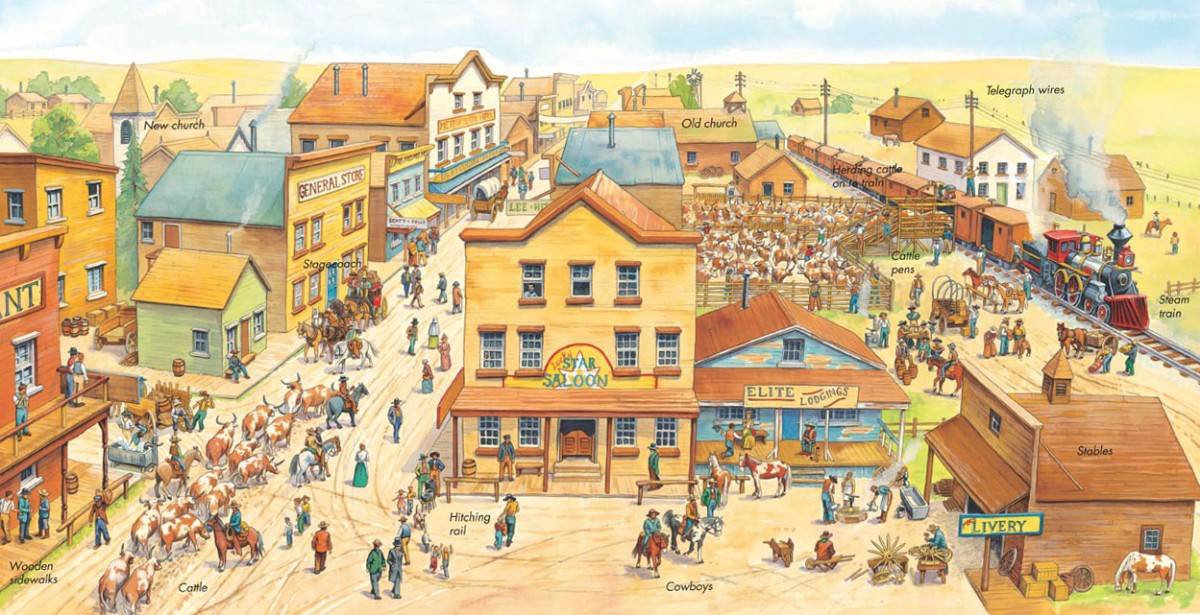
By the 1860s, railways linked the Great Plains to the rich cities in the East. The first ranchers (livestock farmers) settled on the Texas prairies. They used cowboys to herd their cattle north across the Great Plains to the railways, to be transported to markets in the East. Later, ranchers set up home on the Great Plains, closer to the railways. Early ranches were unfenced and cattle could wander for miles. The invention of barbed wire fencing meant that ranchers could keep their own cattle on their land and wild cattle out.
Life in a cattle town
Busy towns grew up on the Plains close to the railways. The cattle were driven by cowboys from the ranches in Texas along cattle trails to the railway towns. After their long journey, the cowboys often went wild when they got to town, getting drunk and brawling in the local saloon bars and dance halls. But they also brought in money to local business, such as the blacksmiths needed to re-shoe their horses.

Outlaws
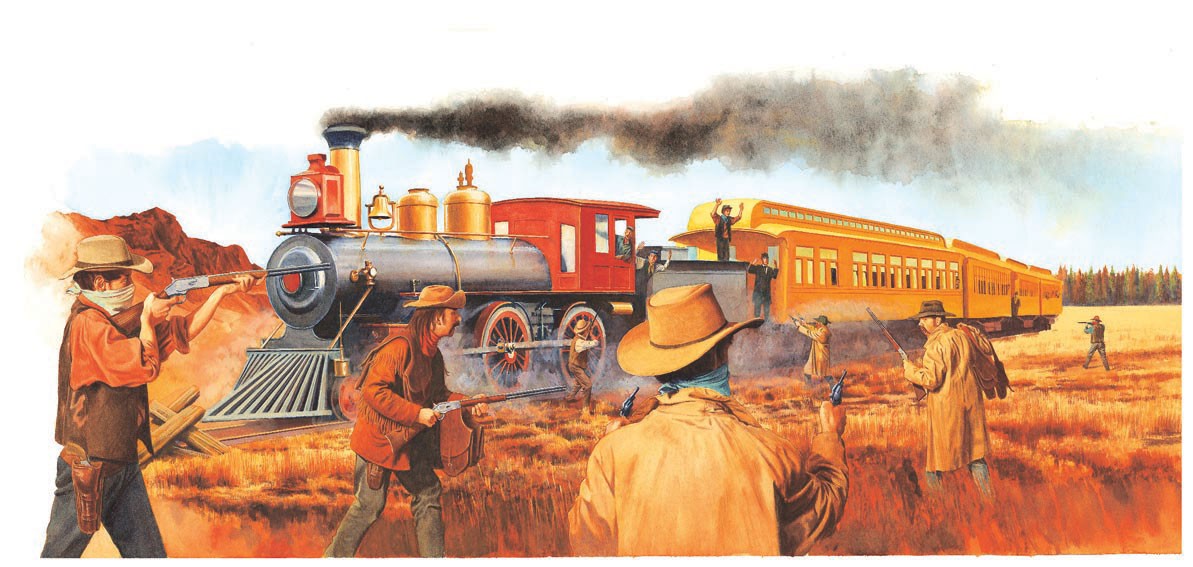
Busy cattle towns often attracted criminals, known as outlaws. Cattle rustlers tried to steal cattle as cowboys drove them towards the town. Other outlaws were robbers, highwaymen and even murderers. Trains were frequent targets. Some outlaws, such as Billy the Kid and Jesse James, became very well known. People wrote stories about their adventures, and myths grew up about how they lived and died.

Law and order
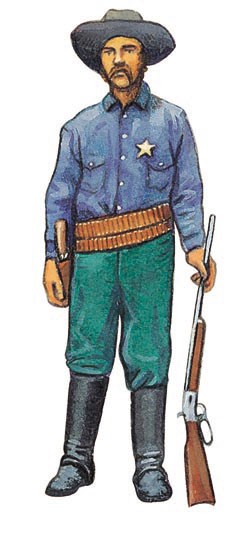
At first, no one took charge of law and order in the new towns that grew up across the West. Instead local people, called vigilantes, grouped together to catch outlaws and hang them for their crimes. However, the vigilantes also attacked innocent people and their own personal enemies. As the towns grew larger, and families began to move into them, the US government sent in marshals, sheriffs and judges.
Town marshals made sure that their town was law-abiding, and dealt with minor crimes such as fights. Sheriffs were in charge of counties. Both sheriffs and marshals had deputies to help them, and also used groups or “posses” of local people when hunting an outlaw. US marshals and their deputies took charge of a territory or state. They dealt with those accused of more serious crimes, and brought them to court to face a judge.
American Indian Wars
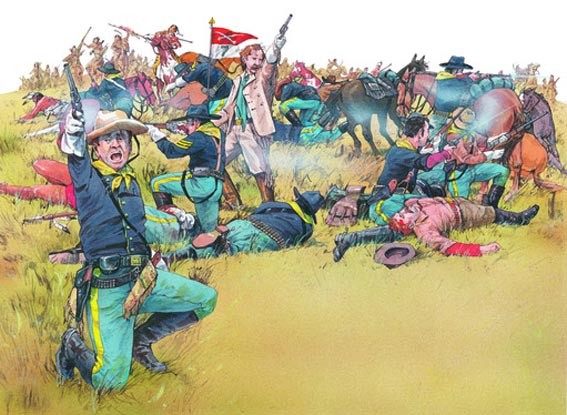
After years of battles in which the Native Americans (known as Indians to the Europeans) usually suffered most, the American Indian Wars between the US Army and the tribes reached their height at the Battle of Little Bighorn in 1876. The battle was fought between a number of tribes, including the Sioux, led by Sitting Bull, and US forces, led by General Custer. Custer's forces were crushed.
The army took revenge for its defeat by forcing all Native Americans into reservations where they had to obey US law, even if they had not taken part in the wars. Sitting Bull was killed by American troops in 1890.
In 1890, stories of a “Ghost Dance” which would make the settlers disappear seized the imagination of the Native Americans. In reality, the Ghost Dance was a religious movement that mixed moral teachings (such as honesty and peacefulness) with Native American traditions. But the army panicked, leading to the killing of 153 Sioux at the Massacre of Wounded Knee. This was the last major battle of the American Indian Wars—the Native Americans were defeated.

Consultant: Philip Parker
pics
Without in any way limiting Q-files Ltd’s exclusive rights under copyright, any use of this publication to “train” generative artificial intelligence (AI) technologies to generate text is expressly prohibited. Q-files Ltd reserves all rights to license use of this work for generative AI training and development of machine learning language models.