
Vikings
Viking ships
The Vikings were among the most skilful boatbuilders and sailors of their time. Their warships, known as longships or dragon ships, were sleek and fast. They were powered by square-shaped sails or, if there was no wind, by oarsmen. The front ends of the ships, the prows, were often carved into ornamental shapes, such as dragon’s heads.

Warships
The Vikings used their fastest ships, the longships, for raids. These ships were long and slender, and had flat bottoms. Their shape allowed them to be navigated up narrow inlets and to be landed on beaches—good for surprise attacks and quick getaways. The ships were flexible enough to bend a little when seas were rough.

The ships were fitted with sails but could also be rowed: some had 50 oars. A steering oar, fastened by leather bands to the hull, worked as a rudder. The helmsman steered using a tiller, which was attached to it. The chief warrior on each ship stood bravely at the bow. Brightly painted shields were slotted into racks that ran the length of the ship on either side.
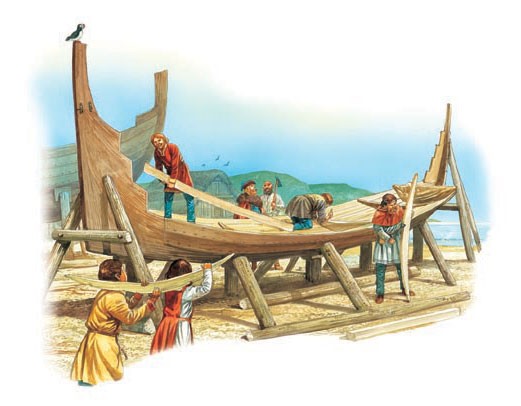
Construction
The hull of the longship was built from overlapping wooden planks, called strakes, a method known as clinker construction. The hull was symmetrical and had cross beams and ribs to give it strength. The gaps between the strakes were caulked (stuffed) with tarred animal hair to keep the water out. The ship had a keel—a strip of wood that ran the length of the ship and cut into the water, helping to reduce the rolling motion.
Cargo ship

The cargo ships which carried settlers to new lands, called knarrs, had wider hulls than those of the narrow longships the Vikings used in warfare. Like longships, they were built with overlapping planks. As well as people, a knarr had to have room for horses, cattle and all the stores needed to build a settlement overseas.
Consultant: Philip Parker