
Vikings

CITE
We have made every effort to follow citation style rules, but there may be some minor differences. If in doubt, please refer to the appropriate citation style manual.
Viking warriors. (2022). In Q-files Encyclopedia, History, Vikings. Retrieved from
https://www.q-files.com/history/vikings/viking-warriors
"Viking warriors." History, Vikings, Q-files Encyclopedia, 10 Feb. 2022.
https://www.q-files.com/history/vikings/viking-warriors.
Accessed 6 Aug. 2026.
Viking warriors 2022. History, Vikings. Retrieved 6 August 2026, from
https://www.q-files.com/history/vikings/viking-warriors
History, Vikings, s.v. "Viking warriors," accessed August 6, 2026.
https://www.q-files.com/history/vikings/viking-warriors


Viking warriors
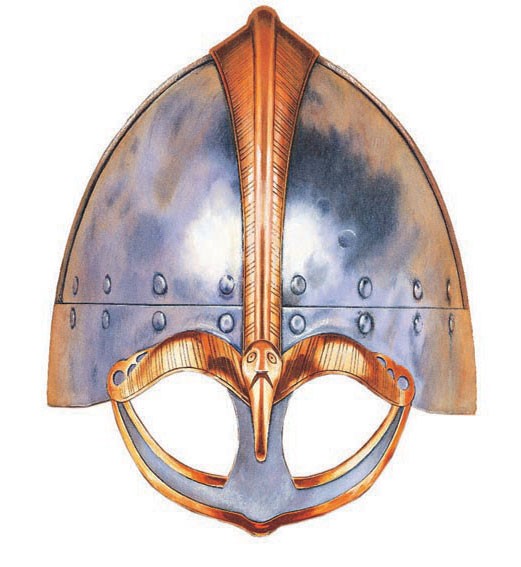
A warrior's weapons depended on his position in society. Ordinary Viking warriors wielded a battle-axe when raiding. With its sharp, deadly blade, it was much feared by enemies. Warriors might also thrust and throw a long spear. Noble warriors often used a sword instead, which was frequently handed down from father to son and thought to have magical powers. Nobles also wore chainmail tunics to protect themselves from sword cuts and axe blows. They were handmade from thousands of linked iron rings. Most Viking warriors, however, could only afford a wooden shield to defend themselves from attack, and some did not even have this. Contrary to popular belief, Viking warriors did not wear horned helmets.

Armour
A noble Viking warrior wore an iron helmet and a chainmail tunic. The shield was made of thick wood with a metal centre called a boss, which guarded the hand. Only the most important warriors wore iron helmets. These had guards around the eyes and over the nose for extra protection. Decorations on the helmet showed off the warrior’s wealth. Poorer Vikings sometimes had helmets made of leather.
Weapons
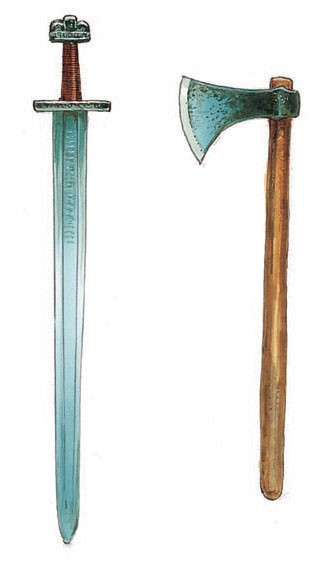
The spear was the Viking warrior’s most common weapon. Up to 3 metres (10 feet) long, it was used both as a throwing weapon and a thrusting weapon.
A sword gave its owner considerable prestige. Swords were often handed down from father to son and were thought to have magical powers. Usually double-edged, they were given vicious names, such as Skull-splitter or Leg-biter. When they died, warriors from wealthy families were buried with their beautifully crafted weapons, including iron swords with highly decorated hilts (handles). Poorer Vikings often carried large knives called seaxes into battle.
One of the Viking warrior’s favourite weapons was the battle-axe. This weapon could be either thrown or swung. With its sharp, deadly blade, it was much feared by the Vikings’ enemies.
Battle tactics
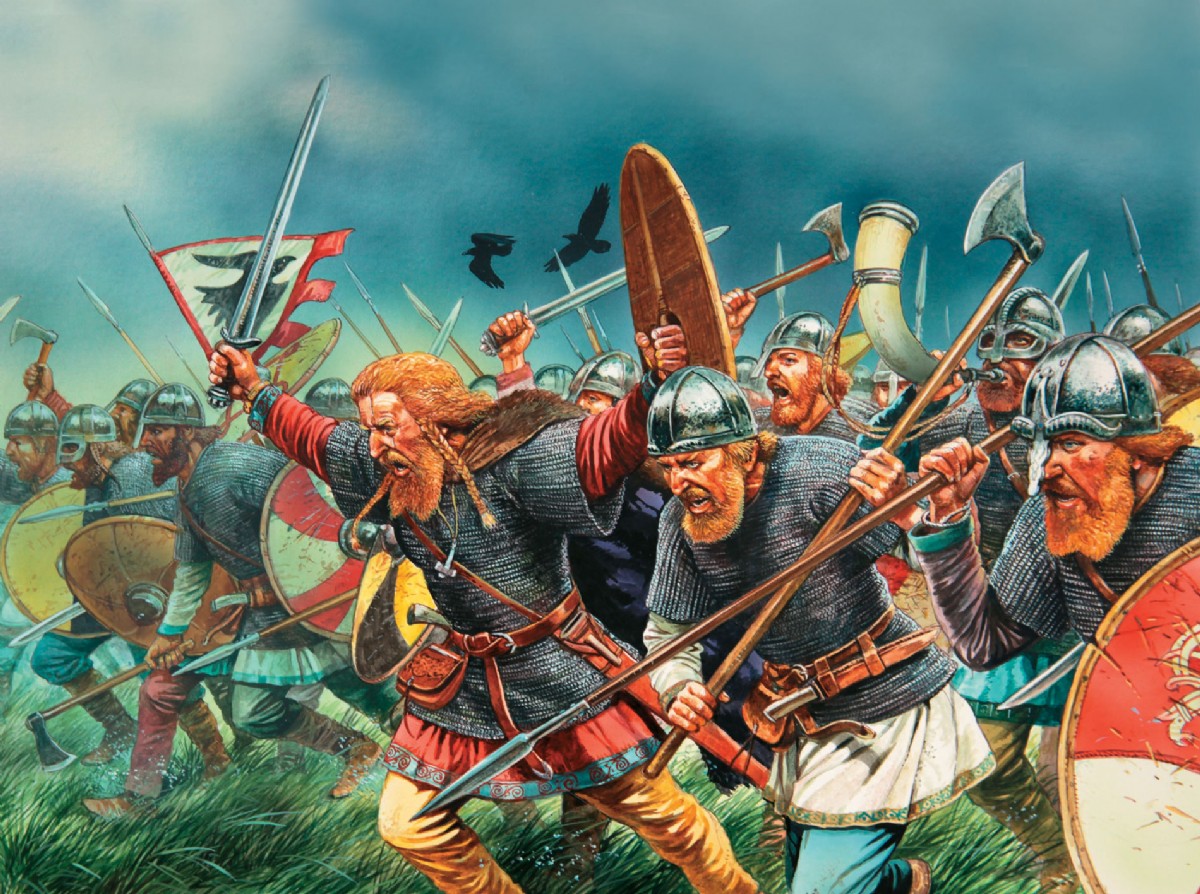
In the face of the enemy, the Vikings would stand together behind a wall of shields. Then they would attack by firing arrows and throwing spears. Hand-to-hand combat with swords and axes followed. If this did not result in victory, the Viking warriors would then attempt to break through enemy lines, capturing or killing their leaders if possible. To achieve this, the commander ordered some of his men to form a “wedge” of 20 to 30 warriors, with its point aimed towards the enemy line. The men would then charge, hoping to succeed by sheer weight of numbers.
Berserkrs
The Vikings believed that if a soldier died in battle he went to the hall of the god Odin. This was a great honour. The fiercest warriors were called berserkrs, named after the Norse word for bearskins. Before fighting, a berserkr would work himself into a wild, frenzied state. The frenzy would be so intense some would actually bite on the edges of their shields.
Fortress
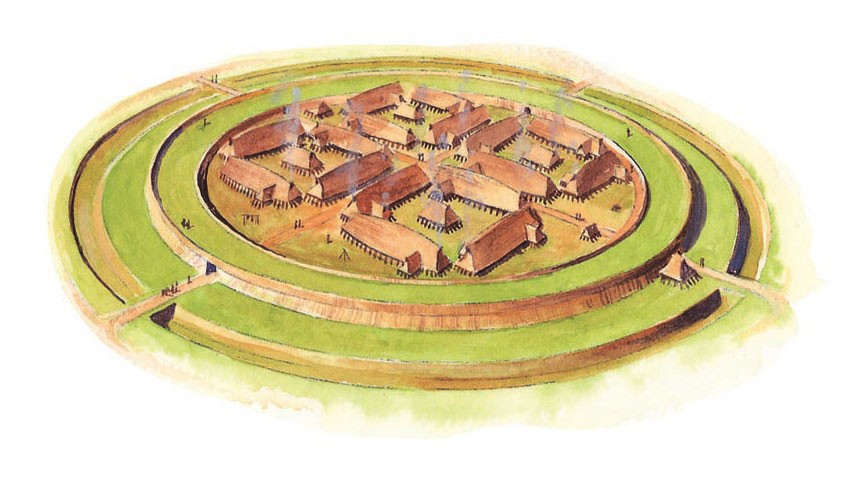
As royal power increased, kings constructed fortresses to dominate their lands. The largest were in Denmark. The wooden buildings were protected by circular embankments of wood and soil. Four wooden roads divided the fortress into quarters. There were four entrances to the fort.
Consultant: Philip Parker
pics
Without in any way limiting Q-files Ltd’s exclusive rights under copyright, any use of this publication to “train” generative artificial intelligence (AI) technologies to generate text is expressly prohibited. Q-files Ltd reserves all rights to license use of this work for generative AI training and development of machine learning language models.