
EASY READ The living world

CITE
We have made every effort to follow citation style rules, but there may be some minor differences. If in doubt, please refer to the appropriate citation style manual.
EASY READ How do trees live?. (2026). In Q-files Encyclopedia, Life, EASY READ The living world. Retrieved from
https://www.q-files.com/life/easy-read-the-living-world/easy-read-how-do-trees-live
"EASY READ How do trees live?." Life, EASY READ The living world, Q-files Encyclopedia, 24 Mar. 2026.
https://www.q-files.com/life/easy-read-the-living-world/easy-read-how-do-trees-live.
Accessed 13 Sep. 2026.
EASY READ How do trees live? 2026. Life, EASY READ The living world. Retrieved 13 September 2026, from
https://www.q-files.com/life/easy-read-the-living-world/easy-read-how-do-trees-live
Life, EASY READ The living world, s.v. "EASY READ How do trees live?," accessed September 13, 2026.
https://www.q-files.com/life/easy-read-the-living-world/easy-read-how-do-trees-live


How do trees live?
A tree is a tall plant with a stiff, woody trunk. The trunk is covered by bark and has branches growing out from it. There are two main kinds of tree: broadleaf trees and conifers. Trees give us fuel, timber, medicines, food, paper, rubber, fruits and oils. As large plants, they take in a great deal of carbon dioxide from the air and give off oxygen for us to breathe.


Parts of a tree
Like most plants, a tree has roots and a shoot. The shoot is made up of a trunk, its stem, and branches bearing leaves, buds, flowers and fruits (or, with conifer trees, needles and cones). The trunk holds up the tree while the branches and twigs spread out the leaves so that they receive as much sunlight as possible. At the base of the tree below the ground, a network of roots spreads outwards, anchoring the tree into the ground.
Inside the trunk

At the the centre of the trunk is the heartwood. It forms the tree’s strong “backbone”. Surrounding the heartwood is the sapwood. It is through this layer that water and nutrients are carried from the roots up to the leaves. A new layer of sapwood grows each year. There is more growth in warm, wet years than in cold, dry ones. On the outside of the trunk is the bark. The inner bark, the phloem, carries the food made in the leaves to the rest of the tree. The outer bark protects the tree against damage and keeps the trunk moist.
Sap
Water containing nutrients from the soil (xylem sap) is drawn up from the soil to the leaves through the sapwood. The leaves use the water together with carbon dioxide in the air to make food by photosynthesis. This process is powered by sunlight. The food passes from the leaves to all other parts of the tree as sap through the inner bark (phloem sap).

Roots
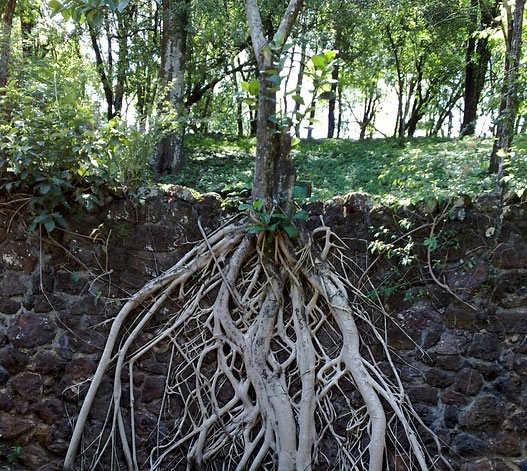
At the base of the tree, a network of roots spreads outwards through the soil, anchoring it into the ground. Behind the tips of each root grow root hairs. These soak up water and nutrients from the soil. A large tree may take up several hundreds of litres of water every day.
Rings
Each year, the growth layer of the trunk makes new bark on the outside and new sapwood on the inside. In this way, the trunk becomes thicker every year. If you look at the stump of a freshly cut-down tree, the sapwood that is added each year appears as a single ring. Count the number of rings and you will find the age of the tree.

Broadleaf trees


Most broadleaf trees are deciduous: they lose their leaves when it gets colder in autumn. The leaves turn yellow, red or browns as the nutrients inside them seep back into the tree. A scar forms at the base of each leaf stalk and the leaves fall off. In winter, the tree is protected by its waterproof bark. The following spring, new leaves grow from small buds and flowers blossom in the warmth. Fruits ripen during the summer months.
Conifers
The word conifer means “cone-bearing”. All conifers are bushes or trees. Firs, pines, spruces and redwoods are examples of conifers. Most conifers have long, narrow leaves called needles. The needles are tough: they can survive frost and long periods of drought. This means that conifers can grow in areas where the climate is cold or dry. Nearly all conifers are evergreen. Their needles are shed over the course of a year, but not all at the same time.

Cones

A conifer’s seeds are found on the faces of each of the scales that make up the cones. In damp weather, the scales are closed. When warm weather comes, they open and the seeds flutter away in the breeze.

Palm trees
A third kind of tree is the palm tree. It is a flowering plant which grows in hot countries. Palm trees have straight trunks without branches. At the top is a crown of large leaves. Coconut palms grow along tropical seashores. Their seeds ripen into coconuts. Sometimes these fall into the sea and float to other beaches where they grow into more coconut palm trees.
Consultant: Chris Jarvis
Ready to find out more?
Here are some pages in other parts of Q-files you might like to explore:
pics
Without in any way limiting Q-files Ltd’s exclusive rights under copyright, any use of this publication to “train” generative artificial intelligence (AI) technologies to generate text is expressly prohibited. Q-files Ltd reserves all rights to license use of this work for generative AI training and development of machine learning language models.