
EASY READ The living world

CITE
We have made every effort to follow citation style rules, but there may be some minor differences. If in doubt, please refer to the appropriate citation style manual.
EASY READ What lives in woodlands?. (2026). In Q-files Encyclopedia, Life, EASY READ The living world. Retrieved from
https://www.q-files.com/life/easy-read-the-living-world/easy-read-what-lives-in-woodlands
"EASY READ What lives in woodlands?." Life, EASY READ The living world, Q-files Encyclopedia, 24 Mar. 2026.
https://www.q-files.com/life/easy-read-the-living-world/easy-read-what-lives-in-woodlands.
Accessed 13 Sep. 2026.
EASY READ What lives in woodlands? 2026. Life, EASY READ The living world. Retrieved 13 September 2026, from
https://www.q-files.com/life/easy-read-the-living-world/easy-read-what-lives-in-woodlands
Life, EASY READ The living world, s.v. "EASY READ What lives in woodlands?," accessed September 13, 2026.
https://www.q-files.com/life/easy-read-the-living-world/easy-read-what-lives-in-woodlands


What lives in woodlands?
Most of the regions of the world that have a temperate climate are covered by farmland or cities. Some woodlands remain. In deciduous woodland, the trees lose their leaves at the onset of winter. Woodland trees and plants provide food and shelter for the animals that live there. Many of them are nocturnal: they come out only at night to hunt or to feed on plants. Some woodland animals hibernate: they spend the winter months asleep in burrows.


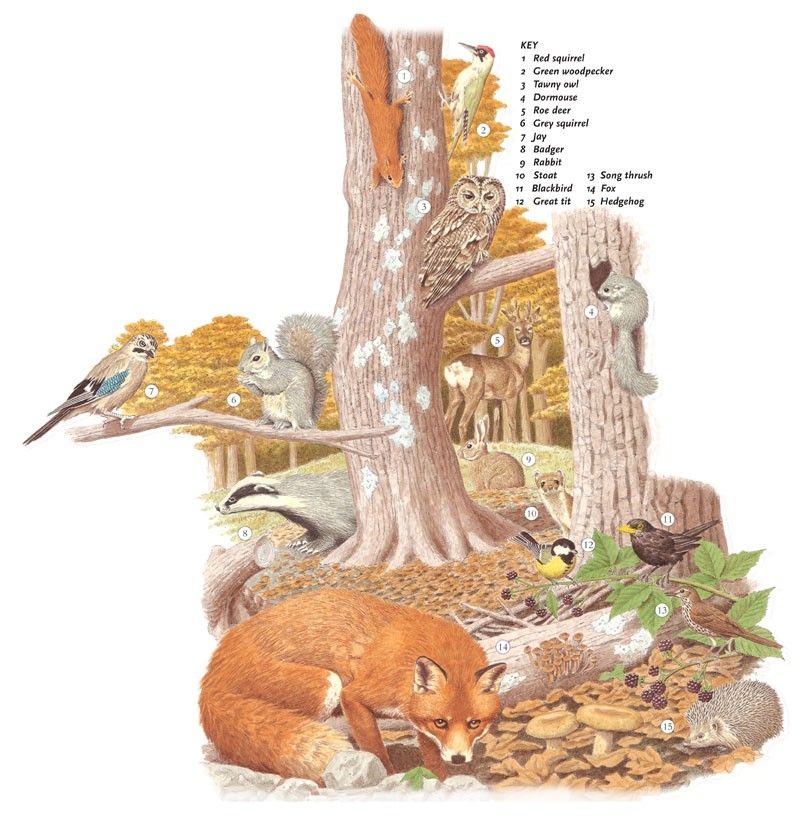
The woodland year
Woodlands are warm and leafy in summer, but cold and bare in winter. Autumn has begun in this wood in Europe (left). The leaves on the trees change colour and fall to the ground. Toadstools grow well in the moist ground. Squirrels and jays hide stores of nuts which will last them through the winter. Dormice prepare to hibernate during the cold months to come. Small mammals, such as voles and rabbits, must look out for foxes or owls in search of a meal.
When spring comes, plants and flowers start to grow again. Leaves on deciduous trees burst into bud in the warmer weather. Many animals and birds make nests, give birth to their young and search for food for them. As spring turns into summer, the leaves open fully and their fruits ripen.


Soil creatures
The woodland soil is home to many small creatures—some of them tiny. As they burrow their network of tunnels, earthworms help to spread nutrients (substances that plants and animals need in their food) through the soil. Worms are also a source of food for much larger burrowing animals, such as moles. Slugs and snails creep along, feeding on plant matter. Ants scurry through the tunnels and chambers that make up their nests. Ants, beetles and other small soil creatures are all prey for spiders.
Consultant: Chris Jarvis
Ready to find out more?
Here are some pages in other parts of Q-files you might like to explore:
pics
Without in any way limiting Q-files Ltd’s exclusive rights under copyright, any use of this publication to “train” generative artificial intelligence (AI) technologies to generate text is expressly prohibited. Q-files Ltd reserves all rights to license use of this work for generative AI training and development of machine learning language models.