
EASY READ The living world

CITE
We have made every effort to follow citation style rules, but there may be some minor differences. If in doubt, please refer to the appropriate citation style manual.
EASY READ What lives on grasslands?. (2026). In Q-files Encyclopedia, Life, EASY READ The living world. Retrieved from
https://www.q-files.com/life/easy-read-the-living-world/easy-read-what-lives-on-grasslands
"EASY READ What lives on grasslands?." Life, EASY READ The living world, Q-files Encyclopedia, 24 Mar. 2026.
https://www.q-files.com/life/easy-read-the-living-world/easy-read-what-lives-on-grasslands.
Accessed 30 Oct. 2026.
EASY READ What lives on grasslands? 2026. Life, EASY READ The living world. Retrieved 30 October 2026, from
https://www.q-files.com/life/easy-read-the-living-world/easy-read-what-lives-on-grasslands
Life, EASY READ The living world, s.v. "EASY READ What lives on grasslands?," accessed October 30, 2026.
https://www.q-files.com/life/easy-read-the-living-world/easy-read-what-lives-on-grasslands


What lives on grasslands?
Large areas where wild grass grows naturally are called grasslands. Some areas have scattered trees as well. Grasslands are found in areas where there is just enough rainfall to stop the land becoming a desert, but not enough rainfall for a woodland or forest to grow. Grasslands are often found in the centre of continents, far from the ocean. They are known as prairies in North America, steppes in Central Asia and pampas in South America.


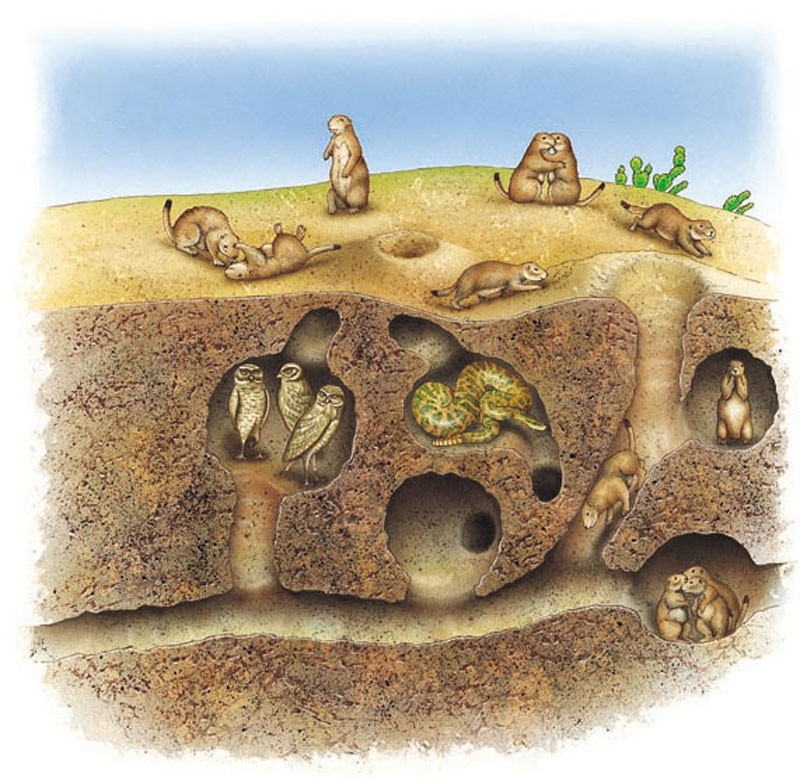
Prairie dogs
On the North American prairie, hundreds of prairie dogs (kinds of squirrel) may live together in underground “towns”: a huge network of burrows. Friendly greetings are made by touching noses. A warning bark from one of the group will send the others rushing down into the safety of their burrows. Old burrows are used by other animals such as burrowing owls or rattlesnakes.
Termites
Dotted around tropical grasslands are huge towers made of compacted soil. These are termite nests. Each is home to millions of termites. Inside is a maze of passages and chambers. At the centre live the king and queen termites. The queen’s huge body is full of eggs. Other termites, called workers, look after the young and go out to find food. The workers collect dead plant material and put it into moist chambers in the nest. Soldier termites guard entrances to the nest.

Consultant: Chris Jarvis
Ready to find out more?
Here are some pages in other parts of Q-files you might like to explore:
pics
Without in any way limiting Q-files Ltd’s exclusive rights under copyright, any use of this publication to “train” generative artificial intelligence (AI) technologies to generate text is expressly prohibited. Q-files Ltd reserves all rights to license use of this work for generative AI training and development of machine learning language models.