
EASY READ The living world

CITE
We have made every effort to follow citation style rules, but there may be some minor differences. If in doubt, please refer to the appropriate citation style manual.
EASY READ What is soil?. (2026). In Q-files Encyclopedia, Life, EASY READ The living world. Retrieved from
https://www.q-files.com/life/easy-read-the-living-world/easy-read-what-is-soil
"EASY READ What is soil?." Life, EASY READ The living world, Q-files Encyclopedia, 24 Mar. 2026.
https://www.q-files.com/life/easy-read-the-living-world/easy-read-what-is-soil.
Accessed 13 Sep. 2026.
EASY READ What is soil? 2026. Life, EASY READ The living world. Retrieved 13 September 2026, from
https://www.q-files.com/life/easy-read-the-living-world/easy-read-what-is-soil
Life, EASY READ The living world, s.v. "EASY READ What is soil?," accessed September 13, 2026.
https://www.q-files.com/life/easy-read-the-living-world/easy-read-what-is-soil


What is soil?
Soil is a vital part of the natural world. It consists of fragments of rock mixed with humus. Humus is the rotting remains of leaves, animal droppings and other organic matter. Between the soil particles are large air spaces. These allow water to drain through the soil. They also allow oxygen to reach both the plant roots and the living things in the soil. Nutrients that are essential to plant life, such as nitrates and phosphates, are also found in the soil.


Soil layers
A slice through the ground reveals the different soil layers, called horizons. At the top is leaf litter: old leaves, twigs and feathers. Below is the topsoil. This layer is rich in organic matter: dead and decaying remains of plants and animals. Home to soil creatures, it also contains the roots of small plants.
Below the topsoil is the subsoil. This has less organic matter, and more and larger rock fragments. The roots of bushes and trees grow into the subsoil. Going deeper into the subsoil, the rock fragments become larger and more frequent until the bedrock itself is reached.
Soil life
Soil contains a mass of living things, most of which are too tiny for us to see. But they perform a vital task: recycling the remains of dead animals and plants into nutrients. These nutrients are then taken up by the roots of living plants. The tiniest of the workers are bacteria. A handful of soil will contain over 10 billion of them—more than there are people living in the world.


Earthworms also have a vital role to play. They tunnel through the soil, letting air in, helping water drain through and mixing up the different soil layers. Insects, spiders, mites and centipedes hunt in the soil, and larger animals like moles and voles make their burrows there.
Nutrient cycle
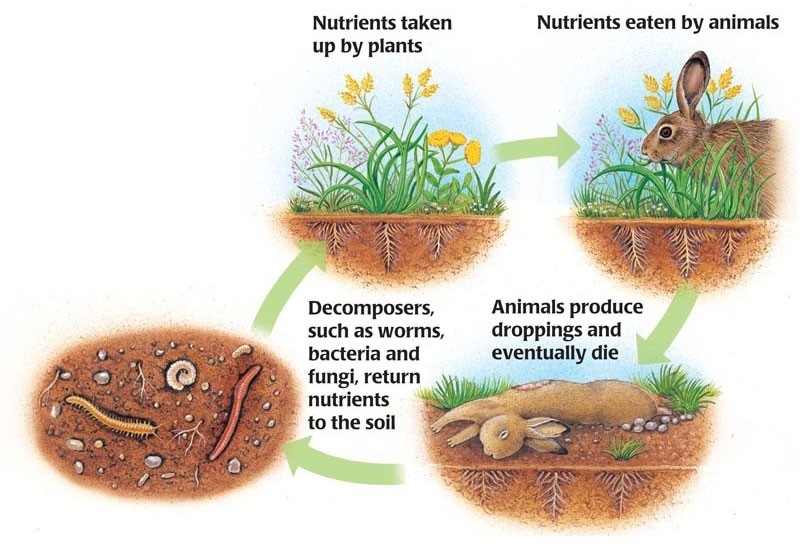
These nutrients return to the soil through waste, or when an animal dies. Fungi, bacteria and earthworms help the rotting process by which living things decay and release the nutrients into the soil. Here they are taken up by plants once more. The cycle begins again.
Consultant: Chris Jarvis
Ready to find out more?
Here are some pages in other parts of Q-files you might like to explore:
pics
Without in any way limiting Q-files Ltd’s exclusive rights under copyright, any use of this publication to “train” generative artificial intelligence (AI) technologies to generate text is expressly prohibited. Q-files Ltd reserves all rights to license use of this work for generative AI training and development of machine learning language models.