
Reptiles
Snakes
Snakes are a group of reptiles that have long, narrow, scale-covered bodies and tails and no limbs. Some legless lizards resemble snakes, but snakes are distinguished from them by their lack of external ears or eyelids. Snakes have many more bones in their spines than other animals. They move by flexing their belly muscles, which are attached to their many ribs. As they move, most snakes curve their bodies into a series of S-shapes, giving them greater speed. Snakes moult throughout their lives, ridding themselves of old, worn skin and replacing it with a bright new layer of skin from time to time.


Reproduction
Many snakes lay eggs, and a few kinds will guard them from predators until they hatch. There are some snakes, such as sea snakes, that give birth to live young. In all cases, young snakes are left to fend for themselves at birth.
Diet
All snakes are carnivores. Some kinds eat small animals, such as snails or worms, but most feed on larger prey, such as frogs, birds and mammals. Snakes have special loosely hinged jaws that can open extremely wide. Their skin can also stretch to take large prey. They swallow their prey whole, using their sharp teeth to pull it into the throat and their muscles to squeeze it into the stomach. A snake may only need to hunt and feed every few weeks or even months.

Senses
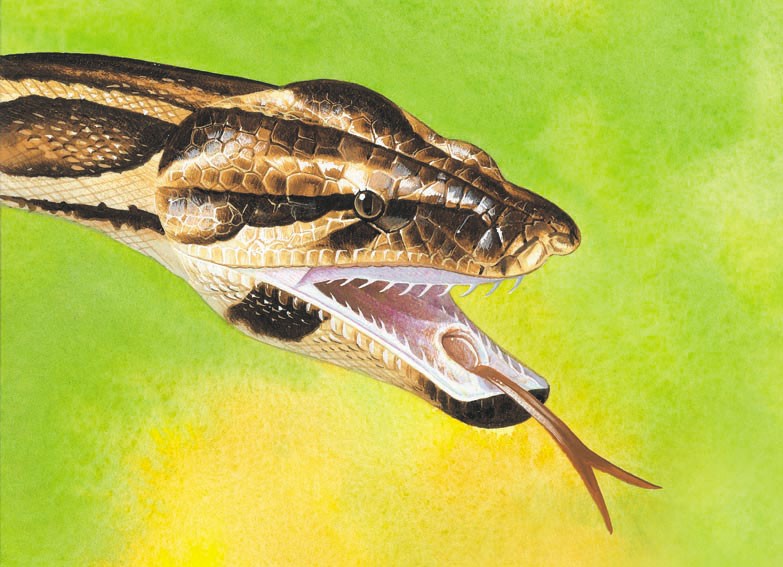
Some snakes have good vision, but most rely on special senses to hunt their prey. Like lizards, snakes are able to collect “tastes” from the air or ground by flicking out their forked tongues. Some kinds of snakes also have heat sensors on their heads that help them to locate the whereabouts of live prey accurately, even at night. Many snakes are also sensitive to faint vibrations in the ground, and so can tell if another animal is approaching.
Hunting

Large prey takes a long time to swallow, so it must be killed first. Some snakes, called constrictors, coil around their prey, suffocating it. Every time the prey exhales, the snake tightens its coils, until the victim cannot breathe. Boas and pythons are constrictors.
Other snakes, such as vipers and cobras, have venom glands. When the snake bites its prey, the venom runs down through the fangs and into the wound. Snakes also bite in defence, and many can kill humans.
Agility
Because of their many bones, strong muscles and flexible joints, snakes are able to slither, burrow or swim at speed, despite having no limbs. Some snakes, such as the python, can even climb trees. The snake grips the tree trunk or branch with its neck or tail then pulls the rest of its body up or down.

Sea snakes
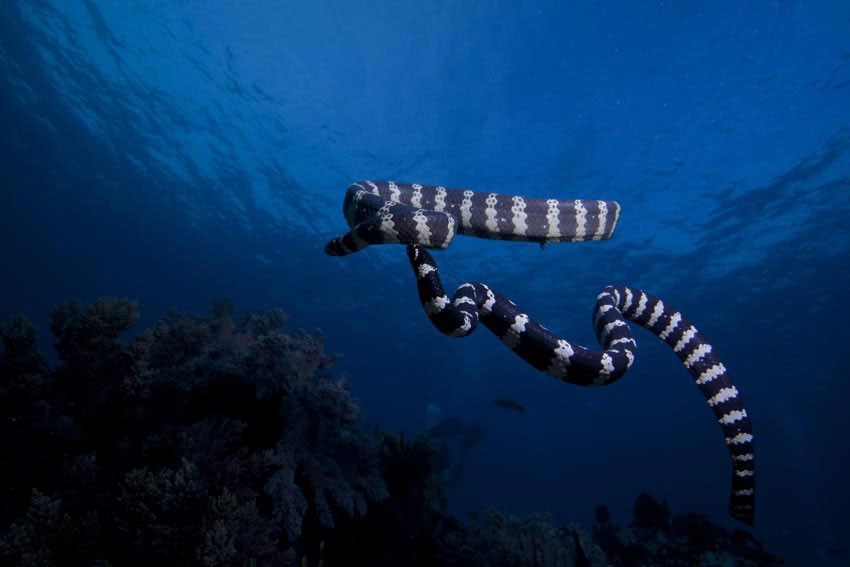
Sea snakes live in warm, tropical waters, hunting fish and eels. They breathe air at the surface and have flattened tails to help them swim. There are around 60 species of sea snake, all of which are venomous. Many species have stripy skin, to help them camouflage with the dappled light and shade of the sea.
Garter snakes
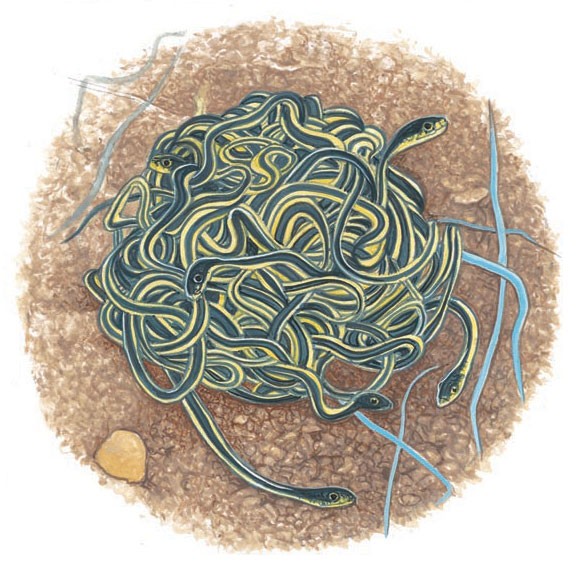
In southern Canada, warmer weather in spring signals the start of the breeding season for red-sided garter snakes. They spend winter in rock crevices, sheltering from frosts, but start to emerge in spring. As each female comes out, she is quickly surrounded by males, all competing to mate with her. “Mating balls” of males around one female may contain up to 100 individuals.
Consultant: Chris Jarvis