
Reptiles

CITE
We have made every effort to follow citation style rules, but there may be some minor differences. If in doubt, please refer to the appropriate citation style manual.
Cobras. (2026). In Q-files Encyclopedia, Life, Reptiles. Retrieved from
https://www.q-files.com/life/reptiles/cobras
"Cobras." Life, Reptiles, Q-files Encyclopedia, 24 Mar. 2026.
https://www.q-files.com/life/reptiles/cobras.
Accessed 22 Sep. 2026.
Cobras 2026. Life, Reptiles. Retrieved 22 September 2026, from
https://www.q-files.com/life/reptiles/cobras
Life, Reptiles, s.v. "Cobras," accessed September 22, 2026.
https://www.q-files.com/life/reptiles/cobras


Cobras
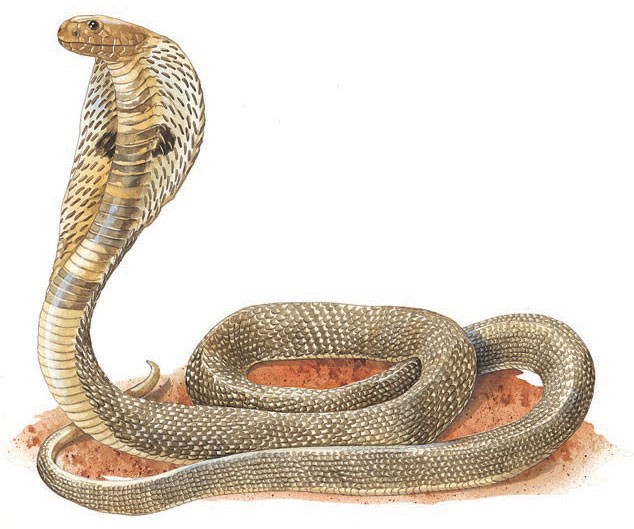
Cobras are venomous snakes with a hood of skin behind their heads which they use in a threat display. They live in both Asia and southern Africa. Cobras have two fangs at the front of their mouths, used to inject a venom that paralyses, then kills, their prey. Cobras eat mainly other snakes, lizards, small mammals and frogs. They rarely attack humans, but will do so if disturbed. Their main predators are other snakes and mongooses.


Attack
Cobras have two long, sharp fangs that can deliver a deadly venom to their prey. When they are startled or threatened, cobras rear up and spread out the hoods of skin behind their heads to frighten their attackers. They may also make a low growl-like hiss. Cobras can strike with lightning speed. Their venom first paralyses, then kills, their prey.
King cobra
The king cobra, from South and Southeast Asia, preys mainly on other snakes. Over 5 metres (16 feet) long, it is the world's largest venomous snake. It is also one of the most feared. An adult human can die from a single bite in less than 15 minutes. Its main predator is the mongoose, which has resistance to its venom. If unable to flee from a mongoose, the king cobra spreads it hood, emits hisses and makes pretend strikes. Being too large for the mongoose to kill with ease, this threat display is usually successful.
Indian cobra
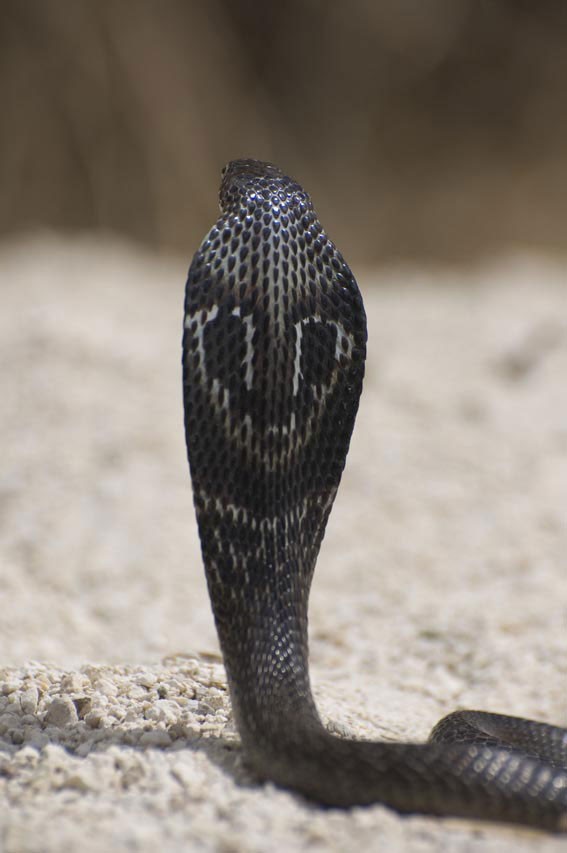
The Indian cobra, or spectacled cobra, lives in the Indian subcontinent, and is found in plains, rainforests and farmland. It preys on rats, which commonly live among humans, so the cobra is also often found in densely inhabited areas as well. The most distinctive feature of the Indian cobra is its hood. It spreads it when threatened by widening some of the ribs in its neck. The spectacle pattern on its hood, along with its overall colour, varies from one individual snake to the next. It averages about 1.9 metres (6 feet) in length, sometimes reaching 2.4 metres (nearly 8 feet).
Consultant: Chris Jarvis
pics
Without in any way limiting Q-files Ltd’s exclusive rights under copyright, any use of this publication to “train” generative artificial intelligence (AI) technologies to generate text is expressly prohibited. Q-files Ltd reserves all rights to license use of this work for generative AI training and development of machine learning language models.