
EASY READ Data

CITE
We have made every effort to follow citation style rules, but there may be some minor differences. If in doubt, please refer to the appropriate citation style manual.
What is probability?. (2025). In Q-files Encyclopedia, Maths, EASY READ Data. Retrieved from
https://www.q-files.com/maths/easy-read-data/what-is-probability
"What is probability?." Maths, EASY READ Data, Q-files Encyclopedia, 10 Nov. 2025.
https://www.q-files.com/maths/easy-read-data/what-is-probability.
Accessed 31 Oct. 2026.
What is probability? 2025. Maths, EASY READ Data. Retrieved 31 October 2026, from
https://www.q-files.com/maths/easy-read-data/what-is-probability
Maths, EASY READ Data, s.v. "What is probability?," accessed October 31, 2026.
https://www.q-files.com/maths/easy-read-data/what-is-probability


What is probability?
We use probability to measure how likely it is that something will happen. We can describe probability as, for example, a one-in-four chance, or write it as a decimal (0.25), a fraction (1/4), or as a percentage (25%). Probability is part of a branch of mathematics called statistics, which is about understanding data.


How likely is it?
If something is likely to happen, we say it has a high probability. If it is unlikely, we say it has a low probability.
If something is definitely going to happen, we say it is certain. For example, in a jar containing only yellow marbles, it is certain that when we pick one out, it will be yellow. In this case, the probability is 1, 10/10, or 100%.
Outcomes
In probability, when something happens, the result is called an outcome.
When you flip a coin, there are two possible outcomes: “heads” or “tails”.
When you roll a dice, there are six possible outcomes: rolling a 1, 2, 3, 4, 5 or a 6.

Working out probability

To work out the probability that an event will happen, we need to know two things: the number of ways it can happen, and the total number of outcomes possible.

For example, let’s say we want to work out the probability that when you reach into a bag of sweets, you will pick out a red one. There are 10 sweets in the bag altogether and 3 of them are red.
To work out the probability of picking a red sweet we use the formula:
Probability = number of ways something can happen / total number of outcomes
The number of ways to pick a red sweet = 3 (there are 3 red sweets which could be picked) and the total number of outcomes is 10 (there are 10 sweets in total which could be picked).
3 / 10 = 0.3
So the probability of picking a red sweet = 0.3
We can also write this as a fraction (3/10), or as a percentage (30%), or describe it as a three-in-ten chance.
Writing probability
The most common way of writing probability is as a fraction. The closer a fraction is to a whole (1), the higher the probability, and the more likely an event is to happen.
Probability can also be written as a percentage, which tells us the likelihood out of 100 that something will happen. A probability of 100% means that something is certain to happen. 50% probability means that it is equally likely to happen or not happen. 0% probability means that it definitely won't happen.

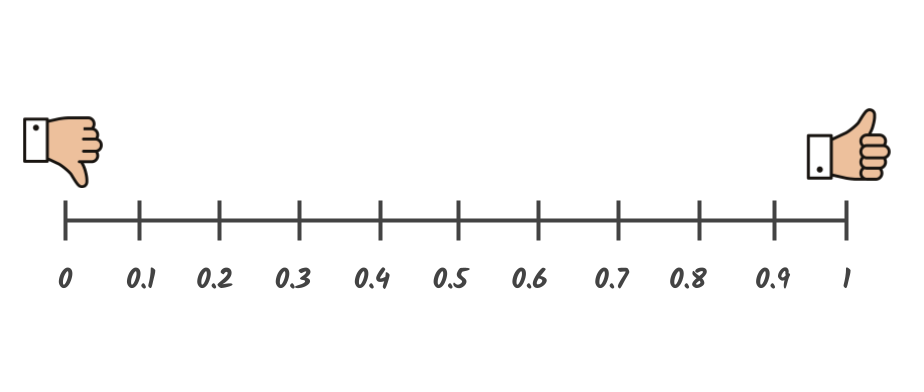
When probability is written as a decimal, it can only be a number between 0 and 1. The closer the number is to 1, the higher the probability. Something with a probability of 0.8 or 0.9 is very likely to happen, while something with a probability of 0.1 or 0.2 is unlikely to happen.
Consultant: Adam Larking
Key words
certain definitely going to happen
outcome the result, for example, pulling a red sweet from the bag, or flipping a coin with "heads" facing up
probability how likely it is that something will happen
statistics the study of data
pics
Without in any way limiting Q-files Ltd’s exclusive rights under copyright, any use of this publication to “train” generative artificial intelligence (AI) technologies to generate text is expressly prohibited. Q-files Ltd reserves all rights to license use of this work for generative AI training and development of machine learning language models.