
EASY READ Numbers

CITE
We have made every effort to follow citation style rules, but there may be some minor differences. If in doubt, please refer to the appropriate citation style manual.
What is place value?. (2025). In Q-files Encyclopedia, Maths, EASY READ Numbers. Retrieved from
https://www.q-files.com/maths/easy-read-numbers/what-is-place-value
"What is place value?." Maths, EASY READ Numbers, Q-files Encyclopedia, 10 Nov. 2025.
https://www.q-files.com/maths/easy-read-numbers/what-is-place-value.
Accessed 13 Sep. 2026.
What is place value? 2025. Maths, EASY READ Numbers. Retrieved 13 September 2026, from
https://www.q-files.com/maths/easy-read-numbers/what-is-place-value
Maths, EASY READ Numbers, s.v. "What is place value?," accessed September 13, 2026.
https://www.q-files.com/maths/easy-read-numbers/what-is-place-value


What is place value?
Numbers are made up of digits: 0, 1, 2, 3, 4, 5, 6, 7, 8 and 9. Place value helps us to understand the value of each digit in a number, by looking at its position or “place” in the number.


Digits
The numbers 1 to 9 have only one digit. The number 10 has two digits, and so do all the numbers up to 99. The number 100, and all the numbers up to 999 have three digits. The number 1000 and all the numbers up to 9999 have 4 digits.
Place value headings
Place value headings help us to understand the value of each digit in a number. The ones have the smallest place value. The tens have the next highest, the hundreds the next.

After the hundreds come the thousands, ten thousands, hundred thousands, millions, ten millions, and so on.

Tenths, hundredths and thousandths
Going the other way on the chart place values get smaller. To the right of the ones comes the decimal point. Then come the tenths, hundredths and thousandths. As we move farther to the right of the decimal point, the place value of each heading gets smaller and smaller.
If you broke a biscuit into tenths, each piece would be quite small. But if it were broken into thousandths, each piece would be extremely tiny.
Larger or smaller?
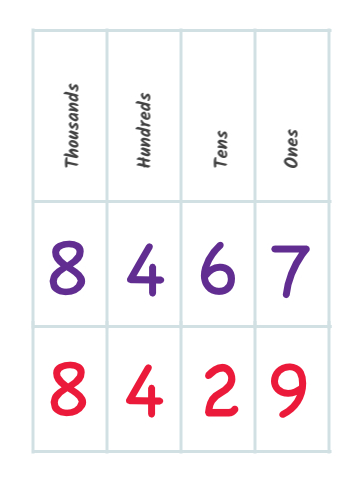
Place value tells you which numbers are larger or smaller. Take two numbers, such as the two in this example (one in purple, the other in red). Start with the Thousands and compare the digits in that column. The digits, both 8, are the same, so compare the digits in the next position to the right, the Hundreds. These digits, both 4, are also the same, so compare the digits in the Tens column. Here the purple 6 is larger than the red 2. This means that the purple number is larger than the red one.

Multiplying and dividing using place value
Place value can be used to multiply or divide numbers by 10, 100 or 1000. When multiplying by 10, each digit moves one place to the left: ones become tens, tens become hundreds, and so on. When multiplying by 100, each digit moves two places to the left: ones become hundreds, tens become thousands, and so on. When multiplying by 1000, each digit moves three places to the left. If there are no digits in a certain position, put a zero (0) in there instead.
When dividing by 10, each digit moves one place to the right: hundreds become tens, tens become ones, ones become tenths. When dividing by 100, each digit moves two places to the right: hundreds become ones, tens become tenths. When dividing by 1000, each digit moves three places to the right: thousands become ones.

Consultant: Adam Larking
Key words
decimal point a dot in a number that separates the part which is whole from the fractional (broken-up) part (tenths, hundredths and thousandths)
digit when a single number, such as 1, 2, or 3, is written as part of a bigger number we call it a digit
value the amount that something, such as a number, is worth
pics


Without in any way limiting Q-files Ltd’s exclusive rights under copyright, any use of this publication to “train” generative artificial intelligence (AI) technologies to generate text is expressly prohibited. Q-files Ltd reserves all rights to license use of this work for generative AI training and development of machine learning language models.