
EASY READ Numbers

CITE
We have made every effort to follow citation style rules, but there may be some minor differences. If in doubt, please refer to the appropriate citation style manual.
How do we work with decimals?. (2025). In Q-files Encyclopedia, Maths, EASY READ Numbers. Retrieved from
https://www.q-files.com/maths/easy-read-numbers/how-do-we-work-with-decimals
"How do we work with decimals?." Maths, EASY READ Numbers, Q-files Encyclopedia, 10 Nov. 2025.
https://www.q-files.com/maths/easy-read-numbers/how-do-we-work-with-decimals.
Accessed 31 Oct. 2026.
How do we work with decimals? 2025. Maths, EASY READ Numbers. Retrieved 31 October 2026, from
https://www.q-files.com/maths/easy-read-numbers/how-do-we-work-with-decimals
Maths, EASY READ Numbers, s.v. "How do we work with decimals?," accessed October 31, 2026.
https://www.q-files.com/maths/easy-read-numbers/how-do-we-work-with-decimals


How do we work with decimals?
When doing calculations, decimals are easier to work with than fractions because we can compare the values of numbers instantly. We can add, subtract, divide and multiply decimals and decimal numbers just like whole numbers. It is useful to understand place value when doing sums with decimals.

Decimal equivalents
Every fraction can also be written as a decimal. This is called its decimal equivalent.
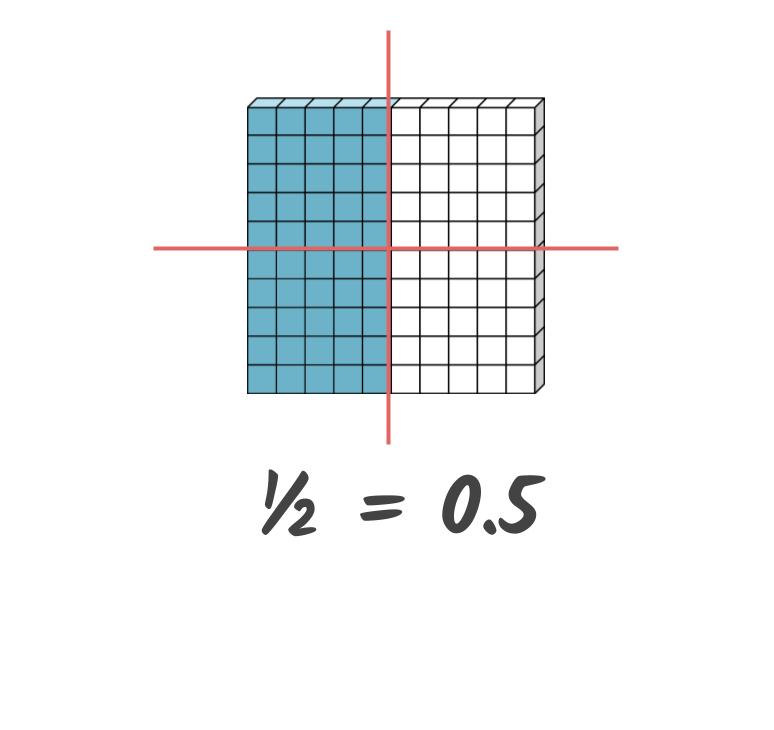
To find out the decimal equivalent of a half (½), take a shape made up of 100 blocks. Divide the shape in two (halve it) and count the blocks. There are 50. So a half is the same as 50 hundredths. Use place value to write this as a decimal: 0.50. This is the decimal equivalent of a half. We often leave off the last 0, so it is written 0.5.
Now follow the same steps to work out the decimal equivalent of a quarter (¼). This time the shape is divided into four equal parts. There are 25 blocks in each, so this means a quarter is the same as 25 hundredths. Written as a decimal this is 0.25.

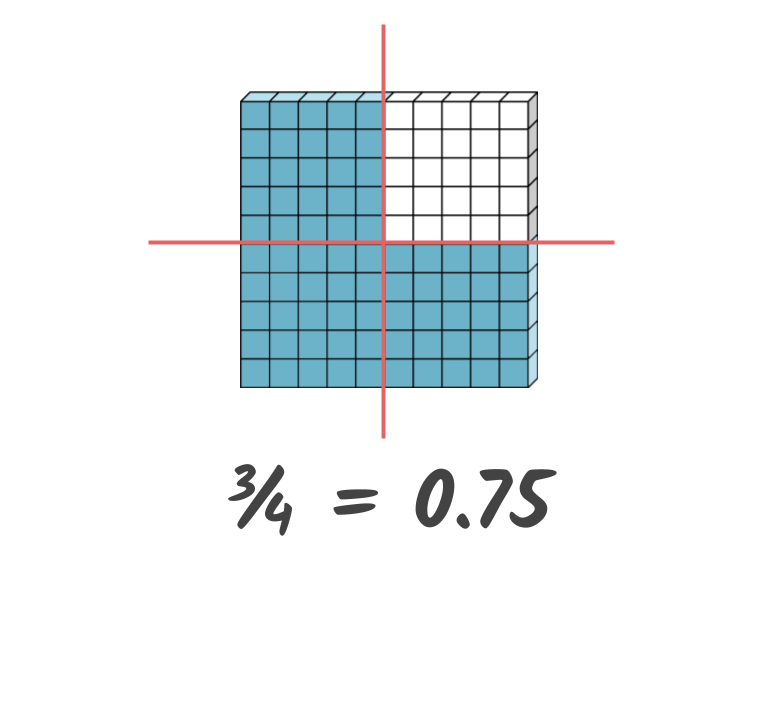
To work out the decimal equivalent of three-quarters (¾), take three of those four equal parts, each made up of 25 blocks. You can either add them up or multiply 25 by 3 to get the same total, 75. This means three-quarters is the same as 75 hundredths. Its decimal equivalent is 0.75.
Sums with decimals
You can add or subtract decimal numbers in the same way as you would add or subtract whole numbers. An example of an addition sum is this: 2.1 + 3.4 = 5.5. An example of a subtraction sum is this: 6.7 - 3.4 = 3.3.
This is an example of an addition sum using numbers with two decimal places: 4.56 + 5.32 = 9.88.

You can also divide or multiply decimal numbers in the same way as you would divide or multiply whole numbers. An example of a division sum is this: 4.6 ÷ 2 = 2.3. An example of a multiplication sum is this: 2.3 x 3 = 6.9.

Dividing and multiplying by 10 or 100
When you divide a number by 10, you slide that number one place to the right. So, using whole numbers, 50 ÷ 10 = 5. You do the same for decimals: 5 ÷ 10 = 0.5 (slide the 5 one place to the right, this time to the right of the decimal point).
When you divide a number by 100, you slide that number two places to the right: 5 ÷ 100 = 0.05.
To multiply numbers by 10, slide the number one place to the left. 2.3 x 10 = 23.0 (or just 23).
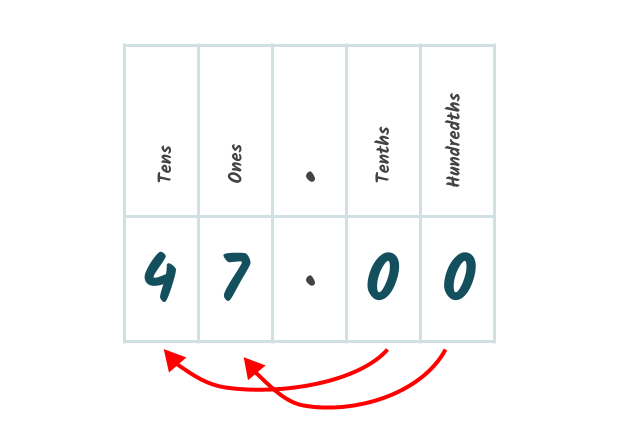
When multiplying a number by 100, slide the number two places to the left. 0.47 x 100 = 47.00 (or just 47).
Consultant: Adam Larking
pics
Without in any way limiting Q-files Ltd’s exclusive rights under copyright, any use of this publication to “train” generative artificial intelligence (AI) technologies to generate text is expressly prohibited. Q-files Ltd reserves all rights to license use of this work for generative AI training and development of machine learning language models.