
EASY READ Numbers

CITE
We have made every effort to follow citation style rules, but there may be some minor differences. If in doubt, please refer to the appropriate citation style manual.
What are decimals?. (2025). In Q-files Encyclopedia, Maths, EASY READ Numbers. Retrieved from
https://www.q-files.com/maths/easy-read-numbers/what-are-decimals
"What are decimals?." Maths, EASY READ Numbers, Q-files Encyclopedia, 10 Nov. 2025.
https://www.q-files.com/maths/easy-read-numbers/what-are-decimals.
Accessed 13 Sep. 2026.
What are decimals? 2025. Maths, EASY READ Numbers. Retrieved 13 September 2026, from
https://www.q-files.com/maths/easy-read-numbers/what-are-decimals
Maths, EASY READ Numbers, s.v. "What are decimals?," accessed September 13, 2026.
https://www.q-files.com/maths/easy-read-numbers/what-are-decimals


What are decimals?
A whole number, 1, can be broken into smaller parts called decimals. They are another way of writing fractions. Decimals can be divided into smaller and smaller parts: tenths, hundredths, thousandths and so on. We use decimals when we count, measure things and use money. We also use decimals when doing sums, because they are easier to work with than fractions.

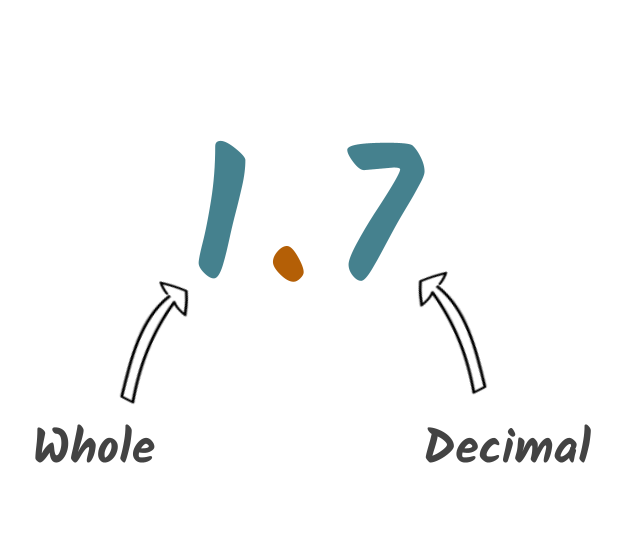
Decimal point
Decimal numbers such as 1.7 are made up of a whole number and a part of a number, called a decimal. The decimal point is a dot that separates the whole number (to the left) and the digits that make up the decimal (to the right).
Decimals are another way of writing fractions. Decimals are easier to work with, because we can compare the values of numbers instantly. Doing sums using decimals is also easier than doing them with fractions. When you use a calculator to divide a number into smaller parts, the result will include decimals if that number cannot be divided into whole numbers.
Tenths
We know that when we divide a whole into parts, we get fractions. This shape below, is our whole.

If we divide it into ten equal parts, we get tenths.

Imagine that the whole is the number 1. In decimals, we write a tenth as 0.1.

Adding together two parts or two-tenths, we get 0.2. Adding together three parts or three-tenths, we get 0.3. Three-tenths, 3⁄₁₀ or 0.3 are different ways of writing the same thing.
Decimal numbers such as 1.7 are made up of a whole number (in this case, 1) and a decimal (in this case, 0.7 or seven-tenths). In fractions, we would write this number as 1 ⁷⁄₁₀ (one and seven-tenths).
Hundredths
Now let's divide that whole into 100 parts.

These parts are called hundredths. In decimals, we write a hundredth as 0.01. Using place value, we know to read this as 0 ones, 0 tenths and 1 hundredth.

Here is a block made up of 100 cubes. The block is the whole and the cubes are each a hundredth of the whole, or 0.01. 30 of the cubes make up thirty-hundredths of the whole, or 0.30.

Adding together two parts or two-hundredths, we get 0.02. Adding together three parts or three-hundredths, we get 0.03. Three-hundredths, 3⁄100 or 0.03 are different ways of writing the same thing.
If we added together 25 parts, or twenty-five hundredths, we get 0.25. This is the same as 2 tenths (0.2) plus 5 hundredths (0.05).
A decimal number may contain whole numbers, tenths and hundreds. The number 6.47, for example, is made up of the whole number 6, 4 tenths and 7 hundredths.

We use hundredths when we count money. A pound, dollar or euro are all divided into hundredths: pennies or cents. 5p is five-hundredths of a pound. This is written in decimals as £0.05. 25c is twenty-five hundredths of a dollar. This is written in decimals as $0.25.
Thousandths
Decimals do not stop with hundredths. A whole can be divided into tinier and tinier parts: thousandths, ten thousandths and so on. We show these decimals by adding digits to the right of the decimal point. For example, the number 13.349 is made up of the whole number 13, 3 tenths, 4 hundredths and 9 thousandths.
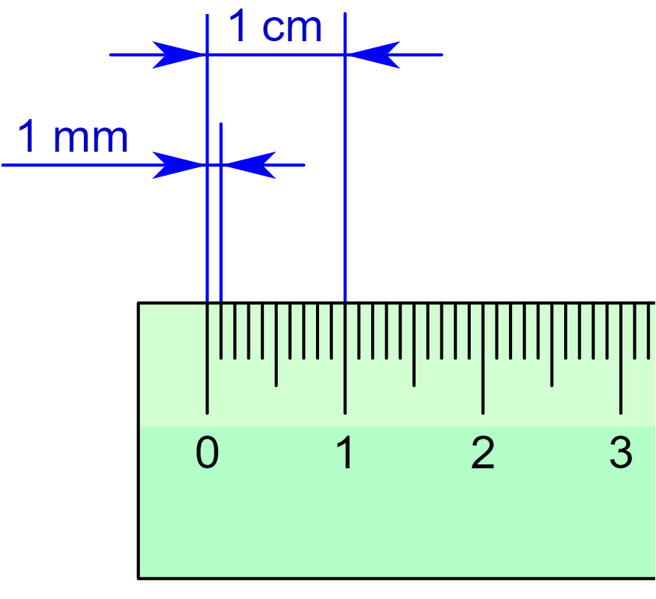
Consultant: Adam Larking
Factfile
decimal a part of a whole, such as a tenth (0.1) or a hundredth (0.01)
decimal point a point which goes after the whole part of a number and separates it from the decimals
divide share out equally, so that every part is the same
fraction a part of a whole, such as a half, quarter, tenth or hundredth
pics


Without in any way limiting Q-files Ltd’s exclusive rights under copyright, any use of this publication to “train” generative artificial intelligence (AI) technologies to generate text is expressly prohibited. Q-files Ltd reserves all rights to license use of this work for generative AI training and development of machine learning language models.