
EASY READ Shapes

CITE
We have made every effort to follow citation style rules, but there may be some minor differences. If in doubt, please refer to the appropriate citation style manual.
What is Pythagoras' theorem?. (2025). In Q-files Encyclopedia, Maths, EASY READ Shapes. Retrieved from
https://www.q-files.com/maths/easy-read-shapes/what-is-pythagoras-theorem
"What is Pythagoras' theorem?." Maths, EASY READ Shapes, Q-files Encyclopedia, 10 Nov. 2025.
https://www.q-files.com/maths/easy-read-shapes/what-is-pythagoras-theorem.
Accessed 1 Nov. 2026.
What is Pythagoras' theorem? 2025. Maths, EASY READ Shapes. Retrieved 1 November 2026, from
https://www.q-files.com/maths/easy-read-shapes/what-is-pythagoras-theorem
Maths, EASY READ Shapes, s.v. "What is Pythagoras' theorem?," accessed November 1, 2026.
https://www.q-files.com/maths/easy-read-shapes/what-is-pythagoras-theorem


What is Pythagoras' theorem?
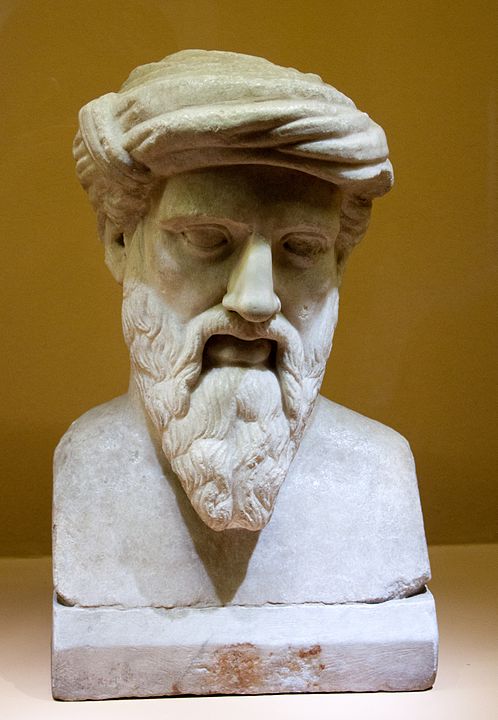
Pythagoras was a Greek mathematician who lived 2500 years ago. He made an important discovery about right-angled triangles. The length of the triangle's longest side, known as the hypotenuse, multiplied by itself (squared) is equal to the squared measures of the other two sides added together. This formula is known as Pythagoras’ theorem. It is useful when we only know the lengths of two sides of a right-angled triangle, and need to find out the third.

Right-angled triangles
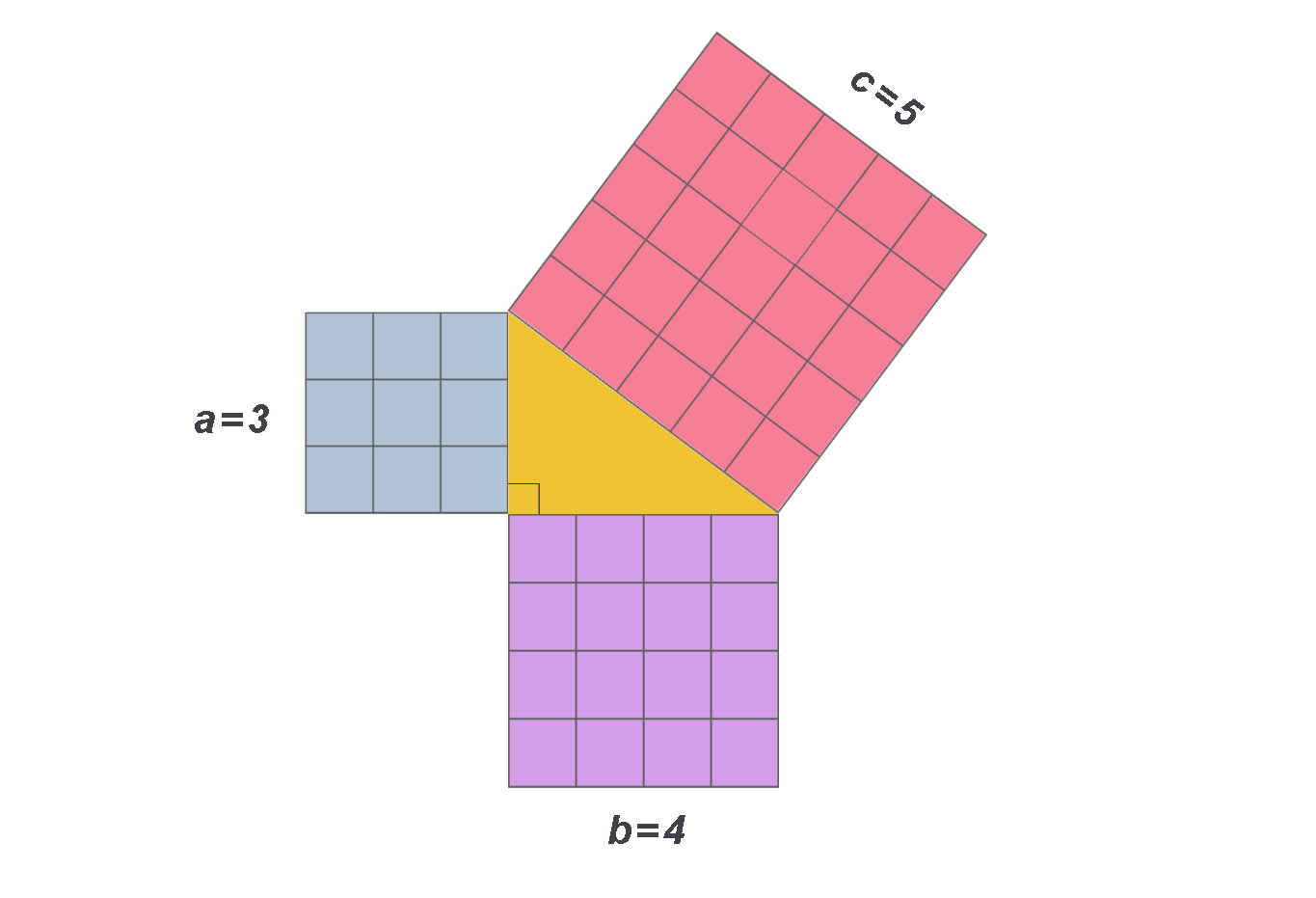
Pythagoras’ theorem only works with right-angled triangles. The longest side of a right-angled triangle is called the hypotenuse (shown here as side c). The two shorter sides are labelled a and b.
Pythagoras' theorem

Pythagoras’ theorem can be written like this:
a2 + b2 = c2
If we draw a square from the hypotenuse, and a square from each of the other two sides, then we can see that the area of the two smaller squares will add up to the area of the largest square.
Using the theorem
Let’s say that we know the length of the two shorter sides (a = 6 cm and b = 8 cm), and we need to find the length of the hypotenuse (c). We can enter the numbers into the formula like this: 62 + 82 = ?2. So the sum is: 36 + 64 = 100

Now we need to work backwards from 100 to find out which number is squared to make it. This is called finding the square root (√). Often we need to use a calculator to find the square root of a number. But in this case, the answer is easy to find because we know that 10 squared, 10 x 10, equals 100.
Pythagoras' theorem has enabled us to calculate the length of the hypotenuse: 10 cm.
Consultant: Adam Larking
Key words
formula a set of mathematical instructions to produce a specific result
hypotenuse the length of the longest side of a right-angled triangle
right-angled triangle a triangle with two sides that meet at a right angle
square root a square root of a number is a value that, when multiplied by itself, gives the number
theorem an idea, statement or rule about something in mathematics
pics


Without in any way limiting Q-files Ltd’s exclusive rights under copyright, any use of this publication to “train” generative artificial intelligence (AI) technologies to generate text is expressly prohibited. Q-files Ltd reserves all rights to license use of this work for generative AI training and development of machine learning language models.