
EASY READ Shapes

CITE
We have made every effort to follow citation style rules, but there may be some minor differences. If in doubt, please refer to the appropriate citation style manual.
What is pi?. (2025). In Q-files Encyclopedia, Maths, EASY READ Shapes. Retrieved from
https://www.q-files.com/maths/easy-read-shapes/what-is-pi
"What is pi?." Maths, EASY READ Shapes, Q-files Encyclopedia, 10 Nov. 2025.
https://www.q-files.com/maths/easy-read-shapes/what-is-pi.
Accessed 13 Sep. 2026.
What is pi? 2025. Maths, EASY READ Shapes. Retrieved 13 September 2026, from
https://www.q-files.com/maths/easy-read-shapes/what-is-pi
Maths, EASY READ Shapes, s.v. "What is pi?," accessed September 13, 2026.
https://www.q-files.com/maths/easy-read-shapes/what-is-pi


What is pi?
Whatever size a circle is, the length of its diameter will fit just over 3 times around that circle's circumference. It actually fits 3.14159 times around it. This number is represented by this symbol: π. It is the letter "pi" in the Greek alphabet, and it represents a number that is approximately 3.14159. Pi is used in any calculation to do with circles or spheres. It has fascinated mathematicians for thousands of years.

An infinite number
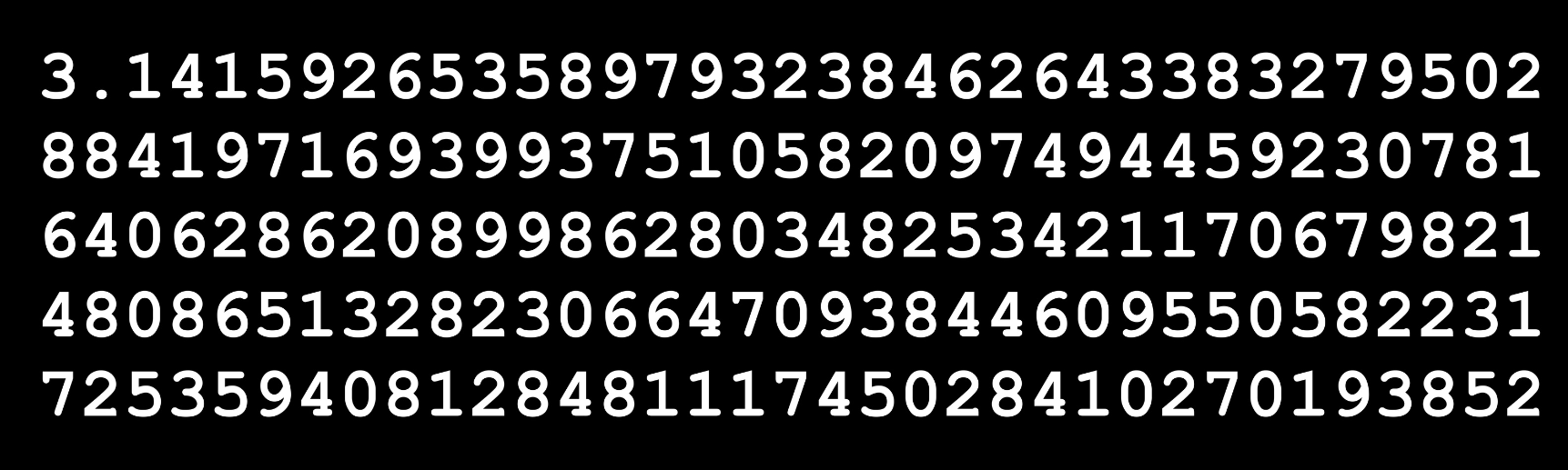
Pi (π) never changes. It is used to calculate the circumferences of circles of every size. Because it never changes, π is known as a mathematical constant, which means that we can use it in maths without having to work it out each time. It is often rounded up to 3.14, but it has an infinite number of decimal places—that is, it goes on forever.
Who discovered pi?
Mathematicians have known about π for around 4000 years. The ancient Babylonians knew that a circle’s area was three times its radius squared. An ancient Egyptian papyrus dating to around 1650 BC shows that Egyptian mathematicians calculated π to four decimal places: 3.1605.
In around 250 BC the Greek mathematician Archimedes worked out a more accurate figure for π. Seven hundred years later, Chinese and Indian mathematicians worked it out to seven places.
Nowadays, computers can calculate π to billions of decimal places... but never an exact figure.

Measuring the circumference


Pi is used in every calculation to do with circles and spheres.
First, we need to know the circle's radius (r). This is half the distance across the circle (half its diameter). The radius is measured from the circle's centre to its perimeter, the edge of the circle.
Once we know the radius, we can work out the length of the circle's perimeter, called the circumference, by using π. The formula is: π x radius x 2. This is written 2πr.
We can do the same calculation using the circle's diameter instead. The diameter is always twice the length of the radius. The formula is π x diameter, and is written πd.
Finding the area of a circle
We also use pi for working out the area of a circle. The formula is π x radius squared. This is written πr2.
In this example, the radius of the circle measures 2 cm. The square of the radius is 22. The sum for this is: 2 x 2 = 4.

Multiplying π by 4 gives us the area of the circle. This sum (usually done by a calculator) is this: π x 4 = 12.56
The area of the circle is 12.56 square cm. This is written like this:
12.56 cm2.
Consultant: Adam Larking
Key words
circumference the distance all the way around the perimeter (edge) of a circle
diameter the distance across the middle of the circle
radius half the distance across the middle of the circle (half the diameter)
pics
Without in any way limiting Q-files Ltd’s exclusive rights under copyright, any use of this publication to “train” generative artificial intelligence (AI) technologies to generate text is expressly prohibited. Q-files Ltd reserves all rights to license use of this work for generative AI training and development of machine learning language models.