
Q-news
Arthur Eddington proves Einstein's Theory of General Relativity—100 years ago
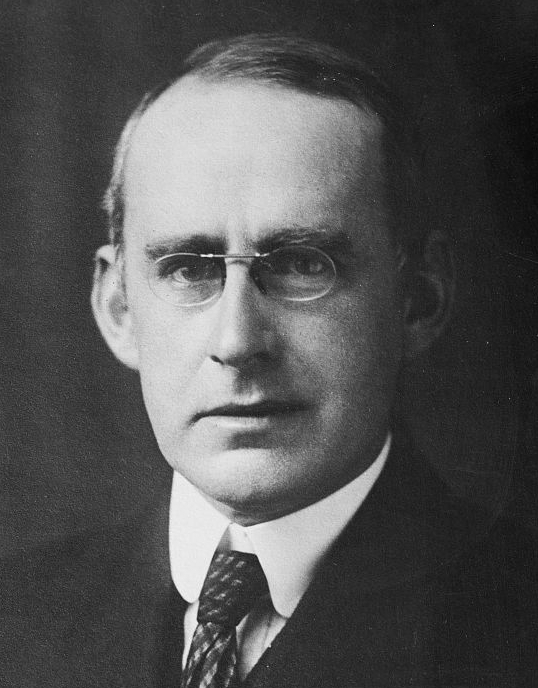
Einstein's Theory of General Relativity, proposed in 1915, predicted that light would bend around a massive object, such as the Sun. Newton's laws of gravity, made in the 1680s, also predicted this would happen. But General Relativity said that light would bend twice as much as predicted by Newton. Measuring how much light bent around the Sun would show which of these great scientists was right. But how was it possible to check whether the Sun was bending light from distant stars, when it is too bright to allow the stars to be seen? The answer was to run the experiment during a total solar eclipse when the sky went temporarily dark. The British astronomer Sir Arthur Eddington (1882–1944) set out to observe a solar eclipse occurring on 29th May 1919—exactly 100 years ago—and so prove whether Einstein's theory was correct or not.
General Theory of Relativity
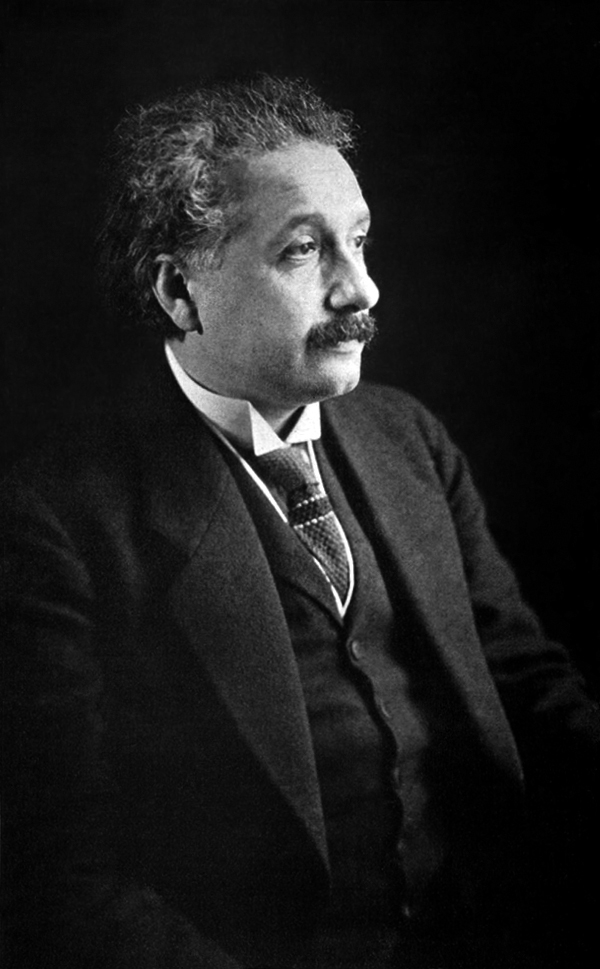
The German-born physicist Albert Einstein (1879–1955) completed his General Theory of Relativity in 1915. He wanted to extend his earlier theory of relativity, put forward in 1905, to include acceleration, the gathering of speed that is due to the effect of gravity. In his General Theory, he showed that gravity, instead of being viewed as the pull exerted by another object, could be seen as the bending of space around that object—exactly in the same way that a person can bend a trampoline when standing on it—causing passing bodies to fall in towards it. A star in space could be thought of as a ball on a rubber sheet. A massive object like a star would “bend” space, and anything close to it would fall, or curve, in towards it—including light.
Curving light
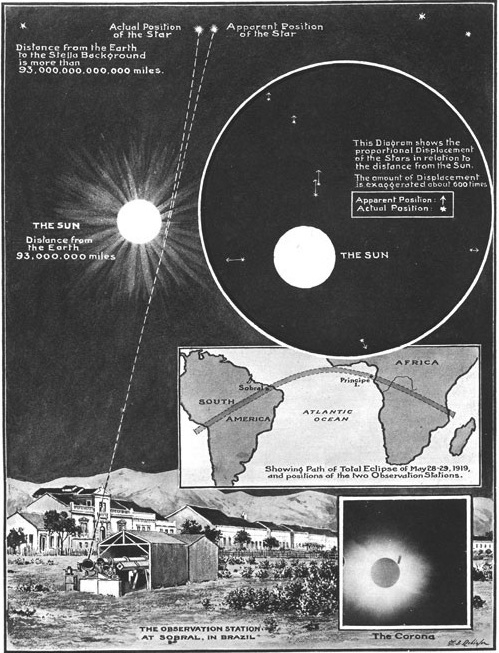
In 1919, the laws of gravity first proposed by English scientist Isaac Newton (1642–1727) were still widely accepted by scientists. But Einstein found that they did not fit with his own General Theory. His theory predicted that light would curve as it neared an object's gravitational field—though not by much. Even as massive object as the Sun, for example, would bend a ray of light "grazing" the edge of its disc a minuscule 1.75 arcseconds, that is, the angle made by a right-angled triangle 1 centimetre high and 1.2 kilometres long (or 1 inch high and 1.9 miles long). Newtonian physics also predicted light would bend due to gravity, but only by half as much as Einstein's theory predicted.
Eddington experiment
Eddington and his colleagues, including the Astronomer Royal Frank Dyson, calculated that the tiny island of Príncipe off the coast of West Africa and the town of Sobral in Brazil would be the best places from which to observe and photograph the solar eclipse occurring on 29th May 1919.
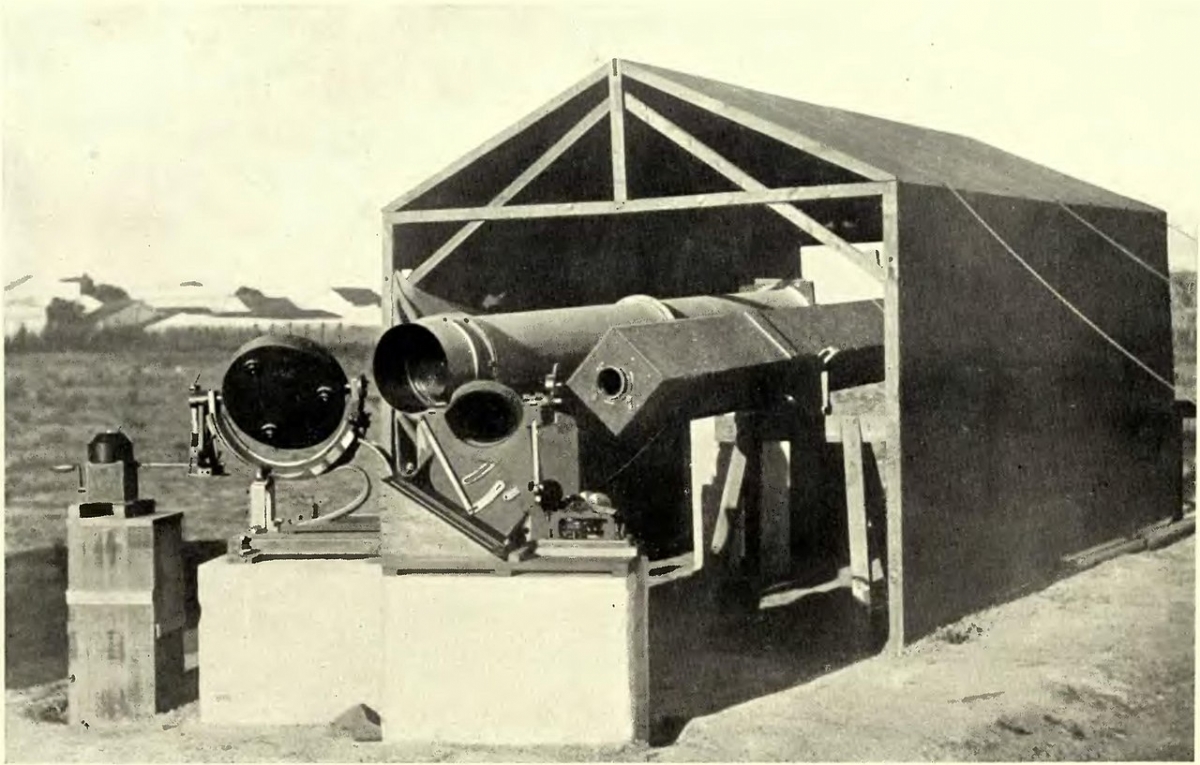
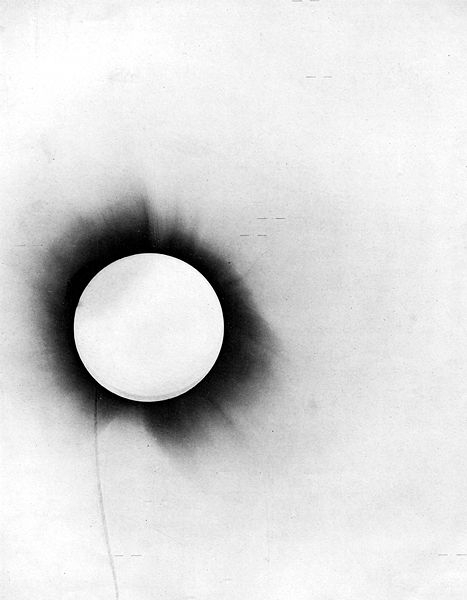
Eddington's aim was to take advantage of the shielding effect of the Moon during the total eclipse, and measure the positions of the stars around the Sun. These stars, invisible in the daytime, would become visible during totality. A difference in their observed position during the eclipse, compared to their normal position at night, would indicate that the light from them had curved as it passed close to the Sun.
During this particular eclipse, the Sun would be in front of a bright open cluster of stars called the Hyades. The brightness of these stars would make it easier to measure any changes in position. Eddington’s experiment would attempt to take an image of the Hyades stars during the eclipse. It would then be superimposed on top of an image taken of the Hyades at night, when the light from its stars was far away from the Sun. The size of the gap between stars on the eclipse image and the night image would determine which prediction, Einstein's or Newton's, was right. If Einstein’s theory was right, then a star located just on the edge of the Sun's disc would be deflected away from the Sun by about 1.75 arcseconds. According to Newton’s laws, the deflection would be half that amount.
Results
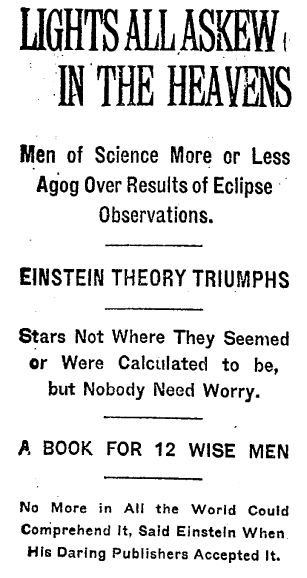
The two teams reported a measurement of between 1.80 and 2.16, which was much nearer to Einstein’s predictions than to Newton’s. This proved that Einstein’s prediction was correct: his General Theory of Relativity had now been confirmed experimentally. The result was considered sensational news and made the front page of most major newspapers. Almost overnight, Einstein became an international celebrity.
When asked by his assistant what his reaction would have been if General Relativity had not been confirmed by Eddington in 1919, Einstein joked: "Then I would feel sorry for the dear Lord. The theory is correct anyway."