
Age of Dinosaurs
Cretaceous North America
By the Cretaceous Period, the continent of North America had drifted away from Europe and South America, although it was still connected to Asia. North America was divided into several large islands by warm, shallow seas. The Western Interior Seaway split the continent down the middle, and joined up with what is now Hudson Bay in the north and the Gulf of Mexico in the south. The climate was warmer than today. On land, flowering plants and broadleaf trees spread among the coniferous forests that previously covered North America. Several new types of dinosaur emerged, including the hadrosaurs or the duck-bills, equipped with cheek teeth enabling them to chew their food.


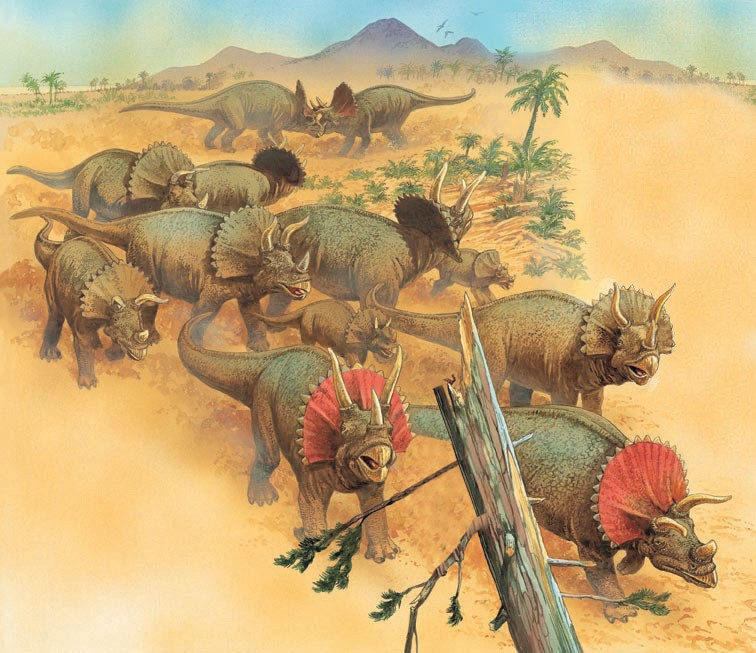
Last years
The last years of the dinosaurs produced some of the most spectacular kinds. A new group of ornithischians, the ceratopsians, or horned dinosaurs, evolved. For the last 20 million years or so of the Age of Dinosaurs, they were the most abundant large herbivores on Earth. The nine-metre (30-foot) Triceratops was typical of the group: it had a massive head with two long, pointed horns on its brow and one on its snout. Behind its skull was a massive, upward-curving sheet of bone, called a neck frill. Using its parrot-like beak, Triceratops could chomp its way through the toughest of plant foods. Only the largest, most powerful predator would have been a match for Triceratops.
Triceratops meets T. rex
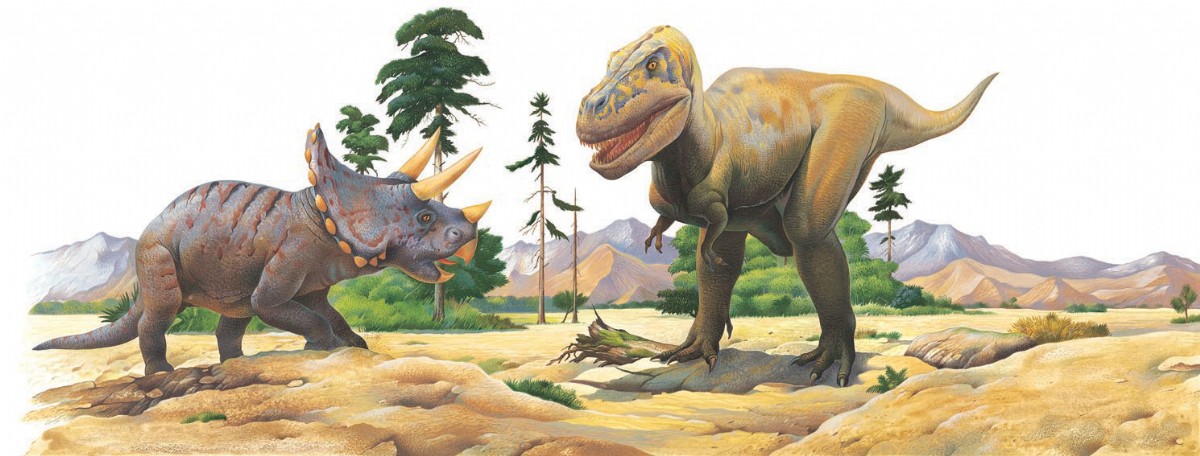
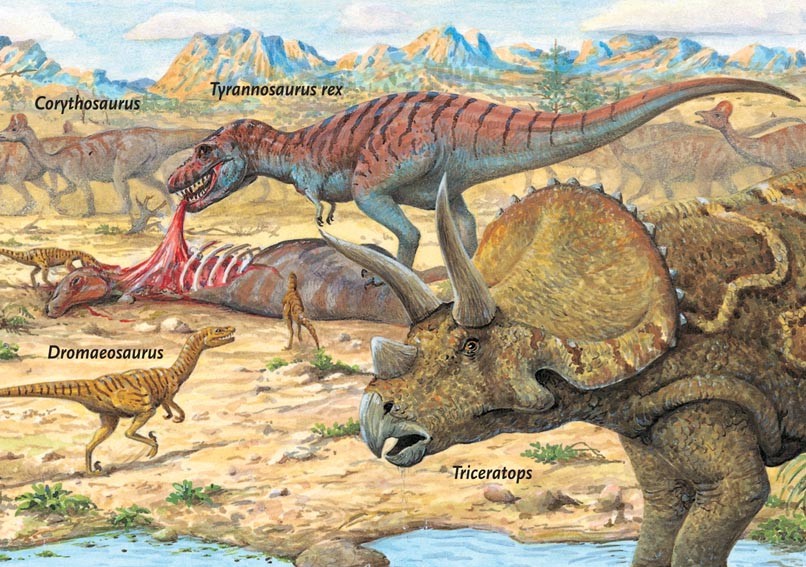
Unfortunately for Triceratops, just such a monster existed: Tyrannosaurus rex. This 12-metre (39-foot) killing machine had massive powerful back legs which gave it great speed over short distances. It had an enormous head, with jaws surrounded by rows of saw-edged teeth. Tyrannosaurus made its kill by charging its prey, bringing it down with devastating bites, but it was probably also a scavenger.
Duelling Dinosaurs
The Duelling Dinosaurs is a fossil discovered in the Hell Creek Formation of Montana in 2006. It consists of the skeletons of a Triceratops and a Nanotyrannus entangled with one another. The Nanotyrannus was previously thought to be young Tyrannosaurus rex, but is in fact an adult of a different, smaller species of tyrannosaur. The fossil remained unknown for years due to a legal dispute over who owned it, which is now resolved.

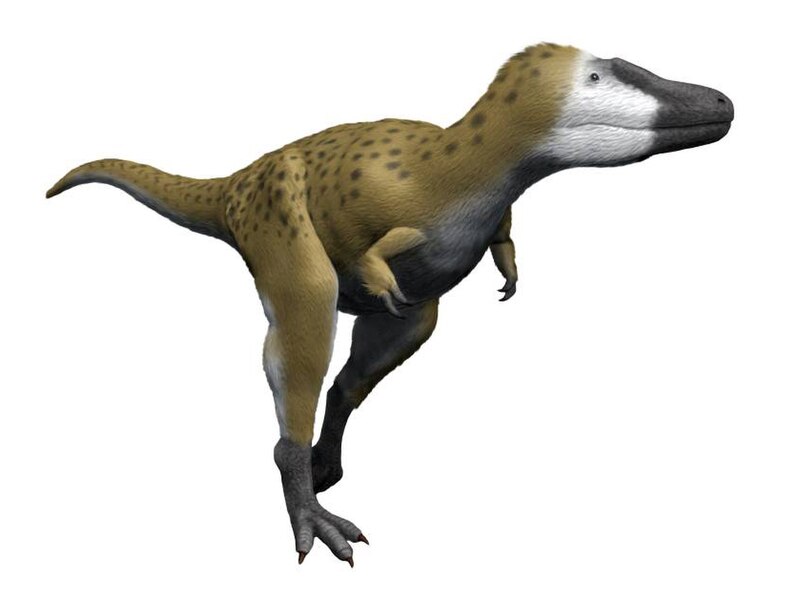
Both dinosaurs appear to have suffered several injuries, including a tooth from the Nanotyrannus embedded within the Triceratops. However, it is not known whether they were buried while fighting one another. The Duelling Dinosaurs fossil, which includes skin impressions and possibly internal organs and stomach contents, is one of the best-preserved and most complete fossils of both Triceratops and a tyrannosaur yet found.
Consultant: Chris Jarvis